• Skip to primary navigation
  • Skip to main content
  • Skip to primary sidebar
  • Skip to footer

Steel Raven Farms

Where muck boots meet ground.

  • Animals
    • Chickens
    • Farm Dogs
    • Goats
  • Garden
    • Compost
    • Garden Projects
    • Seeds and Plants
    • Garden Journal
    • Working With Food
      • Recipes
      • Freezing Foods
      • Dehydrating Foods
      • Canning Tips And Tricks
        • Canning Inventory Sheets
  • Helpful Info
    • Welcome to the Homestead!
    • Emergency Preparedness
    • Frequently Asked Questions
    • Goal Setting
    • Project List
    • Shop Digital Products
      • Hay Calculator
      • Farm Expense And Income Tracker
      • Goat Crash Course: 101
      • Garden Journal Prompts
      • Schedule C Tracker
      • Schedule C Tracker
      • The Homestead Bundle
  • The Truths
  • Episode List
  • Start Here
    • Privacy Policy
    • Affiliate Disclosure
    • Let’s Get in Touch
    • Members Only Library
    • Welcome To Our Homestead

kitchen

How To Set Up A Garden Journal

April 23, 2024 by Leigh Leave a Comment

Much like everything else that is homestead related, there is no one size fits all approach to a garden journal. I wish there was because it would make it easier to just have someone tell you what to do and it work 100% of the time. Unfortunately, that’s not the case. The next best thing that we can do is try different things until something works. Today, I’m going to show you how I set up a garden journal and give you the high points of how to start yours.

garden journal

Before we get too far into this post, I wanted to give a suggestion about keeping a garden journal. A digital garden journal is a fantastic way to keep track of past, present and future gardens. Our Digital Garden Journal is a great way to keep up with everything without getting too overwhelmed.

Buy Now

What Is A Garden Journal

A garden journal is exactly what it sounds like. It’s a journal that details your gardens throughout the years. Yes, years. In the first year, you may notice a high infestation of Japanese beetles. In your journal you would make note of the beetles, an estimate of how many beetles, when you first noticed them, what plants they were attracted to, any treatments you did to get rid of them, etc. The next year as you look through your journal, you remember that you had a problem last year, and you can be proactive this year.

How To Set Up A Garden Journal

Everyone will have a different set up based on what they are growing, where they live, and so on. But here are some starting points. If you aren’t sure where to start, you can purchase my garden journal printable in our general store.

The Binder

I think that the best thing you could do is to purchase a binder for your garden journal. I use this binder because I like that it doesn’t take up a lot of space on my desk. Plus, when I am out in the greenhouse working on seeds or out in the garden, it’s not this huge bulky thing. I also like using a binder because I can move pages around from year to year.

I have a bullet journal and while I love it, it is hard to find what I am looking for since it is chronologically done. Not a bad thing, but if I can’t remember when I did something, it was lost. Being able to look back and see that last year I planted 100 tomato seeds and only 80 germinated tells me a lot about the seeds, soil, watering, etc if I have that information available.

The Dividers

I have a TON of dividers in my garden journal, but again, I want simple and easy to find. I use these mini dividers to match my mini binder. For your dividers, you need to think about the things that you want to track. Do you want to track how many seedlings you bought? Or are you planting your own seeds? Do you want to keep track of your soil tests? What about expenses? These are all things that you need to think about so that you can keep track accordingly.

I like to know what seeds I started and when. Then I want to know my soil tests, pests and what seeds I saved. When our orchard stops getting attacked by goats, I would like to know when I pruned, harvested, and more.

Loose Paper

I use loose leaf sheets to take notes, brainstorm, etc. I get the college rule and blank to make sure that if I want to design a garden bed, I can design it on a blank sheet and write on the lined sheets. I store all the excess paper in the back of the binder. I also use sheet protectors on the important pages.

cropped-3.jpg

Are you looking for garden journal prompts, but aren’t interested in a weekly email? Check out our 365 Garden Journal Prompts! This is an amazing, all in one, yearly product that you only pay for once.

Buy Now!

For example: If I go into the greenhouse and I am working on transplants, I don’t want the pages to get dirty. Or if I have designed a garden bed, I want to be able to take that page out of the binder and take it with me to the bed. By having a sheet protector on it, I don’t have to worry as much about it getting destroyed.

Using Your Garden Journal

After getting your journal set up, you should start filling it out with the information you have. In your soil test section, you should fill out previous years soil test results. Be sure to separate years with a line or something so that you don’t get confused. If you don’t have that information anymore? Or this is your first garden? No worries, do the best you can.

When you start your seedlings, be sure to write where you purchased your seeds from. This will help you decide if that was a good buy. If you buy seeds, make sure to put where you bought them from. In your Pest section, make sure to keep track of what pests came when and how you treated for them. This will help you because next year, you can say, “In 2022, the Japanese beetles came in April and only hit the apple trees.” In 2023, you can make sure to have beetle traps or other treatments already in place.

Tractor Supply

I am the type that will write down everything because I will forget it. We had a great pepper harvest last year, but I know it could have been better if I had known only water them every 4-6 days. Because of my garden journal, I know not to water the peppers as often.

Another cool thing about my garden journal is that I have a harvest/ preservation section. This section tells me how much food I need to harvest and preserve from my gardens. I know that we eat a TON of green beans. Like, I can 100 quart jars of green beans and it’s usually gone by April. That tells me that I need to harvest at least 200# of green beans. Because I know these things, I know I need to plant a minimum of 200 pole bean plants. Same with corn and peas.

If you are looking for a great way to keep track of your gardens for years to come, check out our Digital Garden Journal. It’s a digital spreadsheet that helps you manage not only your seedlings but also your seed inventories, soil testing, orchard, harvests and so much more.

Buy Now

Lastly, in my garden journal, I have a list of monthly chores that I need to do. This helps me stay on track with the needs of my garden. Because our goal is to reduce our grocery bill by 75% in 5 years and our feed bill by 80% in 2 years, I need all the help I can get. It not only tracks the weeding, watering and planting, but it also tells me when exactly when to do those things. In April I have final fill of the garden beds, lay final layer of compost, plant after April 15th, weed weekly until seedlings are established, and so on. That way there is no guess work about what I need to do.

If you haven’t checked it out yet, you can find my garden journal printable in our general store here. There are a ton of different planners on the internet but none of them fit the style that I was going for, so I created my own.

Are you getting overwhelmed in the garden? Stressed? Or just not enjoying the garden like you used to? Check out our garden prompts! We send out weekly emails that get you back in the garden and out of your head! Turn the garden back into a place of love and joy instead of frustration and headache!

Subscribe Now!

If you like the content I put out, feel free to buy us a coffee! It helps keep this site running, marketing and the goats in grain!

Buy me a coffee

If you like this post, feel free to share it and follow us below on our social media accounts!

  • Facebook
  • Pinterest
  • Instagram
  • YouTube
  • TikTok
  • Spotify
  • Threads

Filed Under: Garden Tagged With: Canning, Garden, Gardening, Homestead, kitchen, veggies

JOIN TO OUR MAILING LIST!

Leave us your email to receive new posts and special offers for members only! Don't miss a thing!

Recent Posts

  • Fall Garden Guide
  • Top Mistakes With Goats
  • How To Bond With Your Goats

Avoiding Homestead Burnout

April 20, 2024 by Leigh Leave a Comment

As I was writing about our 2022 goals and planning our 2023 goals, I realized something. I’ve hit burnout. As a medic, I am very, very familiar with burnout. But maybe you don’t know the signs and symptoms of burnout and you may not know how to fix it. Or you didn’t think you could burnout doing something you enjoy and are passionate about, but you’re ready to throw in the towel. Before you do that, let me see if I can help in avoiding homestead burnout.

Avoiding Homestead Burnout

The Ultimate Homesteader’s Starter Bundle – Only $47!

Get the tools you need to stay organized, track profits, and manage your homestead with ease!

Includes:
✅ Schedule F Tracker – Simplify tax prep
✅ Profit Calculator – Track earnings
✅ Hay Calculator – Plan livestock feed
✅ Garden Journal – Digital & printable
✅ Herd Health Tracker – Monitor animal care
✅ Simple Budget – Manage finances
✅ Backyard Homestead eBook – Essential tips

$99 value – now just $47! Start your homesteading journey today!

Buy Now

What Is Burnout?

Burnout is, at it’s core, being overly stressed. The powers that be (psychiatrists) believe that it is work related. While I don’t disagree, I feel like it is more encompassing than that.

Your children can burn you out. That job you love, can burn you out. Those animals you love? Can burn you out. Your beautiful homestead? WILL burn you out. Why? Because burnout is stress and even the things we love most in the world, stress us out.

If you don’t know how to identify burnout, then you will never be able to cope with it.

But What Is Homestead Burnout?

Homestead burnout is no different than work burnout. It’s feeling overwhelmed with all the things that need to be done. Apathy when it comes to chores, projects or other upgrades to the homestead. A lack of empathy with those around you. It’s also a kind of depression, not wanting to get out of bed/house to take care of your farm, life, etc. Homestead burnout can also be trying to push through and failing miserably. Or, lastly, anxiety.

Identifying Burnout

Do your animals no longer bring you joy, or not as much?

Everything you touch seems to turn to shit?

The thought of planning your garden causes so much anxiety that you avoid it at all costs?

The last thing you want to do is start another project?

You and your spouse are not on the same page?

Logo 468x60

You are staying in your house more and more instead of working your property?

Constant fatigue?

Pain?

Congratulations, if you’ve answered yes to literally any of these, you are courting with burnout. If you answered yes to the majority of these, you are burned out.

I can’t talk for any other career field, but as a medic, I know more about burnout then I care to admit. Not only because I’ve had it, but because I’ve watched great medics and EMT’s lose the battle with burnout. In an effort of full disclosure, my homestead is my exit strategy for burnout. BUT I’ve put everything I have into my homestead, and guess what? It’s burned me out too.

Coping With Homestead Burnout

The crappy part is that even if you are burned out because of your homestead, there really isn’t much you can do about it, right? The animals, gardens, children, etc don’t just go away when you say, “That’s it! I’m stressed and I can’t function with this anymore.” Because guess what? You still have to slog out to feed and water the animals. There’s still weeds to pick and eggs to collect. There’s nothing we can do about it….

Or is there something you can do about it?

Save on Seeds

Things That “They” Say To Try

These think tanks that like to tell us how to minimize stress, reduce burn out, etc are obviously upper management and don’t get their hands dirty. For those of us in healthcare, it’s like them saying “I know you asked for increase staffing, higher pay and better equipment, but here’s a pizza party instead.”

I say this because “They” are saying things like “Have a support system” or “Get some sleep”…. and in the real world that doesn’t happen. I can’t just get more sleep. Trust me, I’ve tried. I have a support system. But guess what? They’re burned out too. So what are some ACTUAL ways to help relieve burnout?

If you are struggling with burnout and not sure where to start, there are several really good books out there to help identify and cope with burnout. I found this one and this one to be pretty helpful. Buuuuuttttttt. When I’m burned out the last thing I want to do is read books about burnout.

Identify What Is Causing Your Stress

Identify the things that are stressing you out. Really think about what is happening in your life that is causing your stress levels to be so high. There may not be much you can do about those stresses, but at least by identifying what they are, you can start looking at ways to reduce those. The first step in fixing a problem is realizing you have one, right? Same thing here.

If you are struggling to figure out what is stressing you out, simply look at the things you are avoiding. This may not look like active avoidance, “I refuse to weed the garden.” Instead, it could look something like, “I’m too busy to weed the garden, I’ll do it later.” Lately, I have been avoiding my goats. Not purposefully, but avoiding all the same. I just don’t hang out with them like I used to because I feel this all consuming drive to get all the things done. This resulted in not realizing that they are all covered in chewing lice and now I’m behind the eight ball on treatment.

Reduce Stress

Now, that you know what is causing your stress, you can start to take steps to reduce it. Unlike normal burnout, it may not be as simple as walking away from that job or cutting back hours. Again, you can’t just stop homeschooling the kids. You can’t just stop being a farmer. But there are things you can do and the first is ask for help.

When you reach out for help, you need to be willing to accept that help in whatever form it comes in. This is really hard for us women. We want it done THIS way. But when you are at your wits end, sometimes done is better than not done, even if it’s not the way you would do it. You can always fix it your way later.

You can put off that project until you’re ready to tackle it. It’ll still be there.

You can spend an extra 10 minutes playing with your goats. Everything else can wait.

You can make that homemade bread. If it sucks? The pigs can eat it.

Reducing stress doesn’t include doing nothing. Sometimes it’s as easy as doing something you WANT to do, instead of HAVE to do. But if doing nothing works, then do nothing for a short time every day and call it your meditation time.

Tractor Supply

Understand that it doesn’t all need to be done right now

For the last twenty years or so, we have had it crammed into our head that tomorrow is never promised. So we have been killing ourselves trying to get everything done. Go see that play, hang out with friends, get the garden in, homeschool the kids, work more, save more. More, More, More.

But trust me, there’s always tomorrow. Yes, I understand that tomorrow is never guaranteed. But would you rather die stressed with almost everything done, or happy with a million unfinished projects. Personally, I want both. But I also understand that by stressing myself out getting everything done, I am not happy. Jared isn’t happy. And the farm suffers.

Subscribe to Craft Beer Club Today!

Learn Something New

This may seem counter productive because we are trying to reduce stress, but learning something new or different can help ease stress. How? Because when we are learning, we tend to give ourselves grace. We’re just learning, right? It’s okay to get it wrong because you understand that you can’t be an expert in something you are just learning.

Whenever I’m burned out, I pick a new craft, book, baking technique and start to learn it. This really helps pull my focus off the things that are burning me out, and pulls me back to learning which is something I love.

Are you getting overwhelmed in the garden? Stressed? Or just not enjoying the garden like you used to? Check out our garden prompts! We send out weekly emails that get you back in the garden and out of your head! Turn the garden back into a place of love and joy instead of frustration and headache!

Subscribe Now!

Work On An Easy Project

When you have the anti-Midas touch, sometimes it’s really easy to get even more stressed and burned out. No matter what you are doing, everything turns to crap. But find a project that doesn’t require a lot of brain power from you. Or something you’ve done a million times and probably won’t screw up. Then go do it.

Part of burnout is depression. You just don’t care about whatever it is that you’re doing. But by working on a project that is easy, you are doing something. Even if it’s just taking out the trash or cleaning off your desk. That alone will help you beat back that depression. And if you just can’t, that’s okay too. At least you tried.

How I Deal With Homestead Burnout

I’m not going to lie, usually I step back and punt. That means that I just don’t do the chores or I fall back on planning, cleaning, organizing, or my Finish Line Goals. I am beyond blessed that I have that option, and I know it. There are times when I simply cannot gather up the gumption to build a fence, work on the gardens, or literally anything else. So I ask for help, and do something else.

If that’s not an option and I have to do the things that are burning me out, I do it carefully and slowly. There’s nothing more frustrating that things not going how you want or need them to go.

Lastly, I go play in the dirt. For some reason, that is my reset. It doesn’t have to be anything major, either. Simply watering my plants or spreading grass seed is enough to remember that not everything has to be done the way I want it or think it should be. And that’s okay.

How Can You Deal With Burnout?

The reality is that you will burn out at sometime. Probably multiple times. That’s okay! You are normal. Identify that you are burned out, figure out (if possible) what is specifically burning you out, and then step back or go slower. Or don’t do it at all. Remember, at the end of the day, it’ll get done or it won’t. And both of those answers are just fine.

If you like the content I put out, feel free to buy us a coffee! It helps keep this site running, marketing and the goats in grain!

Buy me a coffee

If you like this post, feel free to share it and follow us below on our social media accounts!

  • Facebook
  • Pinterest
  • Instagram
  • YouTube
  • TikTok
  • Spotify
  • Threads

Filed Under: Homestead Planning, How To's Tagged With: Animals, burnout, Chickens, Goats, homeschool, kitchen, stress

JOIN TO OUR MAILING LIST!

Leave us your email to receive new posts and special offers for members only! Don't miss a thing!

Recent Posts

  • Fall Garden Guide
  • Top Mistakes With Goats
  • How To Bond With Your Goats

Cleaning Cast Iron- The Easy Way

March 2, 2024 by Leigh Leave a Comment

I was reading a forum the other day that absolutely shocked me. A lady was freaking out because she had scratched her cast iron and the advise that she got ranged from “You can never use it again” to “It’s cast iron!” If cast iron can be handed down through generations and that’s all the old homesteaders and farmers had? There’s very little you can do to break it. Unless you get cheap cast iron. But cleaning cast iron doesn’t have to be hard or difficult.

The Ultimate Homesteader’s Starter Bundle – Only $47!

Get the tools you need to stay organized, track profits, and manage your homestead with ease!

Includes:
✅ Schedule F Tracker – Simplify tax prep
✅ Profit Calculator – Track earnings
✅ Hay Calculator – Plan livestock feed
✅ Garden Journal – Digital & printable
✅ Herd Health Tracker – Monitor animal care
✅ Simple Budget – Manage finances
✅ Backyard Homestead eBook – Essential tips

$99 value – now just $47! Start your homesteading journey today!

Buy Now

Cleaning Cast Iron Isn’t Rocket Science

Using cast iron isn’t hard. Cleaning cast iron is not hard. But for some reason there are a lot of people out there that think that this is the holy grail of pans that must not be tarnished and never used. Cast iron cookware has been around for thousands of years. They didn’t have rubber sponges, soft spatulas and other nifty gadgets we have today. So use it, clean it, and enjoy it.

PS: No cast iron was hurt in the making of this post. Although, I think Jared considered killing me when he saw the state of the skillet.

Logo 468 x 60

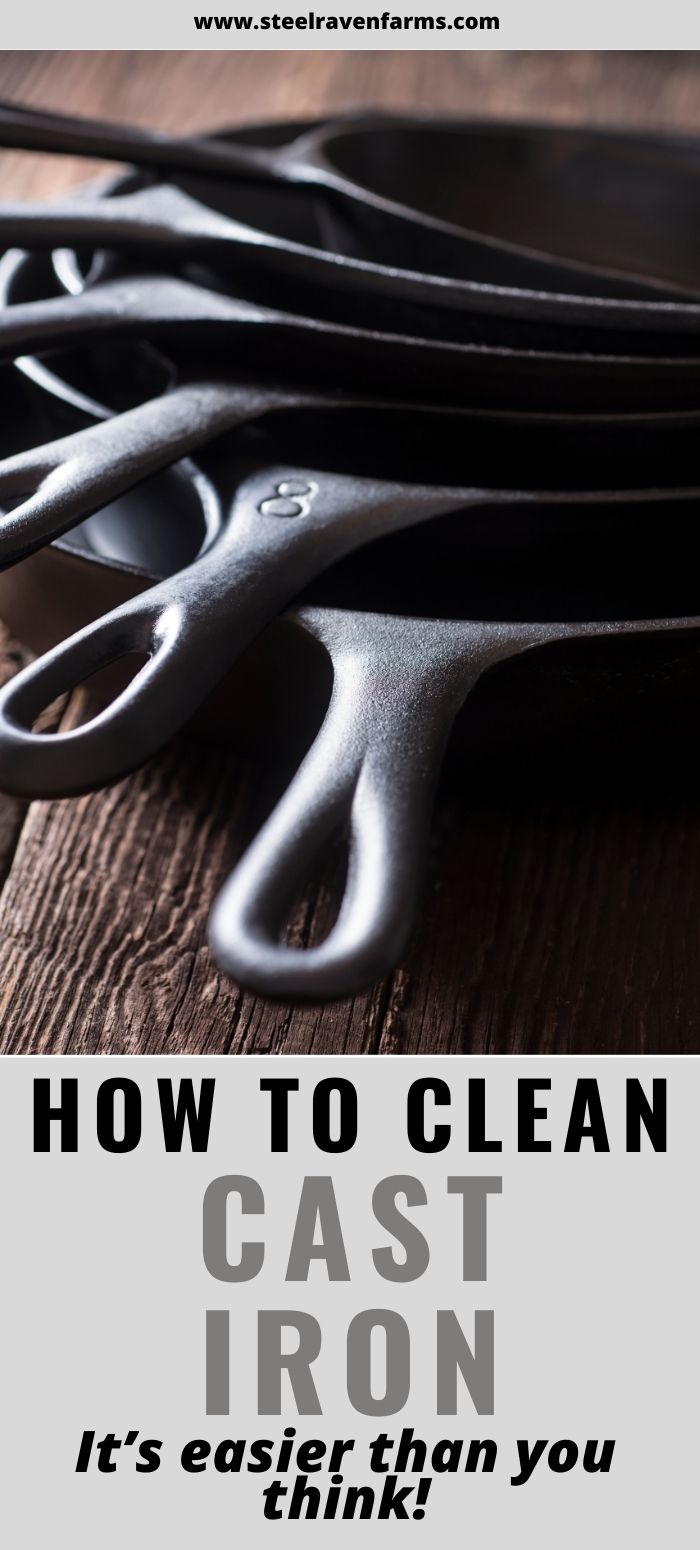
How to Clean Cast Iron

In my other cast iron post, I talked about how to cook with cast iron and briefly touched on how to clean it. This post is about the various ways to clean cast iron. None of these methods are wrong. In fact, some people throw their cast iron in the dishwasher *gasp*. Others use soap, the horror! But technically speaking, they aren’t wrong to do so. Lodge says “You can use a small amount of soap”, in their post about cleaning cast iron.

I do use soap to clean cast iron. But I cannot think of a reason that I would throw it in the dishwasher…. I’m sure I would though. Instead, what I do is a mix of different cleaning methods based off of how nasty the pan got.

When Jared saw this pan, I really thought divorce was coming. But he just raised his eye brow at me when I told him I was doing it for a blog post. He said, “fix it” and walked away. So that’s what I did.

The Ultimate Homesteader’s Starter Bundle – Only $47!

Get the tools you need to stay organized, track profits, and manage your homestead with ease!

Includes:
✅ Schedule F Tracker – Simplify tax prep
✅ Profit Calculator – Track earnings
✅ Hay Calculator – Plan livestock feed
✅ Garden Journal – Digital & printable
✅ Herd Health Tracker – Monitor animal care
✅ Simple Budget – Manage finances
✅ Backyard Homestead eBook – Essential tips

$99 value – now just $47! Start your homesteading journey today!

Buy Now

Cleaning Cast Iron: Step 1

If your pan is a caked, baked, and nasty, fill it approximately half way with water and set it to boil for about 5-10 minutes. As you are letting it boil, start scraping the bottom of the pan to help get everything unstuck.

Boiling water in ANY pan allows the pan to heat up without any additional scorching to the food stuck inside it. As you become accustomed to cooking and cleaning cast iron, you will find that the hotter the pan, the less things stick to the pan. Which is pretty cool.

During the boiling
After boiling and rinsing.

Step 2:

Scrape off any stuff that still stuck on the bottom of the pan with a scrubber or scraper. I use one like this. If the mess in the pan isn’t that bad, I will skip the boiling step and just scrape the pan. Either way the pan is clean and that’s what matters.

The downside to using a chainmail scrubber is that it can scratch the seasoning. So being very diligent in your seasoning after use is going to be key here.

Step 3:

Now we add a fat of your choosing. I like avocado oil because it has a higher smoke point and that is really important when breaking down the oil and getting it to start seasoning the pan. But you can use grapeseed, corn, peanut and canola.

Save on Seeds

This step is very important for creating that glassy, non stick surface. But again, there are a million different ways that people season their pans. Some put a thin layer of oil on a paper towel and smear it all over the pan, some put a dollop of oil in the pan (shown below) and heat the pan. I don’t think it matters as long as the pan is hot and that oil moves around to coat the pan.

The Ultimate Homesteader’s Starter Bundle – Only $47!

Get the tools you need to stay organized, track profits, and manage your homestead with ease!

Includes:
✅ Schedule F Tracker – Simplify tax prep
✅ Profit Calculator – Track earnings
✅ Hay Calculator – Plan livestock feed
✅ Garden Journal – Digital & printable
✅ Herd Health Tracker – Monitor animal care
✅ Simple Budget – Manage finances
✅ Backyard Homestead eBook – Essential tips

$99 value – now just $47! Start your homesteading journey today!

Buy Now

Some people also do this in the oven to allow for the entire pan to heat up, spread the oil, and bake in. Again, it doesn’t really matter. As long as the oil gets into the crevices of the pan, you are good to go.

Step 4:

Once the oil has moved around the pan and coated the bottom and sides, let the pan cool. If I can touch the handle, I will wipe out the excess oil and allow to finish cooling until it’s safe to hang up.

Add some oil and coat the bottom and sides of the pan
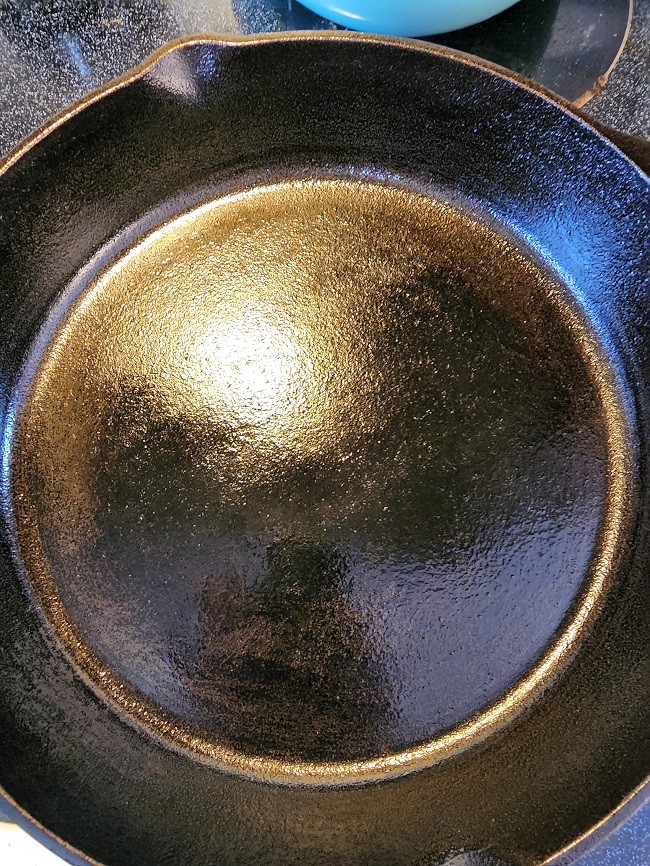
Nice glassy surface and it’s ready for storage

Tips for Cleaning Cast Iron

Pre-seasoned cast iron

If you have just bought your cast iron and it came pre-seasoned, go ahead and just repeat steps 3 and 4. I normally season a brand new pan 2-3 times before I am ready to use it. In my head, that pan is not seasoned enough for use. If I don’t want to go through the seasoning process, I just cook bacon in that pan for a couple of weeks.

Stuck on messes

For stubborn stuck on messes that boiling and scraping aren’t getting off, I will take salt and some water and scrub with that. Sometimes, it just needs a little extra muscle. This is very rare. If that doesn’t work, you can use salt and a half lemon. You’ll need to rinse thoroughly and then season multiple times but it should get it off.

If it is super stuck, I bring out the big guns. I use oven cleaner (outside) and wash with Dawn dish soap. My goal is to strip the pan down as far as I can and start the seasoning process over. I’ve had to do this with a couple of pans that got too nasty for regular methods to work.

Restoring cast iron

If you are getting a yard sale find, or Granny has given you a pan that came from the basement, I would put a sheet of aluminum foil on the rack of the oven and set it to 500. Put the pan upside down and let it go for about 2 hours.

If you have a self cleaning oven, use that setting. Be warned it will smoke like crazy and stink to high heaven. If you have the option of doing on a grill outside, I prefer that way. After that, just repeat steps 3 and 4 until there is a nice layer of seasoning on the pan. It will take time and maybe a few repeated attempts.

Logo 468x60

It is not hard to clean cast iron from the left and make it look like the right. Just a little bit of patience and elbow grease and you will have a pan that will last you and your family a life time.

If you like the content I put out, feel free to buy us a coffee! It helps keep this site running, marketing and the goats in grain!

Buy me a coffee

If you like this post, feel free to share it and follow us below on our social media accounts!
  • Facebook
  • Pinterest
  • Instagram
  • YouTube
  • TikTok
  • Spotify
  • Threads

Filed Under: Working With Food Tagged With: cast iron, cooking, Homestead, kitchen

JOIN TO OUR MAILING LIST!

Leave us your email to receive new posts and special offers for members only! Don't miss a thing!

Recent Posts

  • Fall Garden Guide
  • Top Mistakes With Goats
  • How To Bond With Your Goats

Our Best Dual Purpose Chickens

February 17, 2024 by Leigh Leave a Comment

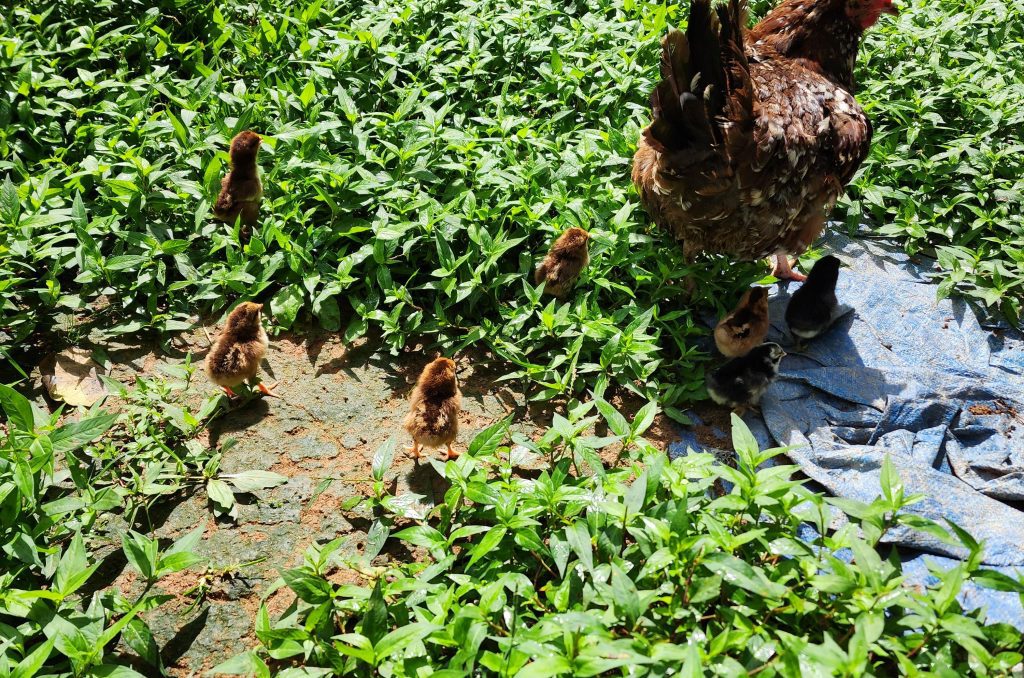
When we first brought chickens to the homestead, we started with 25 chicks. As we became victims of chicken math, we have grown our flock to about 50-75…. They are really hard to count. While I don’t LOVE the thought of dual purpose chickens, there is a need to have a good solid laying hen, that can produce good meat animals. So, these are our best dual purpose chicken breeds.

The Ultimate Homesteader’s Starter Bundle – Only $47!

Get the tools you need to stay organized, track profits, and manage your homestead with ease!

Includes:
✅ Schedule F Tracker – Simplify tax prep
✅ Profit Calculator – Track earnings
✅ Hay Calculator – Plan livestock feed
✅ Garden Journal – Digital & printable
✅ Herd Health Tracker – Monitor animal care
✅ Simple Budget – Manage finances
✅ Backyard Homestead eBook – Essential tips

$99 value – now just $47! Start your homesteading journey today!

Buy Now

Why More Chickens?

Bringing more chickens home is a multi-layered answer. First, we sell eggs. That means that we need more eggs than our current eight hens can keep up with. Seriously, I’ve got a wait list going on. Second, we want to be able to hatch chicks and sell those babies to others. Third, and most sensitive to people, we want meat. Having the additional 24 laying hens will up our production in all of those areas. Since the third reason is so controversial I want to briefly touch on it.

We eat meat, as I am sure many of us do. But with the rising prices of everything, the cost of meat is skyrocketing. I don’t know about you but I can’t afford to keep having to fork out hundreds of dollars a month on meat. And going vegetarian is not a viable option either. Let’s not mention the living conditions of some of these chicken houses. You can read more about my choice to raise our own meat chickens here.

But to expand a little more, when you raise meat chickens you normally hear about the Cornish X. These birds are not genetically modified but they have been bred from several other breeds of chickens to get big as fast as possible. That’s fine with me. We raised fifty of them over winter. But I’m not going to lie, they don’t taste good.

I’m not sure if it’s because they were allowed to free range, we waited to butcher a little too long or what, but I’m not a fan of the meat. But to keep with the point, my issue with the Cornish X is: what happens when I can’t order them? I want to close the holes in our food security as much as possible. So having to order them from a hatchery doesn’t make a lot of sense.

Banner 468x60

So we made sure to order chicks that are all dual purpose breeds. We have Dark Brahmas, Sussex, Ancona, Dorking, Black Cochins, and New Hampshire’s. They are also pretty good egg producers with a mix of cream, white, and brown eggs. Lastly, we made sure to get a couple of breeds that are good mothers. We wanted to have the ability to leave the eggs and let them hatch them out.

cropped-3.jpg

Are you looking for garden journal prompts, but aren’t interested in a weekly email? Check out our 365 Garden Journal Prompts! This is an amazing, all in one, yearly product that you only pay for once.

Buy Now!

Our thinking was, if the power goes out for several days (which we are prone to here), we don’t want to rely completely on an incubator. I’ll keep you up to date on how they are doing but for now, they are warm, happy, and loving their box.

Our Best Dual Purpose Chickens

Speckled Sussex- Our Sussex’s have been absolute rockstars when it comes to doing chicken things. They have been fantastic in the garden and have single “winged” taken out about half of our Japanese Beatle population. They are also fantastic mothers. Sussex are a fairly fast growing chicken with good meat to bone ratio. But be forewarned, it takes them about 6-8 months to get to a decent size.

Black Australorp- I have to say, I don’t really care for the Australorp. They are not very friendly and tend to be pretty flighty. But they produce great eggs and hit a good butcher weight faster than the Sussex. Honestly, I would love to get more of these guys, but having them panic and run away from us is a big sticking point for me.

Barred Rock- This is my second favorite dual purpose chicken. The biggest down side is that they really are a laying chicken more than a meat chicken. They take forever to get to a decent butcher weight. But they will absolutely rock it with eggs. Plus they are a classic sight on the farm.

At the end of the day, any animal is a meat animal. The question becomes is it worth it to butcher them? Because if they are laying a ton of eggs but they are tiny? Keep letting them lay eggs. You could get more meals out of the eggs than the meat. But if they are eating a ton of food and only producing a couple eggs a week? It’s to the freezer.

You have to make that distinction.

The Next Generation

Since the original publication of this blog post, all of the girls are doing fantastic. We’ve had a few issues with predators, but nothing since losing our favorite fluffy foot (black cochin). We are starting to get some eggs from them as well.

We’ve also had a lot of success with our incubator and it has yielded us several roosters which will be butchered with the meat ducks… If I can get Jared to do it. If he can’t, I’m not really sure what we are going to do. I guess in the end we will have 10 jumbo pekins that we have to keep a close eye on for health issues.

The best part about this next generation is the peace of mind. I knew what I was trying to do when I ordered them. I wanted to create a system that reduced our dependence not only on the grocery store, but also hatcheries. To see that actually happening is pretty awesome.

The Ultimate Homesteader’s Starter Bundle – Only $47!

Get the tools you need to stay organized, track profits, and manage your homestead with ease!

Includes:
✅ Schedule F Tracker – Simplify tax prep
✅ Profit Calculator – Track earnings
✅ Hay Calculator – Plan livestock feed
✅ Garden Journal – Digital & printable
✅ Herd Health Tracker – Monitor animal care
✅ Simple Budget – Manage finances
✅ Backyard Homestead eBook – Essential tips

$99 value – now just $47! Start your homesteading journey today!

Buy Now

If you have any questions feel free to ask and I’ll get back to you. If you like this post feel free to share it on all your social media.

If you like the content I put out, feel free to buy us a coffee! It helps keep this site running, marketing and the goats in grain!

Buy me a coffee

If you like this post, feel free to share it and follow us below on our social media accounts!
  • Facebook
  • Pinterest
  • Instagram
  • YouTube
  • TikTok
  • Spotify
  • Threads

Filed Under: Animals, Chickens Tagged With: Chickens, Chicks, Eggs, Homestead, kitchen

JOIN TO OUR MAILING LIST!

Leave us your email to receive new posts and special offers for members only! Don't miss a thing!

Recent Posts

  • Fall Garden Guide
  • Top Mistakes With Goats
  • How To Bond With Your Goats

How We Cook With Cast Iron

February 13, 2024 by Leigh Leave a Comment

I don’t know about the rest of the world, but I know here in the south cast iron is king… or queen. Either way it rules the south with an iron fist and for good reason. Cast iron is easily the most versatile item in your kitchen. No need for six million pans, one cast iron skillet and a good Dutch oven/ stock pot is really all you need.  Big dinner or small, it can do it all. Yes, it’s corny but it’s true. There are so many benefits to cast iron that it is definitely worth using. Here’s why we cook with cook with cast iron.

Cast Iron Is King

For years I have been a firm believer in my non stick skillets and other cookware. Unfortunately, it doesn’t really last that long. We’re talking five years tops before the coating comes off the pan and into our food. Not to mention that most non stick coatings are toxic. After listening to me complain for years Jared, being from the south, asked, “Why not cast iron?”

The Ultimate Homesteader’s Starter Bundle – Only $47!

Get the tools you need to stay organized, track profits, and manage your homestead with ease!

Includes:
✅ Schedule F Tracker – Simplify tax prep
✅ Profit Calculator – Track earnings
✅ Hay Calculator – Plan livestock feed
✅ Garden Journal – Digital & printable
✅ Herd Health Tracker – Monitor animal care
✅ Simple Budget – Manage finances
✅ Backyard Homestead eBook – Essential tips

$99 value – now just $47! Start your homesteading journey today!

Buy Now

Why Not Cast Iron?

The main reason was simple: I’m not used to it. I grew up with everything crappy pots and pans to the best of the best. We wrecked every one of them. So when we made the move to the homestead, out went the non stick and in came the cast iron. The learning curve was huge. I had no clue what I was doing. But with Jared and YouTube’s help? I’ve got the glassiest cast iron on the planet. Well, not quite but we are getting there.

If you’re anything like I was, you have no idea what the best brand is, how to use it, or even how to cook with it. Rest assured, I’ve got you covered. After a ton of research, I could tell you just about everything when it comes to brands and oil. What’s the best, the worst, and the in between. But the reality is that it’s a lot of information. Or, I could just tell you what I did and you can take some of the learning curve out of it.

What Brand to Buy?

Well this one is pretty simple. Lodge. I don’t say this lightly, remember we beat the crap out of every single product that comes into this house. It has to stand up to that. So far my Lodge pans are the only ones that have done that. The other reason I’m a fan of Lodge is because I can find it at pretty much any store. Living in a rural community, that is important to me. I don’t want to have to go around the world to find what I need. Almost every town has a Wal-Mart or at least the next town over does, so it’s easy to find. If you live in an area where stores are minimal, here are some links to the cast iron I bought from them.

Lodge Pre-Seasoned 12in Cast Iron

Lodge 12in double handle pan (corn bread pan)

Lodge 13in Cast Iron

You can also buy them on Amazon here. If you are only looking for one or two to start with I suggest this one and this one.

If you are just starting out cooking with cast iron, I don’t recommend going to the yard/garage/junk sales. The reason I say don’t is this; do you know how to strip, grind, and season? If not, then maybe not start there. Let’s set you up for success instead of frustration and possible failure.

Wall with cast iron pans

Just be forewarned, it is addictive . You will end up with all the cast iron!

How To Cook With Cast Iron?

Again, it’s pretty simple. Turn on your burner, put your cast iron on it and add your fat. Once the pan is hot, start cooking. That’s pretty much it.

But You’ve Heard….

You’ll see groups, posts, articles, etc that will tell you that you can only cook certain things in cast iron. You’ve probably heard that you can’t use soap. Or that there are rules as to what can go into cast iron. Y’all! It is simply not true! I cook everything in cast iron. Everything! Gumbo, fish, eggs, you name it, it goes in the cast iron. I have used *gasp* soap on my cast iron. I’ve burnt cinnamon rolls on my cast iron…. Though that one almost ended in a fight between the hubbins and I….oops.

Maybe you’ve heard that you can’t use cast iron on electric stoves or glass top stoves? Literally, none of these things are true. But I feel like some guidelines would be helpful to those that don’t know anything about cast iron.

Cast Iron Guidelines

I was going to say rules, but I believe that rules (especially around cooking) are made to be broken. So here are some of my guidelines for cooking with cast iron.

Acidic Foods- Tomato bases, lemon juice or vinegar bases, and the like, should be treated with caution. I still do it, all the time in fact. But I make sure to clean, scrub and season my pan after every use. It’s not something I’m super worried about

Limited or No Soap- I’m not going to go in depth about using soap here because I go over it more below, but I feel like it needs to be repeated. If you are going to use soap on cast iron, try not to use harsh soaps that “cut grease”. You will wreck your seasoning with prolonged use. I use Mrs. Myers soaps on my cast iron and it hasn’t wrecked the seasoning.

Truly Non Stick- Uh, unless your pan has been used many times, seasoned many times, and so on. Your pan is probably not going to be non stick for a minute. It takes time to build up the layers of seasoning. I can cook eggs in my pan without them sticking, but not when we first got them. So make sure you are using a good fat and heating up your pan before cooking.

What Fat to Use?

This is totally up to you. I prefer the higher smoke points. For example: avocado oil has a smoke point of 520*. Grapeseed oil is 420*. Olive oil is 375*. Why is this important? The smoke point is when the oil starts to break down. The best temperatures to season cast iron is over 400*. That being said, I normally reach for grapeseed oil when searing, seasoning, or just general cooking.

Logo 468x60

Clean Up

Clean up is just as easy as using it. However, you will hear every possible way to clean your cast iron. Jared boils water in it to help loosen up whatever is stuck on and then after a good rinse he will re-season it. I scrub whatever is stuck on off with one of these these. Other times, I will boil…. And even other times, I will was it with soap. It really all depends on what is going on with the pan and what we cooked.

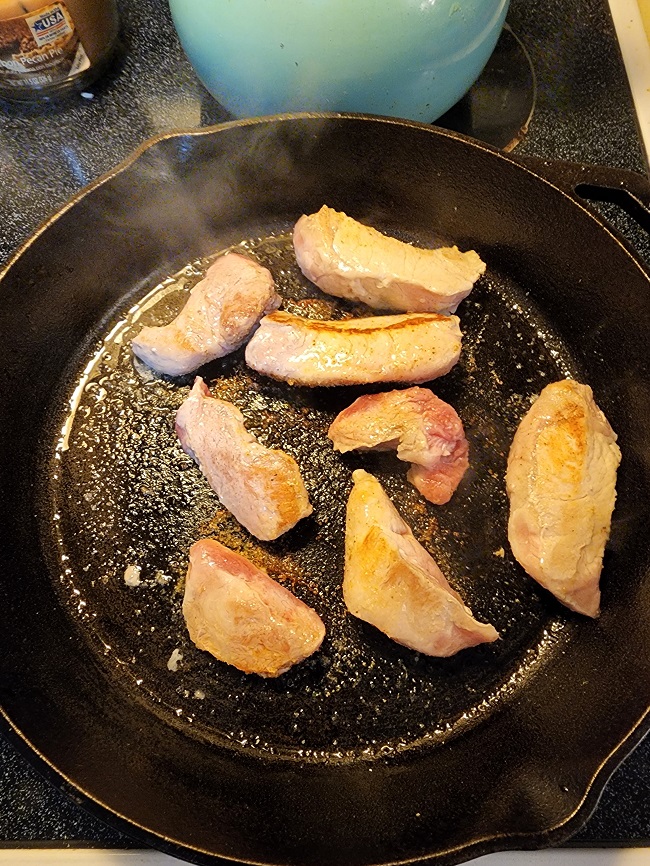
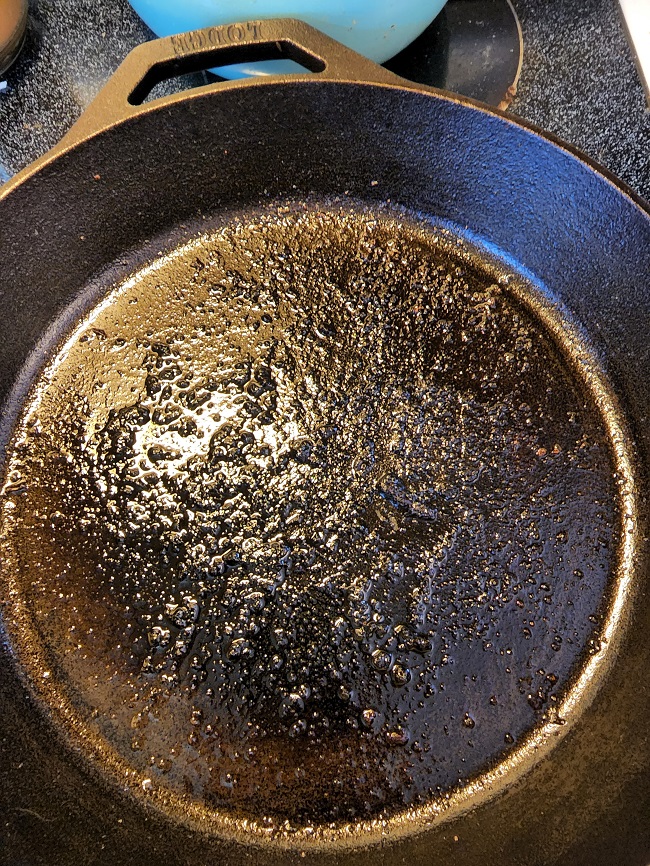
When you have scrubbed off all your dinner and wiped it out, put back on the stove heat it back up, add a light smear of fat and let it absorb. Once that oil is moving, turn off the burner and let it cool. Once you can comfortably touch it, wipe out that excess oil and store it.

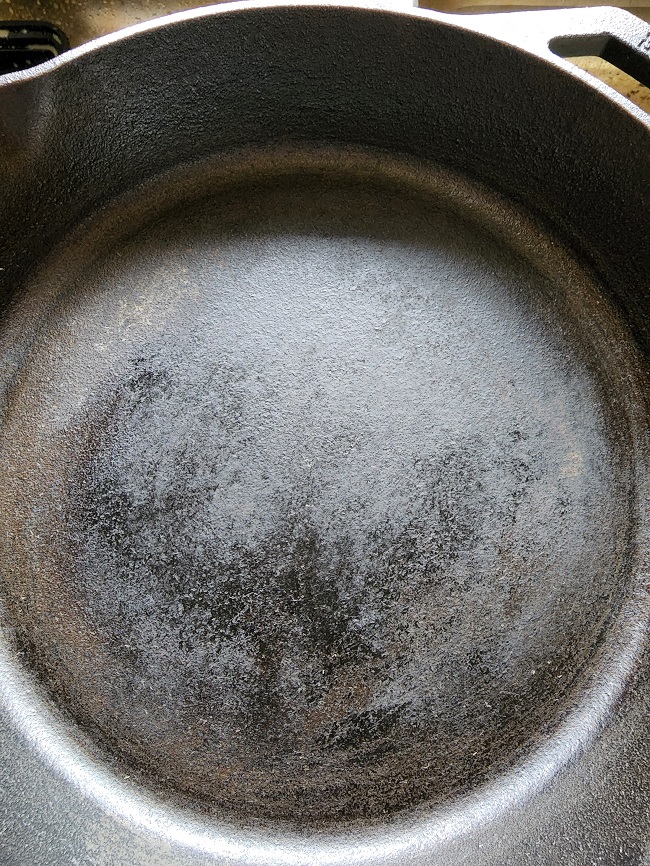
The pan above is clean but not oiled (seasoned). You can see in the middle that it still needs to be oiled. I will usually add grapeseed oil to a lint free towel and then smear the oil around. Once the pan is cool, I wipe out all the excess and then store.

Can You Use Soap?

I might lose some followers here, but yes, you can. And yes, I do. But I only use mild soaps like Mrs. Myers, or a Castile soap. The reason why is because the cast iron has gotten nasty for some reason. I don’t always do it and I immediately re-season it, but it does happen. So don’t feel bad about it. Your seasoning won’t come off just because you used soap. And if it does? Your pan wasn’t seasoned in the first place.

That’s pretty much it. If you have any questions feel free to let me know! If you like this post hit that subscribe button and share it!

If you like the content I put out, feel free to buy us a coffee! It helps keep this site running, marketing and the goats in grain!

Buy me a coffee

If you like this post, feel free to share it and follow us below on our social media accounts!
  • Facebook
  • Pinterest
  • Instagram
  • YouTube
  • TikTok
  • Spotify
  • Threads

Filed Under: Working With Food Tagged With: cast iron, cooking, fat, From Scratch, kitchen

JOIN TO OUR MAILING LIST!

Leave us your email to receive new posts and special offers for members only! Don't miss a thing!

Recent Posts

  • Fall Garden Guide
  • Top Mistakes With Goats
  • How To Bond With Your Goats

February Garden Chores

January 23, 2024 by Leigh Leave a Comment

This is an exciting time for those of us that are getting ready to start seeds. Steel Raven Farms is located in Northeast Georgia, in the foothills of the Appalachian Mountains. We are in zone 7b, even though I don’t really keep track of that. But this time of year is really when I start working on February garden chores and really start on getting my garden stuff going.

cropped-3.jpg

Are you looking for garden journal prompts, but aren’t interested in a weekly email? Check out our 365 Garden Journal Prompts! This is an amazing, all in one, yearly product that you only pay for once.

Buy Now!

February Garden Chores

First and foremost, there is a never ending list of homestead chores that need to be done. But February is a weird month for us. We’ve got goat kids being born, projects getting finished up and prepping for spring planting. And it’s COLD! The very last thing most people are thinking about is a garden. But I know that in just a few short weeks, the weather will turn and we will start warming up.

As far as February garden chores, we are looking at finalizing garden plans, checking seed inventory, checking our garden stuff, and starting seeds. Some of these things will take place towards the start of the month and others will depend on the weather but for the most part, these are the things we are doing in February.

Finalizing Garden Plans

As we are moving out of January, we are still finalizing garden plans. This looks a little different for everyone depending on how you are planning your garden. But for us, we are still in the process of giving our big garden a facelift. So I don’t want to put a ton of effort into planning a space when I don’t know EXACTLY how much space I’m going to have.

But garden plans are not just the physical structures of the garden, though that is a huge part of garden plans. In this case, I’m talking about what I can put IN those structures. This is the time were I am making sure that I have plenty of space for all of the things I want to plant.

Now, I know that regardless of whether my beds are build or not, there will still be plenty of room to plant all the tomatoes, peppers, squash, and all the other delicious veggies. But I do want to ensure that I have plenty of space, seeds, pots, and other things make this years garden a success.

Checking Seed Inventory

I’ve got a whole blog post/ page on creating a seed inventory. This can look like a notebook or a spreadsheet but it is surprisingly important to have some sort of system that tells you exactly what seeds you have on hand. I’ve created a digital seed inventory that you can purchase here, or you can make your own. But now is not the time to buy seeds!

If you are just starting your gardens, then yes, buy the seeds. But if you have a ton of seeds and you don’t NEED to purchase seeds for this years garden, wait till summer! Most seed companies will start putting their seeds on sale in the middle of summer and that is the time to stock up. Plus, come summer, you will have a better idea of what plants are doing well for you and which aren’t.

All that being said, start looking at what seeds you have on hand and match that up to your garden plans. Do you have enough tomato seeds? Which squash was resistant to bores? Which sweet pepper did you love? All of this information should be either in your seed inventory or your garden journals.

Are you getting overwhelmed in the garden? Stressed? Or just not enjoying the garden like you used to? Check out our garden prompts! We send out weekly emails that get you back in the garden and out of your head! Turn the garden back into a place of love and joy instead of frustration and headache!

Subscribe Now!

Prepping Your Garden Stuff

Again, this looks different for everyone, but February garden chores wouldn’t be complete without checking your supplies. Do you have enough compost, soil or amendments? Do you have a fresh garden journal? Are your tools clean and sharp? Do you have enough pots to start your plants?

You would be surprised to find that you need to start sourcing some of these materials NOW before you get too far into the season.

For me, I am making sure that I have plenty of soil and compost, my pots are clean and sanitized, my greenhouse is ready, and I’m good to go! Jared will usually go through and start sharpening tools, finish any big projects that need to be done in the garden and help me with seeds.

Starting Seeds!

This is it, ya’ll! Every single gardener is chomping at the bit to get their gardens started and I am no different. My last frost is supposed to be around April 15th. But I can go ahead and start a fair amount of cool weather, frost hardy things now! Things like cabbage, broccoli, cauliflower, kohlrabi, etc can all be started in my greenhouse without risk of damage.

But there are some summer things we can start now too! I wait till I’m closer to March before starting too many tomatoes and peppers but I will start a tray and put them in the greenhouse around mid February. This is an experiment more than anything, because I want to see just how well my greenhouse stays warm.

But don’t go too crazy with starting your seeds. If your last frost is around the same time as mine, it’s easy to get caught up in the hype of starting seeds early. But remember, the more you start at once, the less bumper crop you will have later.

Pro Amateur Tips For February Garden Chores

Start A Garden Journal

If you haven’t already, start setting up your garden journal! I’ve talked about the importance of journaling here, but garden journals are a must if you are going to “take your garden seriously”. By that I mean, if you want to learn from your garden and grow your gardening skills, then you should make sure that you are writing down what is happening in your garden.

If you’re not sure what to write about, I’ve got my 365 Day Garden Journal Prompt that you can purchase below!

cropped-3.jpg

Are you looking for garden journal prompts, but aren’t interested in a weekly email? Check out our 365 Garden Journal Prompts! This is an amazing, all in one, yearly product that you only pay for once.

Buy Now!

This is also a great place to write down all the seed varieties you grew for the year and how they did for you. This will keep you from purchasing seeds that don’t work for you or remind you of what did well.

Seed Inventory

I have two different ways I track my seed inventory. One is my digital seed inventory and the other is an account ledger book. The reason is twofold. One, I love redundancy. Two, I love having paper copies. There is something about handwriting something that sticks in my brain better.

But having that digital copy of my seed inventory tells me where I bought the seed and has links which is amazing! So no matter if you are super techy or ole school, (or in my case both), make sure that you’ve got something to help you track your seeds!

Don’t Start A TON Of Summer Seeds Yet

I know it’s tempting to start a ton of seeds because you’ve got your hands in the dirt and it’s exciting! But please! Don’t start all of your peppers, tomatoes, cucumbers, etc all at once!

Space out your plantings by about two weeks. This ensures a longer and more spread out harvest, but also won’t wipe out your seed stash if you get a freak storm.

As always, don’t be afraid to try new varieties and have fun! It’s great being a student of the garden!

If you like the content I put out, feel free to buy us a coffee! It helps keep this site running, marketing and the goats in grain!

Buy me a coffee

If you like this post, feel free to share it and follow us below on our social media accounts!

  • Facebook
  • Pinterest
  • Instagram
  • YouTube
  • TikTok
  • Spotify
  • Threads

Filed Under: Garden, Seeds and Plants Tagged With: by month, Chores, Garden, Homestead, kitchen

JOIN TO OUR MAILING LIST!

Leave us your email to receive new posts and special offers for members only! Don't miss a thing!

Recent Posts

  • Fall Garden Guide
  • Top Mistakes With Goats
  • How To Bond With Your Goats

How We Got Into Homesteading

December 26, 2023 by Leigh Leave a Comment

We got into homesteading because we were tired. Tired of every single thing that has happened over the last 25 years. Things that don’t look like they are changing any time soon. But it didn’t start out that way. The cabin in the woods was always the goal for retirement. We wanted to have that secluded spot, away from everyone and no one could bother us. But as we witnessed more of the insanity, we decided to switch the dream from a cabin in the woods, to a homestead in the mountains.

The Ultimate Homesteader’s Starter Bundle – Only $47!

Get the tools you need to stay organized, track profits, and manage your homestead with ease!

Includes:
✅ Schedule F Tracker – Simplify tax prep
✅ Profit Calculator – Track earnings
✅ Hay Calculator – Plan livestock feed
✅ Garden Journal – Digital & printable
✅ Herd Health Tracker – Monitor animal care
✅ Simple Budget – Manage finances
✅ Backyard Homestead eBook – Essential tips

$99 value – now just $47! Start your homesteading journey today!

Buy Now

Why We Got Into Homesteading

Like most modern homesteaders, we got into homesteading because we were tired of the uncertainty. The uncertainty of what was in our food or where it came from. Not knowing if the shelves would be stocked. We wanted to be left alone to do the things we wanted to do. Like actually raising our kids and having a hand in their education. Raising animals for meat in a humane and ethical way. We wanted food that was healthy for us AND the land. We got into homesteading for the peace it brings.

Check out our Microgreens at True Leaf Market

Kids During Chaos

We are millennials, which means that for the last 25 years we have literally watched the extreme highs and lows. We were kids during 9/11 and the following wars, 2 of which Jared fought in. We saw the collapse of the housing market and the almost collapse of the stock market. Where companies too big to fail were bailed out with billions of dollars. We saw the great recession and rise of unrest. We saw the great division of our nation. Then we saw the pandemic.

Now, we are raising our kids in a time were there is a lot of known and unknown threats, division and general unease. I am raising my boys to be men in a world were they are “less than” simply because they are boys. Where women are made to feel unsafe by men, but my boys are expected to protect. Because, as a nation, we can’t just accept people for who they are.

Tractor Supply

We are teaching our boys about history as it was, not as it has been whitewashed to fit whatever agenda is being pushed. We are raising our boys to THINK for themselves and learn to problem solve. While this has been frustrating because they don’t do what they are told. It is amazing knowing that they will NEVER follow lock step with things that just don’t make sense.

Homesteading In Uncertainity

There are a lot of things that homesteading does. It creates a resilient and independent spirit. It teaches you that you are far more capable than you thought. But the best part? When planned “right”, homesteading creates certainty.

Save on Seeds

When I say planned “right”, I don’t mean by following the rules. I mean animals will be born, grow and die, plants will grow and die. When you are a good steward to your resources, you are rewarded with untold bounty. That’s not to say that you won’t fail, but there is a certain amount of peace in knowing that the sun will rise and set, seasons will change, and green things will grow.

When you align yourself with what nature is already doing, and ask her to help you, your gardens will be over abundant. Your animals will thrive. Your kids will see that everything is a cycle. It’s truly amazing what happens when you start homesteading and start paying attention.

Raising Meat Humanely

Homesteaders get asked all the time, and we are no different, how can you raise something and then eat it? How can you claim to care about animals if you are going to kill them? Don’t you feel bad for killing them?

I am going to write a whole blog post on that subject but I’m just going to say this: we raise as much of our meat as possible because when we take responsibility for our food, the food doesn’t suffer.

If you like the content I put out, feel free to buy us a coffee! It helps keep this site running, marketing and the goats in grain!

Buy me a coffee

People get so attached to the animal, but they NEVER stop to think about where their protein source came from. Or they never stop to think about what has had to die for them to get their fruits and vegetables. For the vast majority of American’s, their food comes from the grocery store. So they don’t see what Big Ag, Big Animal, or Big Pharma is doing to the land.

Tractor Supply

If they did, they would understand how much better our animals are raised. How there is minimal stress, absolutely no chemicals, and minimal medical interventions. They would see that our animals are happy, healthy, and thriving. They would see animals that are doing what animals are supposed to do.

Working WITH Nature To Harvest Healthy Food

On our farm, we use zero chemicals on the earth. Period. No fertilizers, no pesticides, no herbicides, and no fungicides. Accidental spills of paint, oils, etc into soil or possible run off, are dug up (where possible) and sunflowers or mustard greens are planted. Those plants are then burned.

We do not till our ground unless we have no other options. We use cover crops, animals, and organic matter to work with the nature instead of against it. When it comes time to plant, we dig a small hole to put a transplant or we use our hands to rake or dig. Then, when the plants are spent, we cut the plant off at soil level and drop the spent plant back into the bed.

This feeds the soil microbiome. Which in turn feeds us.

Our garden produces some of the best tasting vegetables I have ever eaten. Most of them can be pulled straight from the garden and eaten raw, they are that good. Our animals are given the same foods we eat. They absolutely love garden scraps and will wait at the fence, watching and waiting for their bucket of nom noms.

cropped-3.jpg

Are you looking for garden journal prompts, but aren’t interested in a weekly email? Check out our 365 Garden Journal Prompts! This is an amazing, all in one, yearly product that you only pay for once.

Buy Now!

We Got Into Homesteading For Peace

I think the most important thing that the homestead has brought us is peace. Every morning, rain or shine, I go into my kitchen garden. I look at my beds and dream. When it’s cold, I plan the upcoming year. When it’s hot, I enjoy the harvest. And every year, I look for ways to be a better steward to the land.

Every day, I look at my goats. I watch mommas grow big with babies. I watch babies frolic and play. I milk mommas and thank them.

In the years we have been homesteading, I have found life in the slow lane to be more welcoming, joyful and humbling.

And yes, there is stress. This is a real homestead. There are triumphs and failures. But when I go to bed at night, I am at peace.

If you like this post, feel free to share it and follow us below on our social media accounts!

  • Facebook
  • Pinterest
  • Instagram
  • YouTube
  • TikTok
  • Spotify
  • Threads

Filed Under: Our Homestead Tagged With: About Us, Chickens, Goats, Homestead, kitchen

JOIN TO OUR MAILING LIST!

Leave us your email to receive new posts and special offers for members only! Don't miss a thing!

Recent Posts

  • Fall Garden Guide
  • Top Mistakes With Goats
  • How To Bond With Your Goats

Episode 12: A Stricter Diet

December 15, 2023 by Leigh Leave a Comment

Starting A Stricter Diet

Hey Guys! It’s Leigh with Steel Raven Farms! On this podcast, we talk about all the trial and error, successes and wins on the homestead. We have been homesteading for the last several years and I have been a gardener and canner for over a decade. But as always, I am still learning and I want to take you along with me on that journey. 

Think of me as your partner in crime, co-chaos creator, ear to listen, and never, ever the voice of reason. 

Don’t forget to sign up for our newsletter here: Steel Raven Farms Newsletter

Sign up for our newsletter: Steel Raven Farms Newsletter https://steel-raven-farms-llc.ck.page/7edda2c83c

Find our blog here: www.steelravenfarms.com 

Homepage

Our Patreon here: Steel Raven Farms Patreon 

http://patreon.com/SteelRavenFarms

Follow us on Instagram: Steel Raven Farms Instagram 

https://instagram.com/steelravenfarms

Shop our Amazon Store: Steel Raven Farms Amazon Store 

Our YouTube Channel: https://www.youtube.com/channel/UCPCZe-TWXhVSEZ4iR_1o5Yw

Filed Under: Podcast Episodes Tagged With: bacon, carnivore, Chickens, Eggs, Goats, kitchen, Podcast

JOIN TO OUR MAILING LIST!

Leave us your email to receive new posts and special offers for members only! Don't miss a thing!

Recent Posts

  • Fall Garden Guide
  • Top Mistakes With Goats
  • How To Bond With Your Goats

Building Your Legacy: Leaving Your Mark On YOUR World

October 25, 2023 by Leigh Leave a Comment

When I was in school, there was this hype of “You can be anything you want to be”. I had thoughts of being President of the United States. Or maybe an astronaut. But I never really figured out what I wanted to do. Even now, in my 30’s with a great career, I just want to retire. I want to leave the rat race and homestead full time. Over the last handful of years though, the thought has shifted from what do I want to be when I grow up to asking myself: How are you building your legacy?

The Ultimate Homesteader’s Starter Bundle – Only $47!

Get the tools you need to stay organized, track profits, and manage your homestead with ease!

Includes:
✅ Schedule F Tracker – Simplify tax prep
✅ Profit Calculator – Track earnings
✅ Hay Calculator – Plan livestock feed
✅ Garden Journal – Digital & printable
✅ Herd Health Tracker – Monitor animal care
✅ Simple Budget – Manage finances
✅ Backyard Homestead eBook – Essential tips

$99 value – now just $47! Start your homesteading journey today!

Buy Now

Building Your Legacy

I think the first step in building your legacy, is to look at the definition of legacy. I pulled this definition from the Oxford dictionary.

noun

  1. an amount of money or property left to someone in a will. “my grandmother died and unexpectedly left me a small legacy.”
  2. the long-lasting impact of particular events, actions, etc. that took place in the past, or of a person’s life. “he left us a rich legacy of buildings that are both innovative architectural creations and genuine works of art”

For some families, the legacy is being in law enforcement or military. For other families, it’s cycling addiction and abuse. And for me, it’s the dreaded 9-5 and grocery stores.

What Was Passed To Me?

The legacy that was passed to me is the typical American legacy. It was working 40 hours a week in a job that you like just enough to keep going to. Or the feeling of being stuck in a job because you don’t have the time, money or education for something different. It was going grocery shopping at a big box store with labels, directions for cooking, and packaging galore. It was sending your kids to school to get an education that they could take to their 40 hour a week job. It was expected that I get a job at 13 and work as much as possible, or as much as my family could get me to that job.

Beyond the typical legacy, my love of creating came from the women in my life. I learned how to sew from my mom. I learned how to crochet and knit from my grandmother. My love of photography came from my aunt.

But I’ve never been one to do what I’m told. I’ve been accused of not listening or following direction on MANY occasions. And most of the time, it wasn’t in a good way. I am pure frustration for anyone “in charge” of me or any rule follower teaching me how to do something. Being a rebel has a lot of up and downsides. So those skills I picked up from my mother, grandmother and aunt were expanded upon by going further down the rabbit hole on my own.

Wanting Something Different

I’m an observer. I see what other people do, how they do it, and most importantly, how they LIKE it. Then I take that observation and pull it into whatever I’m doing. I saw what the 40 hour work week was like and knew I didn’t want to work 40 hours a week and only see my kids and husband a few hours at night. Being stuck inside 4 walls, without the ability to escape when I need it, causes HUGE amounts of anxiety. There HAD to be something better than packaged food from the grocery store. I wanted something different.

I am a VERY independent 4 year old trapped in a 34 year old body…. with access to the bank cards.

The legacy I want is handed down recipes. I want second and third generation cast iron. I want generational knowledge of gardening, canning, animal husbandry, and working WITH nature. And I KNOW it sounds spoiled but I desperately want to learn these things at my family’s knee instead of the internet.

If you are new to heating with firewood and are looking to master the finer points of it. We’ve got a great eBook that goes in depth of what tools you should consider, how and where to stack, how to build a fire and so much more!

Buy Now

So we started building our legacy

Building your legacy doesn’t always start with a radical shift. Sometimes, it’s just one thing. It’s prioritizing family over work. Or making family meals every Friday night. Sometimes something small is enough to get you moving in the “right” direction for you to build the legacy you want.

Your Legacy Is In Your Hands

We definitely broke the mold over the years.

Since we were a young family and Jared was in the Army, I stayed home with the kids. My cooking skills grew and I no longer had to buy Bisquik to make pancakes. I got a job where I could work two days a week and bring home a full time paycheck. A job allows me to homestead and homeschool while earning a paycheck.

Jared broke the cycles of addiction.

We are creating a legacy of skills, hard work, and independence that our boys can take to their own families.

Do I expect them to be paramedics? No. In fact, I don’t want them to be paramedics. This job is HARD. But I will support them no matter what they decide to do.

Do I expect them to go into the military? No. Again, I don’t want them to. But if that is what they decide, I will support them.

Do I want them to have a homestead? Yes. Because then I know they will be able to take care of themselves and their families. But if not? That’s okay too.

Do I want them to homeschool their kids? Meh. It’s what worked for us.

Before we get too far into this, I have a great course on the basics of goat care. I call it Goat Crash Course: Goat 101. In this course, I explain things like types of shelter, types of feeds and hays, basic assessments and so much more! Check it out!

Buy Now

So What Is My Legacy?

I don’t know, yet. I know what I want my legacy to be. I want my legacy to be a person who is supportive of not only my family’s endeavors and decisions but my own. I want to raise boys who are good and capable men. I want my family to be able to grow their own food, raise and butcher their own animals, and be good stewards to the resources they have been entrusted with. Whether they do those things or not is irrelevant.

I want my children and grandchildren to know that I will pass down second or third generation cast iron. I will teach them how to cook from the heart and not a book. I will always be willing to teach them the skills that I have learned so they don’t have to learn them from the internet. They will learn how to raise and butcher animals. They will know how to put in a garden.

But most importantly, when I die, I know that I did everything I could do to raise a family that doesn’t roll over when things get hard. I know that I have taught the next generation skills that will help them thrive no matter where they find themselves.

If you like the content I put out, feel free to buy us a coffee! It helps keep this site running, marketing and the goats in grain!

Buy me a coffee

If you like this post, feel free to share it and follow us below on our social media accounts!
  • Facebook
  • Pinterest
  • Instagram
  • YouTube
  • TikTok
  • Spotify
  • Threads

Filed Under: Our Homestead Tagged With: Canning, cast iron, Chickens, Chicks, cooking, Eggs, Goats, Homestead, kitchen, Welcome

JOIN TO OUR MAILING LIST!

Leave us your email to receive new posts and special offers for members only! Don't miss a thing!

Recent Posts

  • Fall Garden Guide
  • Top Mistakes With Goats
  • How To Bond With Your Goats

The Real Homestead

September 17, 2023 by Leigh Leave a Comment

As the years have progressed, there has been a huge influx of people wanting to homestead. Which I am ALL FOR! I think it’s absolutely fantastic that we have people rushing out of the cities and onto land. Or turning their lawns into food, either for themselves or pollinators. I love the fact that we have people that are wanting to grow their own food, preserve it, and get away from the overprocessed life. But I’ve got a really big problem when I see the content that people are making and it’s these carefully curated posts or reels. It’s not a real homestead!

The Ultimate Homesteader’s Starter Bundle – Only $47!

Get the tools you need to stay organized, track profits, and manage your homestead with ease!

Includes:
✅ Schedule F Tracker – Simplify tax prep
✅ Profit Calculator – Track earnings
✅ Hay Calculator – Plan livestock feed
✅ Garden Journal – Digital & printable
✅ Herd Health Tracker – Monitor animal care
✅ Simple Budget – Manage finances
✅ Backyard Homestead eBook – Essential tips

$99 value – now just $47! Start your homesteading journey today!

Buy Now

Why Is It Not Real?

This blog post has been on my mind a lot over the last couple of months. To be honest, I wasn’t sure how to write it without sounding judgmental and nasty. While that is not my intent, I feel like I am seeing so many more posts about “I can’t do that because… insert reason here” and it absolutely breaks my heart. And I’ve had enough.

While I know it’s not great for my sleep habits, I scroll TikTok and Instagram at night. I have seen a ton of these carefully curated reels of homesteads and gardens. I see women and little girls in these prairie dresses picking vegetables from the gardens or collecting eggs. Men and little boys working a tractor or building a barn in perfectly crisp wranglers and a pearl snap button down shirts.

Or I see designer chicken coops with perfect eggs and chickens that don’t escape their run. A beautiful garden that has not a single pest, bruised leaf or dropped veggie. Perfectly cropped lawns with beautiful houses.

And I want to scream from the roof tops, IT’S NOT REAL!

Go check out my Instagram feed, I’ll wait.

What you see on my profile is the real stuff. Sure, I try not to get the trash pile from clearing the land or burn pit in the pictures because who wants to see my amazon addiction. But I will gladly tour my homestead and show you the REAL homestead. The one where the chickens have pooped on the deck and I’ve not had a chance to get it cleaned off.

Or the real homestead where Jared is building my greenhouse and there is paint EVERYWHERE. There are piles of scrap wood that needs to be close to the greenhouse for some reason or another.

The fallen trees that we won’t take care of in the summer but will work on in the fall or winter. The goat barn or hay shed that is absolutely not designer. It’s REAL!

Don’t get me wrong, I enjoy those reels because it’s visually pleasing to watch. It’s amazing to dream. But if THAT reel is why you want to homestead, keep reading.

Why Does It Make Me Mad?

It absolutely infuriates me when I hear new homesteaders that are upset that they can’t start their garden because they think they have to have perfect garden beds. Or they give up hope because they saw a TikTok that showed an obviously manufactured chicken coop and run, and they don’t have enough money to buy one.

Content creators are taking the spirit of homesteading out of it and creating this world where people don’t want to try because they think they can’t afford to homestead the way they see on reels. Or they are making people believe that what they are showing is what homesteading is. And people give up before they even start. And that breaks my heart.

Save on Seeds

I could spit nails when I see someone say they just popped out to harvest a couple things from the garden in their white linen dress. They are making a from scratch meal with their fresh bread made from their sourdough starter.

Let me tell you this, that is not what homesteading looks like.

Not a single person would be caught dead wearing WHITE LINEN in their garden, at least not to harvest anything.

I can just imagine wearing a white linen dress, dodging the pigs that have found a mud pit on my way to the garden, dogs playing and the chicken poop on the walkways. While in there, I am having to hold my dress up so it doesn’t get caked with Georgia red clay and trying to harvest a couple of tomatoes, squash or melons. All while knowing I should have brought a basket (and I always forget one) because my dress doesn’t have POCKETS! It’s freaking hysterical! Mainly because I don’t even own a dress.

Logo 468x60

Let’s not mention that my fresh bread rarely looks Insta-worthy, though it’s pretty delicious. And my sourdough starter jar is NEVER clean. In fact, it’s usually caked in starter residue from it overflowing the jar.

But you know what my homestead is? It’s the place that I don’t have to pretend. And I am honored by that.

What Is A Real Homestead?

So if those reels are not entirely accurate, what is a real homestead?

It’s a spirit of self sustainability. A person or family that simply wants better, not just for themselves but for their food, animals, community and the earth. It makes you FEEL every time you step outside.

It’s a perfectly ripe tomato on a hot summer day.

It’s the cry from you and a brand new baby goat that you had to pull from momma.

It’s humanely butchering an animal that has been loved and taken care of from birth.

It’s watching your kids come to you, absolutely filthy, holding a frog, snake or lizard they found.

It’s sitting at the dinner table, talking about your day with those that share what you hold so dear.

It’s creating a legacy were you previously didn’t have one.

It’s slow dancing with your partner in the kitchen while dinner cooks on the stove.

It’s watching your sons learn how to be capable men.

It’s watching your daughters learn to be capable women.

It’s working with nature to bring forth the harvest.

It’s freezing nights in a barn with a momma who is scared.

It’s bringing animals into the house because they are hurt or sick.

It’s NOT asking why there is goat vomit on the ceiling, a duck in the bathtub, or a chicken perched on the shower rod.

It’s syringes by the sink and hay in your hair.

It’s flies in the house, poop on the deck, broken eggs and hearts.

It’s a tearful good bye to a beloved animal.

But most of all, it’s this soul soothing, living and breathing thing that brings us back to nature in a way that a weekly hike or walk through the park just can’t do. It’s something that no content creator can make you feel.

It’s a deep breath and a weight off your shoulders when you realize that more doesn’t equal better.

While I am not a country fan, like at all, because heavy metal is life in this house. I have to appreciate what Zack Bryan said in Fear and Fridays….

“I’ve learned that every waking moment is enough and еxcess never lеads to better things, it only piles and piles atop the things that are already abundantly in front of you like breathing and chasing and slow dancing and love making, fighting and laughing“–Zack Bryan (Fear and Fridays)

My Dearest Homesteader In The Making

I beg you not to look for your life on social media. It doesn’t matter if you are a homesteader or not. The internet is not honest. It’s brief snippets of life, whether real or created. But YOU are real, your dreams are real and you will create YOUR real homestead.

So buy that property, make it YOURS. Make mistakes and learn from it. Dig into the dirt, and feel. Feel every single possibility and make it YOURS.

“Save it with the blame game
I’ve heard it all before
Ain’t nothing holdin’ you down
‘Cept your own feet on the floor
So go on, roll your sleeves up
Put your hands down in the dirt
It’s alright to follow your heart
And take what you deserve
” –Charles Wesley Godwin (Here In Eden)

If you like this post, feel free to share it and follow us below on our social media accounts!

  • Facebook
  • Pinterest
  • Instagram
  • YouTube
  • TikTok
  • Spotify
  • Threads

Filed Under: Our Homestead Tagged With: Canning, cast iron, Chickens, Chicks, cooking, Eggs, Goats, Homestead, kitchen, Welcome

JOIN TO OUR MAILING LIST!

Leave us your email to receive new posts and special offers for members only! Don't miss a thing!

Recent Posts

  • Fall Garden Guide
  • Top Mistakes With Goats
  • How To Bond With Your Goats
  • « Go to Previous Page
  • Page 1
  • Page 2
  • Page 3
  • Page 4
  • Page 5
  • Go to Next Page »

Primary Sidebar

WELCOME

WELCOME

My name is Leigh and I am the lead chaos creator here at Steel Raven Farms. You will see throughout this blog that I am the crazy goat lady.

I am married to my high school sweetheart, Jared and we have two amazing boys.

FOLLOW ME

  • Amazon
  • Facebook
  • Instagram
  • Pinterest
  • TikTok

GET UPDATES!

Leave us your email to receive new posts and special offers for members only! Don't miss a thing!

In all the years that I’ve been growing a garden, the fall garden has steadily remained my favorite. Which is funny because I don’t really like any of the brassicas, which is what most people know the fall garden for. I prefer the root vegetables and cool air. But I have learned over the years…

Read More

  • Animals
    • Chickens
    • Farm Dogs
    • Goats
  • Garden
    • Compost
    • Garden Projects
    • Seeds and Plants
    • Garden Journal
    • Working With Food
      • Recipes
      • Freezing Foods
      • Dehydrating Foods
      • Canning Tips And Tricks
        • Canning Inventory Sheets
  • Helpful Info
    • Welcome to the Homestead!
    • Emergency Preparedness
    • Frequently Asked Questions
    • Goal Setting
    • Project List
    • Shop Digital Products
      • Hay Calculator
      • Farm Expense And Income Tracker
      • Goat Crash Course: 101
      • Garden Journal Prompts
      • Schedule C Tracker
      • Schedule C Tracker
      • The Homestead Bundle
  • The Truths
  • Episode List
  • Start Here
    • Privacy Policy
    • Affiliate Disclosure
    • Let’s Get in Touch
    • Members Only Library
    • Welcome To Our Homestead

Footer

  • Email
  • Facebook
  • Instagram
  • Pinterest

COME AND GET IT!

Leave us your email to receive new posts and special offers for members only! Don't miss a thing!

· Midnight Theme

Copyright © 2026 · Midnight Theme on Genesis Framework · WordPress · Log in