• Skip to primary navigation
  • Skip to main content
  • Skip to primary sidebar
  • Skip to footer

Steel Raven Farms

Where muck boots meet ground.

  • Animals
    • Chickens
    • Farm Dogs
    • Goats
  • Garden
    • Compost
    • Garden Projects
    • Seeds and Plants
    • Garden Journal
    • Working With Food
      • Recipes
      • Freezing Foods
      • Dehydrating Foods
      • Canning Tips And Tricks
        • Canning Inventory Sheets
  • Helpful Info
    • Welcome to the Homestead!
    • Emergency Preparedness
    • Frequently Asked Questions
    • Goal Setting
    • Project List
    • Shop Digital Products
      • Hay Calculator
      • Farm Expense And Income Tracker
      • Goat Crash Course: 101
      • Garden Journal Prompts
      • Schedule C Tracker
      • Schedule C Tracker
      • The Homestead Bundle
  • The Truths
  • Episode List
  • Start Here
    • Privacy Policy
    • Affiliate Disclosure
    • Let’s Get in Touch
    • Members Only Library
    • Welcome To Our Homestead

Goats

Planning For Failure

March 16, 2024 by Leigh Leave a Comment

When you are doing anything in life, you are never going to get it 100% right. It’s just part of the learning process. Whether you are learning a new skill, hobby, or job, you will screw something up. Even when you are a “professional”, you will probably screw something up eventually. And that is OKAY! While absolutely frustrating, it is also totally normal. But there are ways to get around it, and it’s called planning for failure. Everyone can benefit from planning for failure.
Before we get too far into this, I have a great course on the basics of goat care. I call it Goat Crash Course: Goat 101. In this course, I explain things like types of shelter, types of feeds and hays, basic assessments and so much more! Check it out!

Buy Now

What Is Planning For Failure?

This may seem counter productive, right? It may even seem like you are “borrowing trouble” as my aunt would say. But there are a lot of times were you should ABOSLUTELY be planning for failure. Life isn’t easy, nor is is cut and dry. You can do everything 100% right and still fail.

While we don’t want to anticipate failure, you need to be ready and have back up plans…. and then more back up plans. I talked about Semper Gumby in my post about homestead flexibility, and it is no different when it comes to bringing an income to the farm. In fact, when you are relying on nature for your income, you should have plans coming out of your ears.

Today, I want to talk more about planning for failure when it comes to earning money on the homestead. For example, you should plan for crop failure, animals not producing, and market failures. Then I want to talk about how to build your back up plans. Now, everyone can benefit from these things, but this post is more geared for those that are looking to start marketing their homestead.

If you are interested in learning more about my favorite garden planner. I highly recommend Seedtime! This planner has been instrumental in helping me plan out my gardens with WAY more efficiency than I could ever expect! It has also reduced overwhelm, stress, and calmed my ADD/ADHD!

More Info!

Planning For Crop Failure

On this topic, planning for failure starts at the seed level. If you are growing produce for market, you should be starting your own seeds. There are a ton of reasons for this that I go over in this blog post. But in that post, I don’t really talk about starting seeds for market. The reason is because that post is for a first time gardener/ seed starter. Not for someone looking to break into the farmer’s market side of farming.

When it comes to seed starting, I’m not necessarily talking about live plant sales here, though the principle is the same. Start more seeds than you think you’ll need. You will have seed failure. It may be because you watered too much or too little. Too much light or not enough. Or because you looked at the seed wrong…. Either way, because you started WAY more than you needed, a couple of cups that didn’t start isn’t going to derail your entire crop.

As you move into planting/ growing season, always make sure that you are looking at possibilities for failure. When we start pruning our tomatoes and peppers, we take the cuttings and put them in water. Once they have sprouted roots, we put them back into the soil. This helps not only save on seeds, but also weeks or months of growth. The reason for this is because you will have plants that stunt, get damaged or diseased, or some other issue that you didn’t even think to plan against. But you DID plan for failure and now you have a back up plan.

Are you getting overwhelmed in the garden? Stressed? Or just not enjoying the garden like you used to? Check out our garden prompts! We send out weekly emails that get you back in the garden and out of your head! Turn the garden back into a place of love and joy instead of frustration and headache!

Subscribe Now!

Planning For Animals Not Producing

When you have animals for market, no matter the animal or the market, you HAVE to plan for livestock to be livestock. This means that you may have goats that abort and you have lost not only the kids, but milk, meat AND money. Or your pig got pneumonia and you had to give antibiotics. Now, they can’t be sold as organic, antibiotic free.

At the end of the day, on my farm, an animal is the focus of every single thing we do. When we do our farm days, where photographers come out with their clients, we explain that if the goat isn’t feeling it, you don’t get to have pictures with the goat. Same thing with mommas and kids. If that momma is raising hell because you have her baby? You aren’t getting her baby. Period. Yes, it can a loss of income but that animal is more important.

All of these things happen and if you are not prepared, it could absolutely devastate your bottom line. But there are some things that you can do to prevent these failures. Things like good animal husbandry, rotational grazing, etc will help make sure that your animals are in peak condition and able to weather those storms. But sometimes, it still happens. So look at your operation and see where you can add some buffers. I’ll go into more detail below about my buffers for our animals.

Save on Seeds

Planning For Market Failures

There will absolutely be some catastrophe that happens when you are growing for market. It maybe a pest or disease that takes out your entire crop of green beans. It could be coccidiosis that stunts kids for market. Or it could be that the market doesn’t effectively market and no one shows up.

Some of these things you can’t do anything about. But there are things that you can do to make sure that you don’t get stuck holding the bag. To give you an example, we do not disbud our goats. We also no not necessarily take deposits on kids. However, if you decide you want one of my kids and you want it disbudded? You will be paying a full price, non refundable deposit for that kid.

Can you do that with farmer’s markets? Not really, but you can make sure to do your homework before signing up with that market.

Logo 468x60

When it comes to animals, it’s practicing good husbandry to ensure that you have done everything you can to prevent stunting or other poor growth.

Back Up Plans And Buffers

Sometimes, even the best laid plans go to hell in a hand basket. Make sure you have a back up plan. But what do those back up plans look like? How do you build in buffers? What in the world is a buffer?!

Have A Back Up Plan

For every situation, you should have a plan if things go sideways. Let’s take our last green bean crop as an example. Every year, we deal with Japanese beetles that absolutely LOVE our green beans. To ensure that we have plenty of green beans for ourselves and market, we plant green beans in 4 different locations on the property. Is it a pain in the ass? YES! But I would rather have 4 separate crops that I can get something out of than 1 main crop that gets nothing.

This year, we had 3 out of 5 does, abort. That means that I do not have goat kids or meat to sell. I do not have a back up plan for them. But my bottom line does not hang on the goat kids or meat. That is “extra” money. Because livestock is livestock. You cannot make huge decisions on a small herd. If we had a huge herd, then yes, we could make plans and have back up plans.

Save on Seeds

What Is A Buffer?

There are various ways to create buffers on your farm and the best one is diversification. Monocropping is for people with hundreds of acres. It is not for us that are on small acreage. That being said, don’t put all of your eggs in a produce basket. Or even a meat market basket. Make sure that you have plenty of ways for your farm to earn money.

One of the ways we do this is by offering Farm Days. This is our program that allows photographers to come to the farm, with their clients, and use the garden and greenhouse for photos. We charge per hour or per day. We also offer animals as add ons. This requires very little from us, unless animals are added to their day. And this allows us to make money even if our market crops don’t do well.

Another way that we diversify is by selling cut flowers. We sell cut flowers at markets, to florists, and offer to ship. We are not a florist, but it has done pretty well for us. Again, it doesn’t take a lot of extra work for us because I plant flowers all over the property. I love them. Plus, it brings pollinators to the farm.

Building Your Buffers

This is going to look vastly different for everyone. If you don’t want to sell cut flowers, that can’t be a buffer for you. If you don’t want to have people on your property, don’t host farm days. But think about all the different things you do that you could sell. This could be offering classes or starting a few more seeds to sell as plant starts.

Before we get too far into this, I have a great course on the basics of goat care. I call it Goat Crash Course: Goat 101. In this course, I explain things like types of shelter, types of feeds and hays, basic assessments and so much more! Check it out!

Buy Now

Brainstorm the things you know how to do and figure out a way to monetize that. Do you take pictures? Sell digital prints on Etsy. Are you a pro at butchering chickens? Offer a class on it. Can you run a pressure canner with your eyes closed? Make a couple videos and offer a course.

Or offer coaching services! You have knowledge that other homesteaders are looking for!

Lastly, Plan For Bad Press

One more thing that could affect your ability to earn an income is bad press. Now, you won’t please everyone and no, the customer isn’t always right. You will have someone that has a problem with you, your product or your farm. But there are somethings that you can do about it.

First and foremost, be friendly! People are willing to overlook mistakes when you are not a total scrouge. Second, be honest and open. When you start trying to hide behind a facade of “I know everything“, people are going to see right through it. And third, communicate! Seriously, if you have a disastrous year for green beans, and you tell your customers that, they are going to understand.

cropped-3.jpg

Are you looking for garden journal prompts, but aren’t interested in a weekly email? Check out our 365 Garden Journal Prompts! This is an amazing, all in one, yearly product that you only pay for once.

Buy Now!

But sometimes, you are going to get someone who just wants to complain and nothing you do is going to matter. I will tell you this from experience in my real job, as well as literally every interaction I have ever had with the public: your reputation is EVERYTHING. One of my bosses at my real job has said on many occasions, to me and others about me, that I am so honest that I will tell on myself. He knows that, no matter how uncomfortable it is, I will always tell the truth.

Because of my reputation, I have the backing of my department. Because of my reputation, I am making a name for myself in the homesteading world. I will be the first to tell you, this may not be the “right” way, but this is how I do it. This is what has gone wrong, and this is what has gone right. And I’m always willing to hear you out.

When it comes to your farm, you will make your own name for yourself and hopefully, it’s a good one.

Let me know how you plan for failures

If you like the content I put out, feel free to buy us a coffee! It helps keep this site running, marketing and the goats in grain!

Buy me a coffee

If you like this post, feel free to share it and follow us below on our social media accounts!
  • Facebook
  • Pinterest
  • Instagram
  • YouTube
  • TikTok
  • Spotify
  • Threads

Filed Under: Homestead Planning Tagged With: Eggs, Garden, Goats, income, market

JOIN TO OUR MAILING LIST!

Leave us your email to receive new posts and special offers for members only! Don't miss a thing!

Recent Posts

  • Fall Garden Guide
  • Top Mistakes With Goats
  • How To Bond With Your Goats

Overwhelmed With Chores?

March 12, 2024 by Leigh Leave a Comment

It’s easy to get overwhelmed with chores on the homestead. Goats need milked, eggs collected, dogs let out, and ducks bedding changed AGAIN. On top of that everyone needs to be fed, including the children. By the time your day is done you’ve logged 9 million steps and are exhausted. But sleep is for the weak because you have to stay on alert for predators, the baby, and the sick goat in your living room. Chore management on the homestead is a really thing and it’s hard to get a handle on.

Dealing With Overwhelming Chores

Yes, I am overwhelmed and yes, I am tired. But I have found some pretty ingenious hacks to allow me to get some sleep without sacrificing my animals care. Below are my 5 hacks to keeping up with the homestead, while working full time, homeschooling, and running a several businesses.

The Ultimate Homesteader’s Starter Bundle – Only $47!

Get the tools you need to stay organized, track profits, and manage your homestead with ease!

Includes:
✅ Schedule F Tracker – Simplify tax prep
✅ Profit Calculator – Track earnings
✅ Hay Calculator – Plan livestock feed
✅ Garden Journal – Digital & printable
✅ Herd Health Tracker – Monitor animal care
✅ Simple Budget – Manage finances
✅ Backyard Homestead eBook – Essential tips

$99 value – now just $47! Start your homesteading journey today!

Buy Now

Get the kids involved

I have found that there are two sides on this, and few people fall in the middle. Either kids do chores or they don’t. My boys do chores, and they do a lot of them. Every month they switch out, except for animals. We also help each other out. If I see the ducks need water, I fill it up. If Jaxson sees that the cats are out of food, he feeds them. Their current chore list looks like this:

Chase- Goats, feeding dogs/cats, wiping up the counters, vacuuming, and cars

Jaxson- Chickens/ducks, dishes, bathrooms, (yes, this seems off. But in our house, dishes get run 3x a day)

Me- Goats, gardening, other seasonal work

Jared- Building

But I see no reason why kids can’t do chores. Especially when they want toys, electronics, etc.

If you are interested in learning more about my favorite garden planner. I highly recommend Seedtime! This planner has been instrumental in helping me plan out my gardens with WAY more efficiency than I could ever expect! It has also reduced overwhelm, stress, and calmed my ADD/ADHD!

More Info!

Start small and grow

When we started the homestead, we started with our dogs, cats, dragons, and snake. Then we added chickens. Once we were comfortable with that, we added goats, and so on. Before we add anything new, or more of them, we ask if everyone is on board. Since the kids handle most of the day to day animal care, we want to make sure that they are good with getting more.

This means don’t start a 8,000 sq ft garden right out of the gate! Start a small garden and then grow it. This could mean starting a seeds inside before you build or buy a greenhouse.

I am currently working on this right now with our soil and pasture building project. Our soil is so compacted from lack of care that I am working to regenerate the soil and set up a strong pasture so we no longer have to feed our goats off farm inputs.

goat kidding

Before we get too far into this, I have a great course on the basics of goat care. I call it Goat Crash Course: Goat 101. In this course, I explain things like types of shelter, types of feeds and hays, basic assessments and so much more! Check it out!

Buy Now

Get into a routine

While this is tough at first, once you get into a routine of taking care of your chores, it’s easier to see where you have more time. Our routine goes something like this, I wake up, let my dogs out and shower. The boys get up, let their dogs out and start on their animals. If they are hustling they can get their morning chores done in about 10 minutes.

Because we unschool, our homeschool doesn’t take hours and hours. We talk about what they are interested in and they do research on that. We also take time for the basics like math, reading, social studies, and science. They do Spanish on Friday.

During garden season (Mid February to Mid November), I can usually be found outside until the weather drives me inside. I have a list of “rainy day chores” that I work on whenever the weather drives me inside. Like record podcasts or videos, write blog posts, planning days, etc.

Banner 468x60

Delegate

One of the first things I was taught in Paramedic school is delegation, and it’s not something I do well at work. But at home, I’ve got it covered. After talking with Jared about our goals and what we want to accomplish, I come up with the To Do lists and plans and delegate it out. This helps everyone figure out where they need to be, what they need to be doing and how to finance it. It’s not a hard fast rules/ to do lists, but it helps everyone know what they need to do.

Save on Seeds

It also extends to chores. Since keeping up the house is everyone’s chore, we split the chores as evenly as we can. I hate doing the dishes, so the other 3 handle it. They hate doing laundry so that usually falls to me. I handle the grocery shopping and bill paying. Jared handles building. Chase handles the goats, and Jaxson handles to poultry. Then we help each other out as needed to make sure that everything actually gets done.

Cleaning

I could write an entire blog post about cleaning up the house and the homestead. I would be lying if I said my house was spick and span. It’s not. I’ve got 4 huge dogs, and kids living inside my house. Not to mention the occasional goat, chicken, duck, etc. My house is never clean. But I clean up as I go and everyone else helps a lot.

Don’t get hung up in the details. My kitchen is a prime example. That little ledge behind the sink that collects all manner of nasty things is constantly dirty. I have tried everything in my power to keep that area clean but it’s not happening and you know what? That’s fine. My counters and stove are clean and the sink is mostly empty. Pick your battles and move on.

Grace

At the end of the day, you are simply human. Give yourself grace when you can’t get your kitchen scrubbed or the laundry done. The animals have food and water and the kids aren’t dead or hurt? You’ve done just fine.

Overwhelmed With Chores?

One of the biggest lessons that I’ve learned on the homestead is that there is always tomorrow. We have been conditioned to believe that tomorrow isn’t guaranteed. And yes, that’s absolutely true. But if you run yourself, spouse or kids into the ground trying to get everything done TODAY, you will burnout everyone out.

I have a saying that I have adopted since hitting homestead burnout…. If I die tomorrow, it’s not my problem. This may sound very off handed or too laid back way of looking at life, but it’s the honest reality. If I drop dead tomorrow, it’s not going to matter if I took a nap instead of starting seeds. It doesn’t matter if I put tomatoes in the freezer instead of running them through the canner.

I’m not saying that you have to have that mindset. But what I AM saying is that you have to give yourself and your family grace and kindness when it comes to this stuff. To give an example, I was supposed to be done with this blog post about 3 hours ago. But instead, I took a nap because I was exhausted from working a 36 hour shift on the ambulance…. And that’s fine.

If you like the content I put out, feel free to buy us a coffee! It helps keep this site running, marketing and the goats in grain!

Buy me a coffee

If you like this post, feel free to share it and follow us below on our social media accounts!

  • Facebook
  • Pinterest
  • Instagram
  • YouTube
  • TikTok
  • Spotify
  • Threads

Filed Under: Animals, Garden Tagged With: Chickens, Chores, Ducks, Goats, Homestead, Overhelmed, stress

JOIN TO OUR MAILING LIST!

Leave us your email to receive new posts and special offers for members only! Don't miss a thing!

Recent Posts

  • Fall Garden Guide
  • Top Mistakes With Goats
  • How To Bond With Your Goats

Goats Are Not Beginner Livestock

March 9, 2024 by Leigh Leave a Comment

I have recently been asked “If you love goats so much, why do you tell people not to get them?” The answer is simple, if more people would educate themselves before buying animals, I wouldn’t tell them not to buy goats. Most people do not do the research, and they end up getting a bunch of animals that they are not prepared to care for. But the reality is that goats are not for the feint of heart and they are not beginner livestock.

goat kidding

Before we get too far into this, I have a great course on the basics of goat care. I call it Goat Crash Course: Goat 101. In this course, I explain things like types of shelter, types of feeds and hays, basic assessments and so much more! Check it out!

Buy Now

Goats are NOT beginner livestock

I wrote my post about goats coming to the homestead and I will be honest, I left a lot of information out. Mainly because it was a piece designed to give a brief snap shot of why and how we have come to love our goats. But I feel, especially after what I said above, that I needed to be a little more clear about why I feel this way.

The plan truth is that it is easier to kill a goat than keep it alive when you are just starting out. When we first bought Bella and Voldemort, we knew that he had worms. But we had absolutely no idea what that actually meant. If a dog has worms, you give it a pill and repeat again in a week. After that you should be good to go. With goats it’s not that easy. In fact, goats will easily die from worms and quickly.

Banner 468x60

Goats Die Easily

There is a treatment protocol that is now in place because farmers have overtreated for parasites and it has caused resistance to these dewormers. Instead of two doses of one dewormer, it is multiple doses of several dewormers over several days/weeks. If you don’t know these things, you will lose goats before you are ever really comfortable with them.

Banner 468x60

Then there are plants are toxic that can kill them or the predators out there. Or that if their rumen gets out of whack, they could die. I have an entire book of treatment protocols that I have gone over with my vet to make sure I am doing the right thing.

That being said, once you understand what you are doing and why, it is extremely easy to keep them going. With regular herd checks and individual checks, your herd can thrive. We’ve had some touch and go moments since owning goats and we have managed to pull most of them through.

goat kidding

Before we get too far into this, I have a great course on the basics of goat care. I call it Goat Crash Course: Goat 101. In this course, I explain things like types of shelter, types of feeds and hays, basic assessments and so much more! Check it out!

Buy Now

Having Medications On Hand

Unlike your dog, cat or even chickens, you need to have medications on hand for goats and know how to use them. Goats can take Aspirin, but if you don’t know how often or the dosage you could kill them. You need to have antibiotics on hand for things like pneumonia, antitoxin for injuries, thermometers for temp checks and minerals for their general health.

Good luck finding a vet that will treat your goat. Seriously, we got incredibly lucky that not only does our vet treat ALL of our animals, they are goat owners themselves. So they know how to take care of small ruminants, which is huge when figuring out how to take care of these creatures.

I have a tool box that I carry when doing herd checks. It is packed to the brim and a binder that lists medications, FAMACHA scores, weights and much more. I conduct herd checks weekly to make sure that we catch any possible illness before they happen. Even with all that, we ended up with two pregnant goats that we didn’t catch until a few weeks before delivery.

But once you learn what you need to do to care for them appropriately, they are worth it. Every time they bleat when you come into their pen. Their antics when they are playing fighting, and more is so worth every ounce of heartbreak when you lose one.

Goat People vs Everyone Else

There are two types of people when it comes to goats. There are people who have goats and people who love their goats. I know many people who have goats and they are just that, a goat. Goat people truly love their goats. I have chickens, I like them and they’re pretty cool but I don’t love them. I am not a chicken person. I’m not going to snuggle my chickens. I’m not going to check on them constantly. If one goes missing? I’m not going to be upset.

Save on Seeds

My goats? I cried when we lost Voldemort and Texas. My kids bawled with Texas. I refused to entertain the notion of another goat after that for about 5 minutes because I love these goats. I am a goat person. I have spent untold hours researching everything I can about them. I have spent more money on them then I care to admit, but they are my babies.

So No Goats are NOT beginner livestock

They just aren’t. But that is coming from a goat person. Someone who truly loves these animals and wants you to love them too. So if you want goats, by all means, get goats. They are really cool critters that have absolutely stolen my heart. But understand what you are getting into. It’s not all sunshine and roses.

goat kidding

Before we get too far into this, I have a great course on the basics of goat care. I call it Goat Crash Course: Goat 101. In this course, I explain things like types of shelter, types of feeds and hays, basic assessments and so much more! Check it out!

Buy Now

Sometimes it’s recognizing that your goat isn’t acting right and getting in there with a thermometer, FAMACHA chart and figuring it out. Or collecting poop and storing it in your fridge until you can get it to the vet. It’s keeping goats in your house because they could die at any minute and you need to be there to try and stop it. It’s realizing that despite your best efforts some may die and there’s not a lot you can do to stop it.

But it’s also having your goats sing to you as you come down your driveway- RIP Texas

It’s getting snuggles from your best girl- Champ

It’s playing, getting headbutts, and dodging a buck in full rut- Midas

It’s slowly, so slowly winning the affection of Queen Bee- Bella

It’s watching two girls grow and start to play and call out for you- Oakley and Bailey

It’s helping deliver the first goat born on your homestead- Stella

It’s wethering your first buck- BeeBee

It’s being surprised by a new kid on the ground and not realizing your girl was that close- Bailey and Sebastian

It’s doctoring a sore shoulder because he jumped off a log- Finnegan

It’s listening to a tiny bleat from a huge goat with a comb over- Spike

It’s watching 2 little girls melt my husbands heart with every whiny bleat and nibble- Jade and Sapphire

Logo 468 x 60

So while they may not be beginner livestock, they are absolutely worth the time, energy, effort and money that goes into their care and keeping.

If you like the content I put out, feel free to buy us a coffee! It helps keep this site running, marketing and the goats in grain!

Buy me a coffee

If you like this post, feel free to share it and follow us below on our social media accounts!

  • Facebook
  • Pinterest
  • Instagram
  • YouTube
  • TikTok
  • Spotify
  • Threads

Filed Under: Animals, Goats, How To's, Our Homestead Tagged With: Chickens, Goats, Homestead

JOIN TO OUR MAILING LIST!

Leave us your email to receive new posts and special offers for members only! Don't miss a thing!

Recent Posts

  • Fall Garden Guide
  • Top Mistakes With Goats
  • How To Bond With Your Goats

How Much Hay Does Your Goat Need?

March 2, 2024 by Leigh Leave a Comment

No matter where you live, there’s a really good chance that you will need to feed your goats hay to get them through winter. If you live in the south, you probably won’t need a ton. But if you have an actual winter, you probably want to make sure you have enough. To figure out how much hay you need, we’ll need to ask some questions first.

goat kidding

Before we get too far into this, I have a great course on the basics of goat care. I call it Goat Crash Course: Goat 101. In this course, I explain things like types of shelter, types of feeds and hays, basic assessments and so much more! Check it out!

Buy Now

Questions to ask yourself

How many goats do you have? How long do you need to hay your goat? Are you breeding your goats? What kind of storage do you have for hay?

I wish it was a simple equation but the reality is you don’t want to find out you were wrong in the middle of a snow storm. But I am going to give you the high points and what we do with our goats. By the end of this post, you can go into fall and winter with a rough idea of how much hay you’ll need.

Oakley and Bailey the goats
Oakley and Bailey

Before we get started I want to address something. Yes, I am writing this post in March. Why am I writing a post about how much hay you need for winter in the spring? Because being prepared is key for getting your livestock through winter. It doesn’t matter if you are in a mild winter climate like Georgia, or being buried in feet of snow every winter like Alaska. Knowing how much hay your goats need will get your goats through winter without losing body condition or worst case, a goat.

Save on Seeds

How Many Goats Do You Have? And Are You Breeding?

The key to successfully getting your animals through winter is know how many mouths you are feeding and how much they should eat. While this may seem like a no brainer, you must also consider how many additional animals may be coming to your homestead. We ended up picking up two more goats in January, had we not planned for extra hay, we would have been short because we now have two more mouths to feed.

Bella scratching her side because her pregnant belly gets in the way

You also need to consider if any of your does are pregnant, or could become pregnant. If you only get the minimum needed for each goat, and now your doe needs more hay because she is pregnant, you will be short. Or worse case, you don’t have enough for when the babies are ready to eat.

Logo 468x60

How Long Is Your Winter? Where Are You Storing Your Hay?

In Georgia, we have an extremely mild winter. Sure it gets cold and wet, but it doesn’t snow a lot and we usually have some sort of greenery for goats to eat. It is certainly not enough for them to eat throughout winter, but we do have some grasses that will grow year round here. When we start figuring up how much hay we need, we look at how much we got last year, and how long that lasted us. We also figure up how many months we will use hay.

For us, we want the ability to start giving them hay by mid to end October and have enough to carry them to the end of April. Now, we don’t start getting cold enough for our pastures to start hibernating until probably November. Our grass also usually starts growing in March, but having that extra cushion allows us to not worry if we get a freak snow storm in March, which has happened.

Jared also built a hay barn that is about fifty feet from our goat barn. While that is certainly a pain some days, especially when it is raining. It adds a layer of security that if the hay catches fire, which it’s prone to doing, our goats are safe. We tweaked his original design so that it’s easier to load. He’s also going to make an opening so that the goats can still get hay if they run out.

So How Much Hay Do You Need?

The general rule of thumb is 2-4 pounds of hay per day per goat. Or if you know their weight, 2-4% of their weight per day. Before we start looking at how much hay you need, I have a hay calculator in our general store that will make all this math a LOT easier. All you have to do is put the weight of your animal (estimating is fine), the percentage you want to feed per day and the amount of days you want to feed for. On the second page, there is a hay tracker that allows you to see where you bought your hay previously, how much you bought, how much you spent and so on.

The Hay Calculator:

If you aren’t math-y (don’t worry I’m not either), check out our Hay Calculator. It literally does ALL of the math for you and gives you totals based on what you want your goals.

On the second page, you can track where you’ve bought hay, what you spent and how long it lasted.

Buy the Hay Calculator

So let’s crunch some numbers. When we ordered our hay this year we got fescue/ Bermuda mix and we got two strand square bales. We had four goats, but our Texas died before we actually started using the hay. But we figured that each goat weighed 50# and we wanted to make sure that we had plenty of hay. So our equation looked like this

50# x .04= 2#/ day

2#x4 goats= 8#/ day

30 days in a month x 8 months= 240 days

8#x 240 days=1920# of hay

Tractor Supply

I know two tons of hay sounds like a lot, and it is. But if we had minimized what we needed:

30# x .02= .6#/ day

.6#x4 goats= 2.4#/ day

30 days in a month x 8 months= 240 days

2.4#x 240 days=576# of hay

We would have run out of hay in December. Let’s not mention that we wouldn’t have had enough to feed the two new goats we got in January. So knowing these figures allowed us to figure out how much hay we needed and we actually rounded down to about 1600# of hay.

The Hay Calculator:

If you aren’t math-y (don’t worry I’m not either), check out our Hay Calculator. It literally does ALL of the math for you and gives you totals based on what you want your goals.

On the second page, you can track where you’ve bought hay, what you spent and how long it lasted.

Buy the Hay Calculator

Now the second question of where to put the hay comes into question. Because we didn’t have a place to put a round bale of hay, nor anyway to move it into the pens, we opted for 2 strand square bales. Not only did we not have space, but putting all our eggs in that basket seemed like a bad idea. If any portion of that round bale molded and we fed it to the goats, they could all die. So we went with square bales.

Jared built our hay barn so that we could house the hay without it getting wet but still had plenty of ventilation, which decreases the chances of it molding, composting, or any other nasty that would make it unusable. When we ordered our hay we ordered 28 bales of hay to get everyone though winter. That’s about 1600# and we only paid $200 for it.

Tractor Supply

This year we will have twelve goats to get through winter and we have been seeding our pasture to make sure they had plenty of options, especially in winter. To give you a break down of how much hay we are planning for and the corresponding math.

Our seven girls total weight= approximately 525#

Our five bucks/wether= approximately 600#

1125# goat x .04 & .02= 45# of hay/ day or 22# of hay/day

30 days x 45 (and 22)= 1350# or 660#

Logo 468x60

Long feed (September to April) X High Weight= 10,800#

Long Feed X Low Weight=5280#

Short Feed (November to March) X High Weight=6750#

Short Feed X Low Weight=3330#

If all of that is just a lot of information and hard to keep up with? Just head over to our hay calculator and you can purchase the much easier version.

Save on Seeds

Now we average the highest number and the lowest number: 10,800# and 3,300#= 7,050# of hay.

Why do we average it? Because they aren’t only going to eat hay. They get alfalfa pellets and grain as well. Plus they will eat branches, dead leaves, etc. So they won’t need the full 45# of hay per day. But they might. And as I said before, I would rather have too much than not enough. And let’s face it, they are going to waste a fair amount of it.

Is there an easier way to do this? Absolutely. I could just multiply by .03 instead but I like having the high and low numbers. If I am aiming for 10k # of feed and only hit 5k #, then I know I will have to buy extra grain, alfalfa pellets, or beet pulp.

So how much hay do you need to get through winter? Use the formula above to figure it out and remember, it is better to have too much than not enough.

If that was a little too much to handle, don’t forget you can use the hay calculator to make it a TON easier

The Hay Calculator:

If you aren’t math-y (don’t worry I’m not either), check out our Hay Calculator. It literally does ALL of the math for you and gives you totals based on what you want your goals.

On the second page, you can track where you’ve bought hay, what you spent and how long it lasted.

Buy the Hay Calculator

If you like the content I put out, feel free to buy us a coffee! It helps keep this site running, marketing and the goats in grain!

Buy me a coffee

If you like this post, feel free to share it and follow us below on our social media accounts!

  • Facebook
  • Pinterest
  • Instagram
  • YouTube
  • TikTok
  • Spotify
  • Threads

Filed Under: Animals, Frequently Asked Questions, Goats Tagged With: Goats, hay, Homestead

JOIN TO OUR MAILING LIST!

Leave us your email to receive new posts and special offers for members only! Don't miss a thing!

Recent Posts

  • Fall Garden Guide
  • Top Mistakes With Goats
  • How To Bond With Your Goats

Bringing Goats to the Homestead

February 24, 2024 by Leigh Leave a Comment

I could write a million blog posts on my goats. In fact, I have an entire category created for them, including our breeding pages. They are amazing creatures that really do make everything better. When I am stressed, upset, or just need a breather, I head to our goat pens and just hang out with them. They are seriously my favorite critter on the homestead. But it wasn’t always the case. Bringing goats to the homestead wasn’t my first choice, but I’m really glad we did it.

goat kidding

Before we get too far into this, I have a great course on the basics of goat care. I call it Goat Crash Course: Goat 101. In this course, I explain things like types of shelter, types of feeds and hays, basic assessments and so much more! Check it out!

Buy Now

Before Goats Came To The Homestead

When we were set to actually close on our homestead, we knew we wanted to raise rabbits, chickens, maybe a pig or two. But I had done some research on goats and I was pretty resistant to the idea. I’m sure anyone that wants to homestead has heard that goats are escape artists. They will find the smallest of holes and your entire herd is gone. We have heard that they eat everything and are hard to kill. Or my personal favorite, goats are entry level livestock. Uh, no. This is wrong. Except the escape artist part.

Save on Seeds

After all of that research, I quickly realized that goats were a lot more work than I wanted to start with on the homestead. We would need to have two because they get lonely. They cannot eat everything, in fact more things will make them sick then they can actually eat! The fencing had to be waterproof and even then they would still get out. This is not how I want to start this adventure.

Bellatrix and Voldemort

But Jared Wanted Goats

While we were working on clearing fencing and brush, Jared says, “Let’s get goats. They will be like long term lawn mowers.” After the research I had done, I really didn’t want to. But I really dislike telling Jared no. So off we went to get goats.

If you are a farmer/ homesteader and looking for a way to track your income and expenses, I highly recommend our Schedule F Tracker! We have been using it for years and it is the easiest, fastest and best way that we have found to keep track of the money spent on the homestead.

Buy Now

We got two mini Nubians simply because we liked the way they looked. But we had absolutely no clue what we were doing. We wanted animals that were going to eat brush and very low maintenance. That is not what we got.

Not Entry Level Livestock

Voldemort came to us loaded with worms. The guy we got him from said they treated him and said he would be fine. We got Bella and V on July 4th and by end of July, he was dead. When we took him to the vet the day prior, she said she had never seen a worm load as high as his was. We were told to prepare for him to die.

Barber pole worms attach to the lining of the intestines so when the worms died off, there was a very high chance that he would bleed out internally. If that didn’t kill him, the dewormer we were forced to use, may kill him. He died the next day.

Since goats are herd animals, they will escape to find a new herd. Bella was without a friend for four days. In those four days, I was scrambling to find a new goat, she escaped three separate times. But, I found three new goats to bring to the homestead. Midas came first but he was a Drama King! Seriously, he was a nightmare for a brand new goat owner!

Drama King

Then Champion and Texas came the day after Midas. We were doing okay at that point. We got everyone together after a quarantine, which I didn’t know was a thing until Midas’ breeder told us. Que a hasty fence build. But we were getting there. We were learning and I was doing all the research I could on them. I had officially fallen in love with them!

What we learned about goats:

That day at the vet, we learned all about FAMACHA scores, dewormer resistance, and basic care of goats. But I was heartbroken. Bella was, and still is extremely skittish, but V? He wanted all the love. He was so sweet. When we lost him, I told Jared that I wanted to sell Bella. I couldn’t stand the heartbreak of losing another goat. But he wanted to keep trying.

Tractor Supply

Then tragedy struck again. Texas got really sick. We had no idea. I posted on one of my Facebook groups about how he was fading and I didn’t know what to do. Unfortunately, we were not prepared and we lost him the next morning.

Education is king

Since then, I have turned into a goat nerd and have read every thing I can get my hands on about goats. I am part of several goat groups on Facebook and we have an amazing vet. Now, I feel like I have a better handle on what is going on with these babies. At least now I have people and resources that I can use to help keep my babies healthy.

Save on Seeds

I don’t think anyone can learn all there is about goats. They like to create new ways of un-aliving themselves. Jade just learned that she can jump on top of our propane tank. Finn learned the hard way that jumping off of things leads to hurt shoulders.

goat kidding

Before we get too far into this, I have a great course on the basics of goat care. I call it Goat Crash Course: Goat 101. In this course, I explain things like types of shelter, types of feeds and hays, basic assessments and so much more! Check it out!

Buy Now

Since bringing home our first goats, our herd has grown to 12. Here in a few months we will be welcoming two new does to start our meat goat program. We have also fought off six different cases of mountain laurel poisoning.

We came through all of this because we learned.

Banner 468x60

A Year Later

In the year since owning goats, we have learned a ton. I have helped pull two of the four kids born on the farm. We learned how to train goats on a milk stand. How to flip dominant goats to make sure they don’t hurt you. We’ve also learned that giving goats injections is totally different than giving them to humans. We learned how to castrate.

We’ve learned how much hay we need, what kind of foods they love, how to tell if they’re in labor and so much more.

Goats are seriously amazing and I do highly encourage people to get them. They are really cool critters that have amazing personalities. But they are not entry level livestock. They will escape. Goats die WAY easier than anyone lets on. But man they are so much fun!

The Hay Calculator:

If you aren’t math-y (don’t worry I’m not either), check out our Hay Calculator. It literally does ALL of the math for you and gives you totals based on what you want your goals.

On the second page, you can track where you’ve bought hay, what you spent and how long it lasted.

Buy the Hay Calculator

If you like the content I put out, feel free to buy us a coffee! It helps keep this site running, marketing and the goats in grain!

Buy me a coffee

If you like this post, feel free to share it and follow us below on our social media accounts!

  • Facebook
  • Pinterest
  • Instagram
  • YouTube
  • TikTok
  • Spotify
  • Threads

Filed Under: Goats Tagged With: Goats, hay calculator

JOIN TO OUR MAILING LIST!

Leave us your email to receive new posts and special offers for members only! Don't miss a thing!

Recent Posts

  • Fall Garden Guide
  • Top Mistakes With Goats
  • How To Bond With Your Goats

Quieting The Pantry

February 20, 2024 by Leigh Leave a Comment

I talked about starting a stricter diet at the end of last year (December 2023) and there are some truly amazing things that have happened as a result. I’ve lost some weight, which is always nice but never my goal. I noticed a significant improvement in my stomach pains, bloat, etc. But the coolest part about this stricter diet is the quieting the pantry.

Quieting In The Pantry

The Ultimate Homesteader’s Starter Bundle – Only $47!

Get the tools you need to stay organized, track profits, and manage your homestead with ease!

Includes:
✅ Schedule F Tracker – Simplify tax prep
✅ Profit Calculator – Track earnings
✅ Hay Calculator – Plan livestock feed
✅ Garden Journal – Digital & printable
✅ Herd Health Tracker – Monitor animal care
✅ Simple Budget – Manage finances
✅ Backyard Homestead eBook – Essential tips

$99 value – now just $47! Start your homesteading journey today!

Buy Now

Quieting The Pantry

In October 2023, I got really sick. Like, overnight stay in the hospital sick because I couldn’t stop vomiting. They had me so doped up on anti-psych meds (because you can’t puke if you’re unconscious) and I was still vomiting through them. Finally, we were able to get it somewhat under control and they started me on some pretty stout meds to take home for “correcting” the stomach acid, easing the vomiting, etc. But I knew that if I wanted to get better, I needed to change my diet.

Diets Vs Lifestyle Changes

Now, I’ve said it before that we eat “healthy” about 85% of the time. Sometimes, we just can’t because of our jobs. Other times, because of stress. But for the most part, we don’t consume a lot of junk food. Things like soda, candy, and other overly processed foods are a treat if they ever happen at all.

I started looking into various “elimination diets” as a way to heal my gut. But all of the diets seemed to be a band aid. Think about it, you diet to lose weight. Or maybe you diet so that you can figure out what is causing an issue (me). But at the end of the day, a diet means that you plan on going back to the way you were eating after the thing is corrected, with maybe a couple of adjustments. But that’s not what I wanted.

I wanted to completely, maybe even radically, change the way we were eating. Even if it was only one step at a time. I wanted to move my family away from the loud pantry.

What Is A Quiet Pantry?

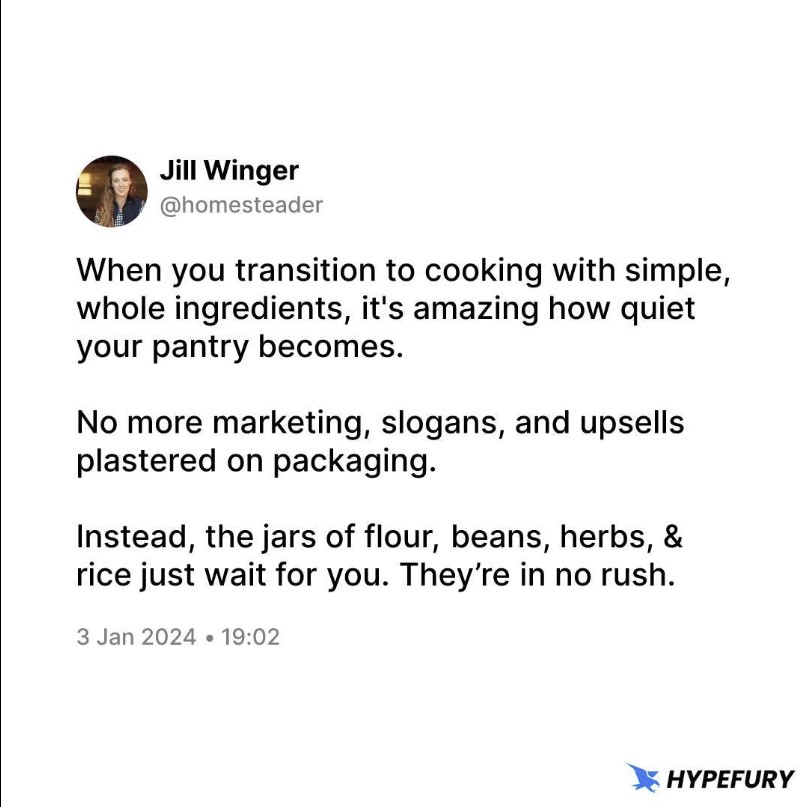
Well, to be honest, I didn’t know what a quiet pantry was until I had one. Jill Winger over at The Prairie Homestead nailed the one feeling that I have been coming back to over the last several months. But I just couldn’t put my finger on why I felt so much better opening my cabinets. My pantry, now full of jars of rice, soups, dehydrated veggies, and many more simple ingredients, had become quiet.

As I look at my pantry, I don’t see the hydrogenated oils masquerading as cheese. Or quick boxes of pasta that somehow only needed a few ingredients from me to turn into a “delicious” meal. I no longer see “quick”, “easy”, or “ready to serve” keywords jumping out at me. The bright packaging has been replaced by clear jars. Where you can clearly see what you are getting. And as odd as it is, the stress of figuring out what’s for dinner has just about vanished.

Now, I am not the type of person to throw out food. I will continue to use it until it’s gone or I will give it to the chickens. But over the last several months, there are less of those keywords in my pantry. It’s so cool, opening my cupboards and seeing jars and jars of dried beans, flour, rice, and other simple ingredients. And the fact that I know how to cook with them!

If you are new to heating with firewood and are looking to master the finer points of it. We’ve got a great eBook that goes in depth of what tools you should consider, how and where to stack, how to build a fire and so much more!

Buy Now

When I tell you that figuring out what to do for dinner has gotten easier, it really has. But not in the way you’re probably thinking. When you get stuck in the drag of “quick”, “easy”, or “ready to eat” your creative energy gets stuck in neutral. I’ll go over more of that below.

Quieting The Pantry Has Extended To The Fridge

I am a coffee junkie. Actually, to be fair, I am a creamer junkie. I absolutely love flavored creamers. My favorite was Cinnamon Toast Crunch from Coffee Mate. But in 2021-2022 it was difficult to find, then as time went on, it was harder and harder to find other creamers that I liked. I will make my own creamers from goat milk, but if I don’t have goat milk, I don’t have creamer. When I got sick in October, I knew that the first thing to go needed to be the creamer.

goat kidding

Before we get too far into this, I have a great course on the basics of goat care. I call it Goat Crash Course: Goat 101. In this course, I explain things like types of shelter, types of feeds and hays, basic assessments and so much more! Check it out!

Buy Now

Why? Well, most commercial, flavored creamers are not actually diary. Those creamers are mostly oil and most oils are made from either soy or corn…. Do I need to go on?

After cutting the creamer, I started really looking at the rest of the stuff in the fridge. Y’all, I didn’t realize how much junk was in my fridge. Looking past the creamer, we also had a ton of sauces, marinades, and other processed stuff. It really opened my eyes to just how much junk we were still consuming. But it also clued me in to how much we were still relying on the store for things that I can make.

And The Freezer!

I don’t know how your freezer looks. But in our freezers, it looks like about 90% meat. But there are still a fair amount of packing. Not as much as it could be, and it’s definitely a lot better than what I was expecting. But realizing just how much of the non-meat products in there were probably not good for us either. I love frozen corn, but the vast majority of corn bought from a store is going to be GMO. I don’t think I need to go in depth about why that isn’t ideal….

The Ultimate Homesteader’s Starter Bundle – Only $47!

Get the tools you need to stay organized, track profits, and manage your homestead with ease!

Includes:
✅ Schedule F Tracker – Simplify tax prep
✅ Profit Calculator – Track earnings
✅ Hay Calculator – Plan livestock feed
✅ Garden Journal – Digital & printable
✅ Herd Health Tracker – Monitor animal care
✅ Simple Budget – Manage finances
✅ Backyard Homestead eBook – Essential tips

$99 value – now just $47! Start your homesteading journey today!

Buy Now

Freeing Your Creative Energy

When you allow the quieting of the pantry to actually take affect, it forces you to become more creative with dinner. And as weird as it sounds, it makes figuring out what’s for dinner a lot easier. For example, you can transform basic rice into chicken flavored rice with chicken bullion or stocks. Add in some peppers, beans and corn (non-gmo of course) and you’ve got dirty rice. Throw in some shredded chicken or andouille sausage and you’ve got a meal.

By giving yourself the creativity to make dinner fun, you end up with some really fun recipes that are quick, easy, and HEALTHY!

Last night, we had chicken tacos. They were absolutely delicious and not one thing came out of a box, can or packaging. No taco seasoning packets, plastic wrapped tortillas, or box and packet of flavoring for the rice.

The other really cool thing about having these very basic staples in your pantry is that when you know you’ve got something getting ready to go bad, you can plan a meal around it. Or you just need to use up the very last of this item, you can just throw it in the pot. To give you an example, every week I make a Brunswick stew style dinner. This is literally any fresh produce that is about to turn, or the very last bit of dehydrated leeks that need a home.

cropped-3.jpg

Are you looking for garden journal prompts, but aren’t interested in a weekly email? Check out our 365 Garden Journal Prompts! This is an amazing, all in one, yearly product that you only pay for once.

Buy Now!

Grocery Shopping Is Cheaper!

For years, we have been conditioned to think that eating from scratch or “healthy” is too expensive. And yes, it can be. When you are talking about getting two weeks worth of groceries and half of your meals are “quick”, “easy”, or “ready to eat”, yea it’s going to be more expensive. Or when $75 of your food budget goes to creamer **raises hand** yes, it’s going to get expensive.

Since the quieting in the pantry, I have cut our grocery budget in half. Now, some of that is because we have bulk purchased rice, beans, sugar, etc. But the other part of that is because I am more deliberate in what I am buying. I am not buying prepackaged meals, or cans of soup. We are also using more meat instead of filling the plate with over processed junk.

Quieting The Pantry Takes Time

You can absolutely go nuts and clean out the pantry, fridge and freezer. Or you could slowly use everything up. I’m not going to tell you how to cook your dinners. But I will say that if you are not a strong cook, it can be VERY difficult to move away from packaged foods and dinners.

To be honest, I’m kind of in between a strong cook and great cook. There are a lot of meals that I do really well… Tacos for example. But there are still others that I am learning. When you walk into ANYTHING that you are learning, please give yourself grace. Your dinner may not look just like the recipe. That’s okay! Just don’t give up!

If you like the content I put out, feel free to buy us a coffee! It helps keep this site running, marketing and the goats in grain!

Buy me a coffee

If you like this post, feel free to share it and follow us below on our social media accounts!
  • Facebook
  • Pinterest
  • Instagram
  • YouTube
  • TikTok
  • Spotify
  • Threads

Filed Under: Working With Food Tagged With: cooking, Eggs, Goats, Homestead

JOIN TO OUR MAILING LIST!

Leave us your email to receive new posts and special offers for members only! Don't miss a thing!

Recent Posts

  • Fall Garden Guide
  • Top Mistakes With Goats
  • How To Bond With Your Goats

Dealing With Death On The Homestead

February 9, 2024 by Leigh 4 Comments

I really struggled with writing this post. I am the person that takes an animal death way harder than a human one. I don’t know why, maybe it’s my job or that I have attachment issues. But when an animal dies, I am a sobbing mess. It hurts in ways that I can’t describe. If you are reading this post, you probably feel similar. While death is a normal part of life, there is no easy way to handle it. Dealing with death on the homestead for those of us that feel it deeper, it’s a lot harder.

The Ultimate Homesteader’s Starter Bundle – Only $47!

Get the tools you need to stay organized, track profits, and manage your homestead with ease!

Includes:
✅ Schedule F Tracker – Simplify tax prep
✅ Profit Calculator – Track earnings
✅ Hay Calculator – Plan livestock feed
✅ Garden Journal – Digital & printable
✅ Herd Health Tracker – Monitor animal care
✅ Simple Budget – Manage finances
✅ Backyard Homestead eBook – Essential tips

$99 value – now just $47! Start your homesteading journey today!

Buy Now

Dealing With Death On The Homestead

We have lost more than our share of animals on the homestead and it never gets easier. We have lost goats, chickens, our dogs, and today a duckling. To be honest, the duckling was up there with the goats. I have always wanted a duck and now that I finally have 20, it tears my heart to know that she died. But knowing why they died and how to prevent it really helps me heal from it.

Dealing with death on the homestead is understanding that livestock are not pets. But it’s also understanding that animals will die. While that doesn’t absolve the guilt or heartache, understanding that when you farm you are going to do everything you can, and animals will die anyways. But at the same time, knowing that you are going to do everything in your power to help anyways.

goat kidding

Before we get too far into this, I have a great course on the basics of goat care. I call it Goat Crash Course: Goat 101. In this course, I explain things like types of shelter, types of feeds and hays, basic assessments and so much more! Check it out!

Buy Now

Understanding The Role Of Your Animal

While this may seem odd, when you understand the role of your animal, it really helps you plan their existence. For example, when we purchase meat birds, we know that their role is to end up in the freezer. That means that we will do everything in our power to make sure that every single day of their lives are as happy and humane as possible. But we are not going to take a meat animal to the vet and waste resources.

However, our milk goats have a role too. Their role is to provide milk and future meat animals. That means that when they are no longer filling their role, we have to make the decision to sell or butcher. During their time on the homestead, we will take them to the vet as needed and care for them to make sure they are happy, healthy and raised humanely.

Because you understand the role of your animal, it allows you to make decisions based on the role vs your need to care for animals as pets or companion animals. It sounds heartless, but you have to decide if you are a homestead or animal rescue.

Why the Why is so important

When you know why an animal died, not only does it help you from a practical stand point, it also helps you heal. I think that it’s because it can be a learning opportunity or simply because it absolves guilt. Either way I think it helps us heal while dealing with the death of our favorite animals.

Texas was my favorite goat. He was unbelievably vocal and would sing to me every time I came home from literally anywhere. Whether I was gone for a 24hr shift or a ride to the grocery store, it was always the same. He would bleat at me until I came to love on him. That was the best part of coming home.

He died because of polio. Goat polio is different from human polio but basically it is caused by thiamine deficiency or sulfur toxicity. My lack of knowledge and lack of medicines on hand did not help him and killed him. As unfortunate as it was, and as much as I beat myself up about it, there is a bright spot. No other goats will die because I didn’t know what I was doing.

Voldemort was our first goat that died. His was due to an extremely high parasite load. He had an unbelievable amount of barber pole worm, strongyle worms, and coccidia. It took us several days to realize that he was as sick as he was. When we got him to the vet, she told us that he was probably going to die. The worm load was just too high. If he didn’t die from the worm load, the internal bleeding of the worms suddenly being gone would kill him. We did everything we could but he still died.

With both goats, I poured over hundreds of articles, consulted with our vets and came up with a plan for future treatment. It will never bring back our babies, but at least now we know what to do, what to look for, and what to do to keep it from happening.

Learning From Mistakes

We have lost several chickens for several reasons; overcrowding, mareks, and predators. But we are learning how to raise our chickens in the best environment for them. They have plenty of access to open pasture. They are vaccinated from the hatchery for mareks. We keep an eye on their general condition to make sure that we catch potential injury or illness before it becomes a problem.

But today, we lost a duckling. It broke my heart. I tried everything I could think of but it was simply too late. Unfortunately, we don’t know why or how. We’ve got another one that is going down the same path but we are trying everything we can.

This is life though. Even more to the point, this is homestead life. Animals will die. Whether it’s because they are meat or because they are sick, hard labors, failed hatches, and more. It happens and it hurts.

My Advice For Dealing With Death On The Homestead

The best advice I can give you is don’t give up. Yes, it is hard and some days it doesn’t seem worth it. But I promise you it is. It’s worth the heartache for the good days. I would not give up a single second of owning goats because we lost Texas and Voldemort. I will always own dogs, despite having lost so many. The good out weighs the bad, every single time.

My second piece of advise is to honor their life. It doesn’t matter if they are meat animals or a beloved pet. It doesn’t matter if they’ve been with you for twenty years or twenty minutes, that life needs to be honored. If you can, have a cemetery for them. We have an old corral that we will never use and it is perfect. Baby bearded dragons, chicks, goats, and even toads that the dogs have killed go in there and get a flower seed planted with them. That is how I honor them.

goat kidding

Before we get too far into this, I have a great course on the basics of goat care. I call it Goat Crash Course: Goat 101. In this course, I explain things like types of shelter, types of feeds and hays, basic assessments and so much more! Check it out!

Buy Now

If you like the content I put out, feel free to buy us a coffee! It helps keep this site running, marketing and the goats in grain!

Buy me a coffee

If you like this post, feel free to share it and follow us below on our social media accounts!
  • Facebook
  • Pinterest
  • Instagram
  • YouTube
  • TikTok
  • Spotify
  • Threads

Filed Under: Animals Tagged With: Chickens, Chicks, duckling, Goats, Homestead

JOIN TO OUR MAILING LIST!

Leave us your email to receive new posts and special offers for members only! Don't miss a thing!

Recent Posts

  • Fall Garden Guide
  • Top Mistakes With Goats
  • How To Bond With Your Goats

What Do I Do With Bucks?

January 30, 2024 by Leigh Leave a Comment

Depending on how you run your homestead, you may start to realize that your male livestock and poultry don’t have a long life span. Or, maybe you aren’t used to the livestock way of life and are really struggling with the idea of butchering the males. Either way, you are probably asking yourself, “What do I do with bucks?” And the real answer is one that you may not like or it may not fit with your ideals. But I’m going to tell you what I do with my bucks.

What do I do with Bucks

Two goat kids in a field
goat kidding

Before we get too far into this, I have a great course on the basics of goat care. I call it Goat Crash Course: Goat 101. In this course, I explain things like types of shelter, types of feeds and hays, basic assessments and so much more! Check it out!

Buy Now

What Do I Do With Bucks?

Well, this entirely depends on your homestead goals, philosophies and needs. And that is something that you need figure out BEFORE you start breeding. Seriously, don’t get livestock or poultry and then not know what you are going to do with the animals. You will end up in a world of hurt. Ask me how I know.

Some of the ways that we handle the bucks on our farm is selling, castrating, and butchering.

Selling Bucks

We always try to sell any bucks that we don’t need for next seasons breeding cycles. But there are two very important criteria that have to be met before selling an uncastrated buckling. One, he has to come from good, hardy, proven lines. Two, he has to have good conformation, size, and disposition. If he doesn’t meet those criteria, he is castrated.

We do everything in our power to only sell uncastrated males that hit those criteria. The reason why those criteria are so important to us is the heavy losses we have sustained on our farm due to unhealthy kids and weak genetics. We don’t want to spread that to other farms. It has taken years for us to finally get our herd genetics figured out and sending out weak goats isn’t something I’m interested in.

If for some reason, we cannot sell a solid and healthy buckling by ten weeks, he is castrated.

goat kidding

Before we get too far into this, I have a great course on the basics of goat care. I call it Goat Crash Course: Goat 101. In this course, I explain things like types of shelter, types of feeds and hays, basic assessments and so much more! Check it out!

Buy Now

Castrating Bucks

If we cannot use a buck on our farm, we cannot sell him, or he doesn’t meet our criteria, he is castrated. We do this by banding around ten to twelve weeks and putting him in the buck pen. If he met our criteria but we couldn’t sell him, then we attempt to sell him as a wether or pet. Unfortunately, bucks and wethers are not as sought after as does. So this happens a lot.

I don’t want to sell any inferior goats. Goats have become increasingly fragile for a lot of reasons like; overbreeding, poor genetics, breeders just trying to make a dollar, and overuse of medical interventions. Because of all these things, it’s really hard to guarantee the health of a goat. Weak goats don’t make it through winter and you are stuck digging a hole in the frozen ground.

So to keep from spreading weak genetics, we are very strict when it comes to who is leaving our farm.

Butchering Bucks

Unfortunately, we cannot afford to feed a bunch of goats that don’t have a purpose. It’s the reality of farm life. And it HURTS! I didn’t grow up like this and I still struggle with the idea of culling members of the herd. But it’s part of responsible breeding and, PLEASE, breed responsibly. Goats are so fragile to start with and irresponsible breeders are out there just selling kids to make a dollar. That’s not doing anything to improve the situation.

When it comes to deciding who gets butchered and who stays, we have made it easy on ourselves. Well, as easy as this decision can be. If the buck doesn’t meet our criteria, he is castrated and will be butchered. If we are not using him for breeding, he gets sold. If we can’t sell him by ten to twelve weeks, he is castrated. If we cannot sell him as a wether, he is butchered.

Unfortunately, this is the life we lead.

The Ultimate Homesteader’s Starter Bundle – Only $47!

Get the tools you need to stay organized, track profits, and manage your homestead with ease!

Includes:
✅ Schedule F Tracker – Simplify tax prep
✅ Profit Calculator – Track earnings
✅ Hay Calculator – Plan livestock feed
✅ Garden Journal – Digital & printable
✅ Herd Health Tracker – Monitor animal care
✅ Simple Budget – Manage finances
✅ Backyard Homestead eBook – Essential tips

$99 value – now just $47! Start your homesteading journey today!

Buy Now

Our Does Get The Same Treatment

And just so everyone is clear, this is the same criteria we use for our does. Just without the castration part. If a doe requires deworming, we don’t breed her and she will go to the butcher. If she is sickly, she gets butchered. We don’t try to sell our does as a rule. The main reason is we want the milk.

If she doesn’t fit our requirements, there’s a really good chance she isn’t a solid goat and we don’t want to put out inferior goats. Maybe in a few years, when we have our established lines and have enough milk goats, we will think about selling our does. But for right now, we are standing by our standards.

Dealing With The Emotions Of These Decisions

I will say it again, we didn’t grow up like this. We were taught from a young age that you care for animals. You don’t kill them because they don’t “meet your criteria“. You get your meat from the grocery store like everyone else. I talked extensively about livestock are not pets in this blog post, and it’s very hard to stand by these criteria and make these decisions.

This whole situation and subsequent conversations, can create a very difficult and emotional rollercoaster ride. But I have found that when you pick a goal, set perimeters for that goal, and measure EVERYTHING against that goal? It makes these decisions a LOT easier.

But don’t get it twisted, it’s still hard.

If you are new to heating with firewood and are looking to master the finer points of it. We’ve got a great eBook that goes in depth of what tools you should consider, how and where to stack, how to build a fire and so much more!

Buy Now

Since getting into goats, we lost at least two goats a year until we implemented this criteria. We lost beloved pets because we didn’t want to make the hard decisions. We bred for milk, not for healthy kids. We thought overusing medical interventions was normal.

We did it wrong

Since making the decision that we were going to breed for hardiness first, then milk, then meat, we have had a lot less death on the homestead. We have placed beloved goats on the cull list, and it’s a hard decision to make. It feels terrible to take them to the slaughter house, but I will NOT sell inferior goats. Because I will not be part of the problem.

What’s more heartbreaking? Losing a goat to the cold because she wasn’t strong enough to survive it or butchering a goat that was raised in a healthy, happy, loving environment?

Is it better to perpetuate a vicious cycle of over deworming or only breed hardy, parasite resistant goats?

Is it better to make a dollar on any kid, or only produce top notch animals that don’t require medical intervention?

These are all decisions that you will HAVE to make if you are getting into livestock that will have a purpose. I’m not going to say that either side is right or wrong. I AM going to say that when we are making decisions on our farm, these are some of the questions we ask ourselves.

Because we are tired of sickly goats that don’t survive winter. We are tired of digging new holes in the pet cemetery.

If you like the content I put out, feel free to buy us a coffee! It helps keep this site running, marketing and the goats in grain!

Buy me a coffee

If you like this post, feel free to share it and follow us below on our social media accounts!
  • Facebook
  • Pinterest
  • Instagram
  • YouTube
  • TikTok
  • Spotify
  • Threads

Filed Under: Animals, Goats, Homestead Planning Tagged With: Butchering, Freezer, Goats, Homestead, meat goat

JOIN TO OUR MAILING LIST!

Leave us your email to receive new posts and special offers for members only! Don't miss a thing!

Recent Posts

  • Fall Garden Guide
  • Top Mistakes With Goats
  • How To Bond With Your Goats

Livestock Are Not Pets

January 20, 2024 by Leigh Leave a Comment

If you did not grow up on a farm or with livestock animals, it may be a foreign concept of raising animals for meat. It could bother you that people, like myself, butcher animals for meat. It’s difficult for a lot of people to wrap their mind around the fact that I can genuinely love my animals, yet I’m still able to put them in the freezer. But that’s because I have realized that livestock and poultry are not pets and that helps a lot. Before you click off this blog post, stick with me and I will explain more about how people can raise an animal and then butcher it. Maybe then, you can understand why people like me choose to raise our meat.

goat kidding

Before we get too far into this, I have a great course on the basics of goat care. I call it Goat Crash Course: Goat 101. In this course, I explain things like types of shelter, types of feeds and hays, basic assessments and so much more! Check it out!

Buy Now

Livestock Aren’t Pets

Now, you can absolutely have livestock animals that you bought with the sole purpose of it being a pet. But before we get too far down this rabbit hole, we need to discuss some things first. Like, the definition of livestock and poultry, what is a companion animal, why people choose to raise their own meat, and why we need to respect those decisions.

Remember, stick with me! Don’t get upset and storm off because you don’t like what I have to say. I mean, obviously you can, but if you truly want the answer to “how can you slaughter something you raised” stick around and find out.

What Is Livestock And Poultry

The Oxford Dictionary defines livestock as “Domestic animals kept on a farm for use or profit; esp. cattle, sheep, and pigs.” And poultry as “Domestic fowl collectively; birds which are commonly reared for their flesh, eggs, or feathers, as chickens, ducks, geese, turkeys, etc.“

The reason this is important is that a lot of people confuse ALL animals with pets or companion animals. They think that all animals that are kept by people should be raised but not butchered. Because that is the lens in which they see animals. They’ve never been on a farm or raised an animal knowing that it’s entire purpose is to end up in the freezer.

Which makes me wonder who they think raises the meat they get at the grocery store?

What Is A Companion Animal

I’m not going to pull out the dictionary for this one but I define a companion animal as a pet. This could be a dog, cat, gerbil, or even a pig or goat. And we have PLENTY of these on the homestead. These animals don’t really have a job, they aren’t an asset or really have a use other than companionship.

Champ is a goat and companion animal. She will live out the rest of her days here on the farm with no use. When she dies, she will be cremated. BUT she started out as livestock. Her original purpose was to give us milk and babies and she did that. Now that she is older, she has earned her retirement.

But what a lot of people don’t seem to understand is that my herd, and most peoples herd, of goats are not companion animals. They have a purpose: Milk, Money or Meat. While I don’t WANT to butcher any of my goats, I know that it is a reality that I will have to deal with. Especially because I want milk.

BeBe and Rory are not companion animals, they are livestock. They will be butchered as soon as they hit 75# or we head into winter, whichever comes first.

Answering Questions With Questions

To answer the question of why we raise our own meat, the answer is another question, actually a couple. Have you ever seen where livestock is raised? I’m not talking about the fields dotted with cattle and chicken or woods with pigs. I’m talking the pig houses, chicken houses or CAFOs. Have you seen what those animals are fed? Do you know where that feed comes from? Do you have any knowledge of ruminant biology?

I don’t ask these questions to be rude or nasty. I ask them because if you have never seen any of those things, I can understand why you would be confused. I can understand why you ask “why raise your own meat?”

Why We Raise Our Own Meat

Now, to be completely transparent, we don’t raise cow or pig on the homestead. We tried to raise pigs and it was a colossal failure meat-wise. We will try again when we are in a better position…maybe. But we do raise our own chicken and goat. That may not seem like a lot, but we just don’t have the infrastructure to raise cows yet. Building pasture for cattle and goats is a big goal for 2024.

In the mean time, we source our beef from a local farm that raises grass fed beef. We source our pigs from someone who raises pasture pork. We purchase meat in bulk instead of relying on the grocery store.

The reason is because we want the animals that are being raised for meat, to be animals. Pigs root and wallow. Cattle should walk around and eat grass. Chickens should scratch and peck. Goats should scream and eat grass. That is what they are SUPPOSED to do.

Industrial Agriculture

Industrial agriculture has created these confinement systems to hold huge groups of animals together, feed them low grade antibiotics and grains, pack them onto trailers and send them to the processor.

The amount of stress those animals endures is not okay. In fact, it’s inhumane. Animal welfare is not at the top of industrial agriculture’s list of priorities.

Like most homesteaders, I choose to source or raise the meat my family is going to consume as humanely as possible. I want animals that are raised as natural a diet as possible. I want animals that have only one bad day.

Respecting Decisions

I’m not sure when we became a country that isn’t allowed to have differences of opinions. But what I will say is that no matter where you fall on the meat eating/ raising spectrum you fall on, respecting other’s decisions is a key part of being an adult. If a person chooses to only source their meat from local farms, great. If a person decides to go to the grocery store, great…. I don’t have to like it.

I can desperately want to take them to the different chicken farms around here and show them how these animals are raised, shoved into cramped boxes, transported in the rain, heat, etc. I want show them where these animals are unloaded and butchered.

But I can’t do that. I have to respect their decision.

But the beautiful thing about a blog?

I can also show you my operation. I can show you transparency.

I can talk about all of the crazy things my chickens and goats do.

In doing those things, my hope is that you make the decision to source your food locally. From farmers who really do love their animals, instead of industrial ag….

If you like the content I put out, feel free to buy us a coffee! It helps keep this site running, marketing and the goats in grain!

Buy me a coffee

If you like this post, feel free to share it and follow us below on our social media accounts!

  • Facebook
  • Pinterest
  • Instagram
  • YouTube
  • TikTok
  • Spotify
  • Threads

Filed Under: Animals Tagged With: Ducks, ethical meat, Goats, Homestead, livestock

JOIN TO OUR MAILING LIST!

Leave us your email to receive new posts and special offers for members only! Don't miss a thing!

Recent Posts

  • Fall Garden Guide
  • Top Mistakes With Goats
  • How To Bond With Your Goats

Episode 19: End Of A Season (2023)

January 12, 2024 by Leigh Leave a Comment

Other Episodes

The Reason You NEED A Seed Inventory!!!!
The Reason You NEED A Seed Inventory!!!...
Rarely, will I tell you what you NEED to do. In fact, I live my life by your kitchen, your family, your land, YOUR...
00:10:22
February 01, 2024
Let's Look At The Benefits of Seed Starting
Let's Look At The Benefits of Seed Star...
Seed starting can be pretty intimidating. But it's probably the easiest part of gardening. Sure, you can purc...
00:19:53
January 30, 2024
February Garden To-Do List: Essential Chores for a Successful Garden
February Garden To-Do List: Essential C...
Hey Guys! It’s Leigh with Steel Raven Farms! On this podcast, we talk about all the trial and error, successes ...
00:34:45
January 26, 2024

Filed Under: Podcast Episodes Tagged With: Eggs, Garden, Goats, homesteading, Podcast, vegetables

JOIN TO OUR MAILING LIST!

Leave us your email to receive new posts and special offers for members only! Don't miss a thing!

Recent Posts

  • Fall Garden Guide
  • Top Mistakes With Goats
  • How To Bond With Your Goats
  • « Go to Previous Page
  • Page 1
  • Interim pages omitted …
  • Page 5
  • Page 6
  • Page 7
  • Page 8
  • Page 9
  • Page 10
  • Go to Next Page »

Primary Sidebar

WELCOME

WELCOME

My name is Leigh and I am the lead chaos creator here at Steel Raven Farms. You will see throughout this blog that I am the crazy goat lady.

I am married to my high school sweetheart, Jared and we have two amazing boys.

FOLLOW ME

  • Amazon
  • Facebook
  • Instagram
  • Pinterest
  • TikTok

GET UPDATES!

Leave us your email to receive new posts and special offers for members only! Don't miss a thing!

In all the years that I’ve been growing a garden, the fall garden has steadily remained my favorite. Which is funny because I don’t really like any of the brassicas, which is what most people know the fall garden for. I prefer the root vegetables and cool air. But I have learned over the years…

Read More

  • Animals
    • Chickens
    • Farm Dogs
    • Goats
  • Garden
    • Compost
    • Garden Projects
    • Seeds and Plants
    • Garden Journal
    • Working With Food
      • Recipes
      • Freezing Foods
      • Dehydrating Foods
      • Canning Tips And Tricks
        • Canning Inventory Sheets
  • Helpful Info
    • Welcome to the Homestead!
    • Emergency Preparedness
    • Frequently Asked Questions
    • Goal Setting
    • Project List
    • Shop Digital Products
      • Hay Calculator
      • Farm Expense And Income Tracker
      • Goat Crash Course: 101
      • Garden Journal Prompts
      • Schedule C Tracker
      • Schedule C Tracker
      • The Homestead Bundle
  • The Truths
  • Episode List
  • Start Here
    • Privacy Policy
    • Affiliate Disclosure
    • Let’s Get in Touch
    • Members Only Library
    • Welcome To Our Homestead

Footer

  • Email
  • Facebook
  • Instagram
  • Pinterest

COME AND GET IT!

Leave us your email to receive new posts and special offers for members only! Don't miss a thing!

· Midnight Theme

Copyright © 2026 · Midnight Theme on Genesis Framework · WordPress · Log in