• Skip to primary navigation
  • Skip to main content
  • Skip to primary sidebar
  • Skip to footer

Steel Raven Farms

Where muck boots meet ground.

  • Animals
    • Chickens
    • Farm Dogs
    • Goats
  • Garden
    • Compost
    • Garden Projects
    • Seeds and Plants
    • Garden Journal
    • Working With Food
      • Recipes
      • Freezing Foods
      • Dehydrating Foods
      • Canning Tips And Tricks
        • Canning Inventory Sheets
  • Helpful Info
    • Welcome to the Homestead!
    • Emergency Preparedness
    • Frequently Asked Questions
    • Goal Setting
    • Project List
    • Shop Digital Products
      • Hay Calculator
      • Farm Expense And Income Tracker
      • Goat Crash Course: 101
      • Garden Journal Prompts
      • Schedule C Tracker
      • Schedule C Tracker
      • The Homestead Bundle
  • The Truths
  • Episode List
  • Start Here
    • Privacy Policy
    • Affiliate Disclosure
    • Let’s Get in Touch
    • Members Only Library
    • Welcome To Our Homestead

Chickens

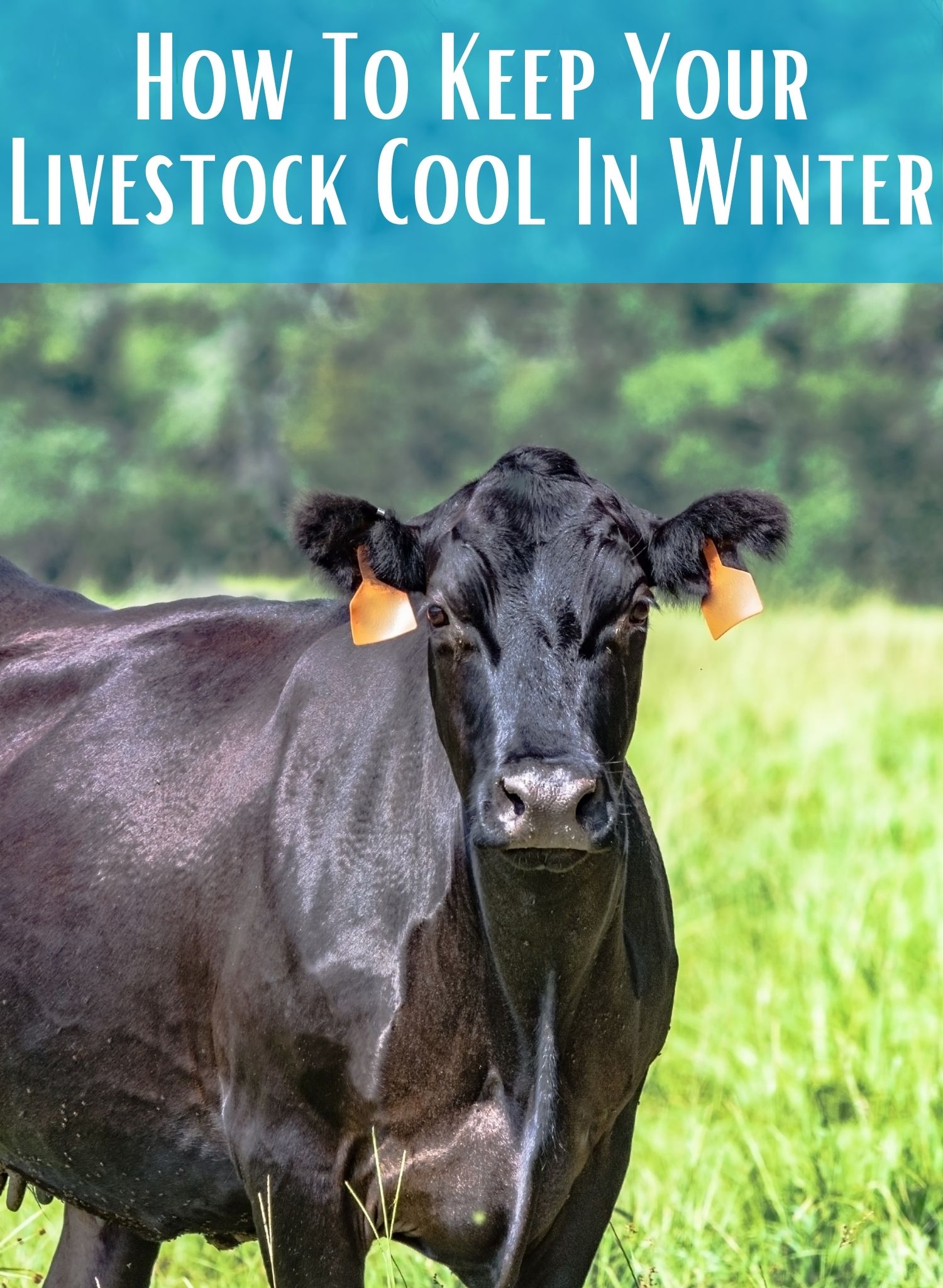
How To Keep Your Livestock Cool In Summer

April 30, 2024 by Leigh 7 Comments

It’s hot, humid and over all icky to be outside in Georgia right now. I’m pretty sure it’s the same everywhere, but I feel like Georgia slowed down to pass the state trooper and decided to “open ‘er up” once it was clear. It went from comfortable mid to upper 70’s to devil’s armpit in less than 24 hours. Not to mention we came back from Yellowstone where it was a balmy 40*! We were a little climate shocked to say the lest. Oh, and our AC doesn’t work, so we are having to use fans and window units. But what do you do with the animals that can’t come inside? How do you keep your livestock cool in summer?
Before we get too far into this, I have a great course on the basics of goat care. I call it Goat Crash Course: Goat 101. In this course, I explain things like types of shelter, types of feeds and hays, basic assessments and so much more! Check it out!

Buy Now

Keeping Your Livestock Cool In Summer

It doesn’t really matter if you have cattle, sheep, goats, chickens or just dogs and cats. There are universal truths about how to keep your livestock cool in summer that can actually keep them alive. Some are basic “Duh’s” but some of these may be new to you.

Clean Water

Every single day, multiple times a day, you need to be out there checking to make sure that they have plenty of cool water. Depending on your watering system this may just be a couple buckets in the shade. Or maybe a water trough that has a frozen gallon milk jug in it.

Regardless, it needs to be clean and fresh every single day. We have these 5 gallon buckets for our goats and we have four of them throughout the pastures and fill them on average 3x a day. On the super hot or humid days we will fill the buckets part of the way with ice to help keep the water cool. We are also planning on getting a 50 gal stock tank once the current kids are a little bigger.

Shade

It is so important for any animal or human to have access to shade when they are outside. Nothing will dehydrate an animal (including humans) quicker than being stuck in the hot sun with no shade. If you don’t have access to shade for your animals, or their shelter is in the sun, you can grab a couple of shade canopies for less than $40 depending on the sizes you choose.

We are lucky enough that all three pastures have a ton of shade so we don’t need the canopy but I would definitely look into it if you don’t.

    Electrolytes

    All animals require electrolytes, but in the summer it is especially important to have more on hand. We buy these, but have also bought Bounce Back, and Electrolytes Plus. Remember that not all electrolytes are equal. I use Bounce Back as my standard and as long as the other brands are close, I’ll buy it in a pinch.

    I will say, right now Bounce Back is expensive on Amazon but pretty affordable at Tractor Supply. Also, as a side note, Electrolyte Plus WILL FIZZ! You have been warned. I still have orange goat-r-aid on my ceiling.

    We usually will put a 5 gallon bucket out of electrolytes and then another with regular water. As we refill buckets throughout the day, we don’t add anymore electrolytes and let it get watered down. The next day we dump and refill

    Keep Their Coats Clean

    Much like with dogs, if their coat is matted, clumped, or dirty, they will have a hard time staying cool. The breeze, if there is one, can not get through to their skin. That will trap heat and cause them to get or stay hot. We brush out their winter coats, if they haven’t already blown them, when the weather maintains 70*. We also give their hooves a good trimming as well. This is also the time that they get any meds, copper bolus’, and vaccines.

    Be careful when using water to cool your animals! I know they seem hot, but when you get their coats wet, it will trap all that body heat to them.

    Also, unless your animals needs to be sheared, do not shave your animal! It doesn’t matter if it is a dog, cat, cattle, etc I have found it does more harm than good. I’ve got dogs with double coats and yes, I see them panting, but I know that the minute they get shaved, they have lost the ability to regulate their temperatures.

      Air Flow

      We all know that when it gets hot, we just want a breeze to blow through to cool us off. If you live in an area that doesn’t get a lot of wind or air movement, consider getting a solar powered fan. You can pick the size that you need but the end result is the same, get the air moving. If you’ve got electricity in your barn, then get a bigger fan. Your goats will thank you.

      Cold Treats!

      We freeze fruit and veggies in muffin tins with water. This gives them a cold treat on hot days. We have also frozen whole watermelons, cantaloupes, etc. We do this mostly for chickens but the goats love them too.

      Make sure whatever you are giving you animal, they are allowed to eat!

        But what if they get too hot?

        Much like dogs, goats will pant when they get too hot. Unlike dogs, however, this is kind of a last ditch effort in cooling themselves down. If they are panting, you need to start working to get them cooled down, right now.

        What are some signs and symptoms of a hot goat? Panting or labored breathing, poor FAMACHA, lethargic, high temperature, etc.

        In the post about what to have on hand for goats, you need to first get a rectal temperature. Their temps should be between 101-102ish. A little higher or lower is not a big deal but more than a degree in either direction needs to be monitored. More than 2 degrees and you need to start warming or cooling.

        Then check their FAMACHA. The card below will show you how to do it and what the color is. The FAMACHA tells you if they are anemic or not. If they are anemic, they do not have the blood volume necessary to handle stress well. If they can’t handle stress, like a heat emergency, they are less likely to bounce back. There is MUCH more to a FAMACHA than this, but for the sake of this post, a score under 3 is going to require a lot more care to get them healthy.

        FAMACHA Card

        Next, get bottoms of their legs in some cool (not cold) water. We don’t want to shock their system but we need to get them cooling down quickly. But do not lay them down in the water. The problem is that their fur will act like a wet blanket and keep all that heat inside. Instead, only put cool water on “bare” skin like the utters, belly, or behind their knees. All areas were their coat should be thinner.

        I bring cold, hot, or otherwise sick goats in the house. My house is relatively comfortable, despite the lack of an HVAC system. This will passively cool them. You can also put them in your bath tub to ensure they are getting cool water in a place that is designed to get wet.

        Tractor Supply

        Also, try to get some cold water into them, if they won’t drink it then you need to drench them. Recheck their temperature every five minutes or so to make sure they are cooling down. We don’t want that temperature to go too low because then we have to start warming them back up.

        Keep at it until their temperature comes down. And it should come down. Hot things will generally cool off when cold things are put on them. The most important thing is to move with a purpose but without shocking the goat.

        If you like the content I put out, feel free to buy us a coffee! It helps keep this site running, marketing and the goats in grain!

        Buy me a coffee

        If you like this post, feel free to share it and follow us below on our social media accounts!
        • Facebook
        • Pinterest
        • Instagram
        • YouTube
        • TikTok
        • Spotify
        • Threads

        Filed Under: Animals, Chickens, Goats, How To's, Pigs Tagged With: Chickens, Goats, Summer

        JOIN TO OUR MAILING LIST!

        Leave us your email to receive new posts and special offers for members only! Don't miss a thing!

        Recent Posts

        • Fall Garden Guide
        • Top Mistakes With Goats
        • How To Bond With Your Goats

        A More Realistic Way To Raise Meat Chickens

        April 27, 2024 by Leigh Leave a Comment

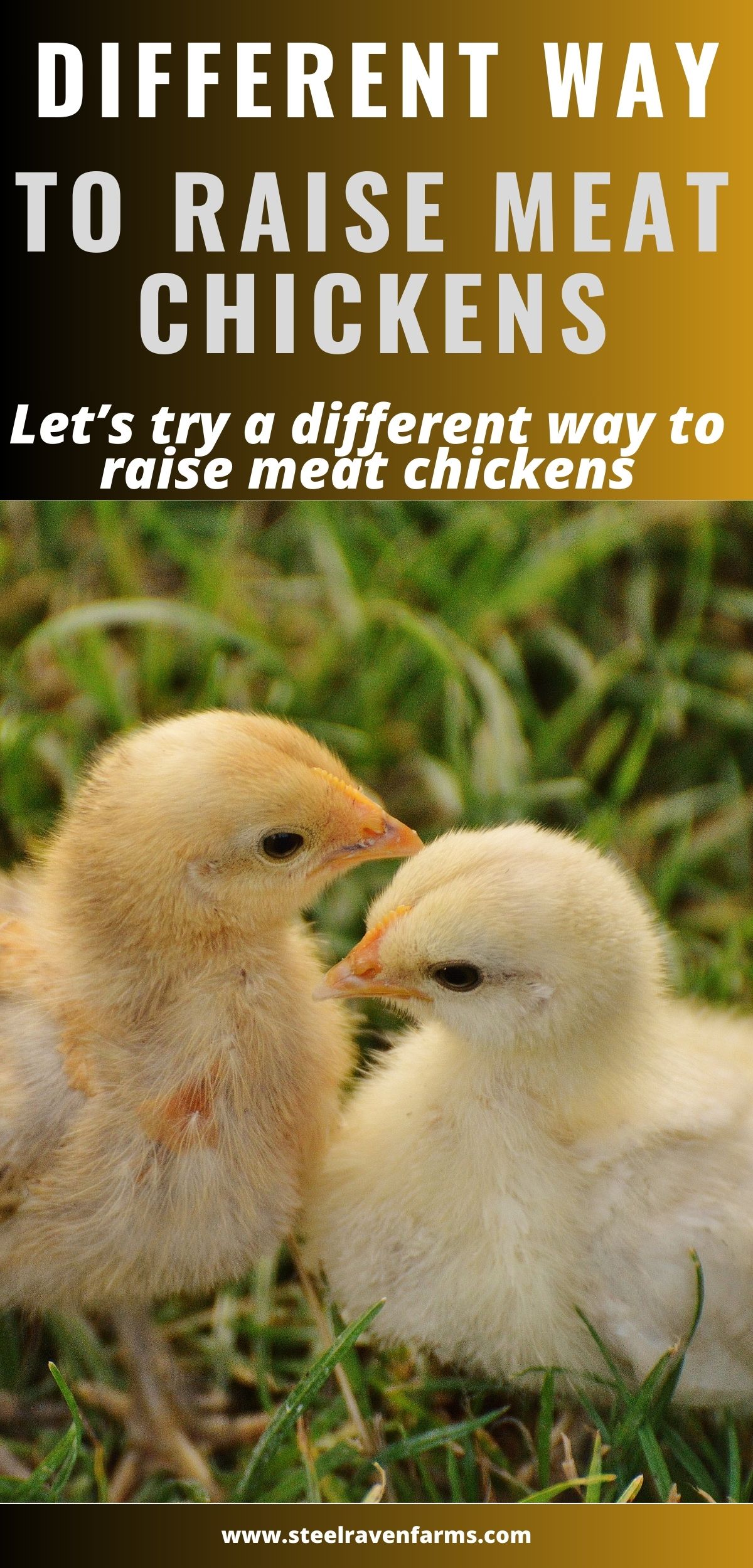
        If you have watched any YouTube-r, TikTok-er, or other social media influencer, you’ve probably seen them butcher and process 50-100 chickens in one shot. Maybe you tried that and it didn’t work. Or maybe you are currently doing that but it’s just not working well for you, your family and your schedule. You are not alone. So how do we raise meat chickens?

        How We Used To Raise Meat Chickens

        Before we bought our property, we researched like crazy. We wanted to be as prepared as possible. Also, we knew that there was going to be a ton of trial and error. That was okay. We were learning as we went and are still learning. But one of the biggest lessons we learned on the homestead was that raising meat chickens 50-100 at a time, simply doesn’t work for us.

        Tractor Supply

        I talked about a lot of the things we did in our post about Raising Meat Chickens Humanely. There were somethings that I didn’t mention in that post though. The first is that butchering out 50 chickens in one shot is freaking hard. We only had 25 that made it out of our first batch, and I’m not going to lie, I won’t do that again.

        Another thing that we learned was that the space that 25, 50 or 100 chickens take up is a lot. If you don’t have that space, then this may not be a good option. And it’s not just freezer space. If you aren’t going to free range them, you have to have a ton of tractors which means moving them a lot. If you do free range them and put them up at night? It’s still a lot of space for you to find.

        Processing them is another issue when it comes to space. You’ve got to have a ton of coolers or other ways to store the meat until it’s ready for the freezer. If you’re going to freeze them whole? That’s another huge space taker. Parting the chicken out is good and will save space, but not a lot.

        How Do We Raise Meat Chickens Now?

        We purchase our chicks from McMurrary Hatchery and we’ve gone with their Big Red Broilers. We still purchase 100 chicks at a time and it can be a ton of work. But we have found that we don’t always get 100 chickens in our freezer. Sometimes that because of predators or sickness. Other times we recruit help or put on a class and give some of those chickens away.

        When it comes to the decision on which chickens to raise for meat, it will always come down to your preference and your farm needs. I’ll dive more into that in a second.

        On our farm, the best part about the Big Red Broilers is that they take longer to get to weight and they don’t all get to weight at the same time. This sounds counter productive, right? YouTube University says that you should get the Cornish Cross so that all the chickens are ready to go at 8 weeks. But this doesn’t work for us.

        Because of our work schedules, we cannot devote an entire weekend to butchering 50-100 chickens. We just can’t. It would involve taking time off work and that’s more counter productive.

        Our Butchering Day

        Our butchering day isn’t an actual day… it’s weeks. Again, this may seem counter productive to some but if we can’t get time off work or if not all of our chickens are ready at the same time, we can’t do them all on one day.

        So what we do is set up our butchering area (which is on our driveway) and leave it set up for a couple of weeks. We will find the chickens that are at butchering weight and we will butcher them that day. This is usually 5-10 depending on what all we have going on that day, how many chickens are ready, etc. We put them in coolers full of salt and ice water. Then we will part them out into thighs, breasts, legs, and wings. After we have gotten what we need, we take the chicken back and put it on the stove for bone broth.

        Everything is cleaned up and “put away” in the butchering area until we have another 5-10 that are ready to go. This will go on until all the chickens are butchered. Usually, it only takes a couple weeks to get every chicken done and in the freezer.

        While this may not seem ideal to many, it works well for us.

        Why Does This Work So Well For Us?

        The reason we love the Big Red Broilers is because the meat is much more tender and tastes better. Another reason is because they have more time to get to weight. Usually, they hit weight around 12-16wks. This gives us a whole month to butcher them.

        Again, for someone (like myself) that will work themselves into the ground to get a job done, this isn’t ideal. But one of the lessons I have learned with homesteading is that you don’t have to do everything in one day, season or year. Working yourself into the ground is not ideal, especially when you are dealing with sharp knives and lives.

        It’s okay for it to take weeks to butcher the chickens.

        Have you ever tried to make 100 chickens worth of bone broth? Have you ever tried to pluck 100 chickens in one day? Do you know what to do with 100 chickens worth of blood? PS, that’s about 5 gallons of blood.

        Because we have tried it, and it just doesn’t work for us.

        Getting Help Or Giving A Class

        Sometimes, you HAVE to butcher 20-50 in one day. There’s no way around it. Everyone is ready and you’ve got to get it done. When this happens, we recruit help or put on a class. Keep in mind the difference between the two things though.

        Putting on a class means that you are teaching people how to butcher a chicken. This means that you have to walk people through the steps one by one. And it takes time! People have questions and they want to make sure they are dispatching animals as humanely as possible. I’m all about it! But when I have to get it done, the last thing I want to do is teach.

        Recruiting help means that the people that are coming know how to butcher chickens and are going to help you do it. I don’t have to make sure they know what their doing.

        Both of these things have their purpose and I love teaching people. But when we have 50 chickens that are ready to go and I need to get them in the freezer, that is not the right time to put on a class.

        So make sure that when you are reaching out for help, you are getting help. And give them a couple chickens for their help!

        Raise Meat Chickens The Way YOU Want To

        Whether you raise a years worth of chickens and butcher them in one shot, or you spread it out like we do, the most important thing is that you do it humanely and in a way this is right for you. The greatest thing about homesteading is that there is no right or wrong way. You can have livestock or not. You could love cattle and not chickens.

        If you dread processing day because it’s a multi day affair? Try doing smaller batches. Or raise two batches of meat chickens a year. Hell, do four batches if it make sense for you!

        Regardless of how you do it, just know that you are feeding your family the best possible chicken you can.

        If you like the content I put out, feel free to buy us a coffee! It helps keep this site running, marketing and the goats in grain!

        Buy me a coffee

        If you like this post, feel free to share it and follow us below on our social media accounts!

        • Facebook
        • Pinterest
        • Instagram
        • YouTube
        • TikTok
        • Spotify
        • Threads

        Filed Under: Animals, Chickens, How To's Tagged With: Chickens, Chicks, meat chickens

        JOIN TO OUR MAILING LIST!

        Leave us your email to receive new posts and special offers for members only! Don't miss a thing!

        Recent Posts

        • Fall Garden Guide
        • Top Mistakes With Goats
        • How To Bond With Your Goats

        Avoiding Homestead Burnout

        April 20, 2024 by Leigh Leave a Comment

        As I was writing about our 2022 goals and planning our 2023 goals, I realized something. I’ve hit burnout. As a medic, I am very, very familiar with burnout. But maybe you don’t know the signs and symptoms of burnout and you may not know how to fix it. Or you didn’t think you could burnout doing something you enjoy and are passionate about, but you’re ready to throw in the towel. Before you do that, let me see if I can help in avoiding homestead burnout.

        Avoiding Homestead Burnout

        The Ultimate Homesteader’s Starter Bundle – Only $47!

        Get the tools you need to stay organized, track profits, and manage your homestead with ease!

        Includes:
        ✅ Schedule F Tracker – Simplify tax prep
        ✅ Profit Calculator – Track earnings
        ✅ Hay Calculator – Plan livestock feed
        ✅ Garden Journal – Digital & printable
        ✅ Herd Health Tracker – Monitor animal care
        ✅ Simple Budget – Manage finances
        ✅ Backyard Homestead eBook – Essential tips

        $99 value – now just $47! Start your homesteading journey today!

        Buy Now

        What Is Burnout?

        Burnout is, at it’s core, being overly stressed. The powers that be (psychiatrists) believe that it is work related. While I don’t disagree, I feel like it is more encompassing than that.

        Your children can burn you out. That job you love, can burn you out. Those animals you love? Can burn you out. Your beautiful homestead? WILL burn you out. Why? Because burnout is stress and even the things we love most in the world, stress us out.

        If you don’t know how to identify burnout, then you will never be able to cope with it.

        But What Is Homestead Burnout?

        Homestead burnout is no different than work burnout. It’s feeling overwhelmed with all the things that need to be done. Apathy when it comes to chores, projects or other upgrades to the homestead. A lack of empathy with those around you. It’s also a kind of depression, not wanting to get out of bed/house to take care of your farm, life, etc. Homestead burnout can also be trying to push through and failing miserably. Or, lastly, anxiety.

        Identifying Burnout

        Do your animals no longer bring you joy, or not as much?

        Everything you touch seems to turn to shit?

        The thought of planning your garden causes so much anxiety that you avoid it at all costs?

        The last thing you want to do is start another project?

        You and your spouse are not on the same page?

        Logo 468x60

        You are staying in your house more and more instead of working your property?

        Constant fatigue?

        Pain?

        Congratulations, if you’ve answered yes to literally any of these, you are courting with burnout. If you answered yes to the majority of these, you are burned out.

        I can’t talk for any other career field, but as a medic, I know more about burnout then I care to admit. Not only because I’ve had it, but because I’ve watched great medics and EMT’s lose the battle with burnout. In an effort of full disclosure, my homestead is my exit strategy for burnout. BUT I’ve put everything I have into my homestead, and guess what? It’s burned me out too.

        Coping With Homestead Burnout

        The crappy part is that even if you are burned out because of your homestead, there really isn’t much you can do about it, right? The animals, gardens, children, etc don’t just go away when you say, “That’s it! I’m stressed and I can’t function with this anymore.” Because guess what? You still have to slog out to feed and water the animals. There’s still weeds to pick and eggs to collect. There’s nothing we can do about it….

        Or is there something you can do about it?

        Save on Seeds

        Things That “They” Say To Try

        These think tanks that like to tell us how to minimize stress, reduce burn out, etc are obviously upper management and don’t get their hands dirty. For those of us in healthcare, it’s like them saying “I know you asked for increase staffing, higher pay and better equipment, but here’s a pizza party instead.”

        I say this because “They” are saying things like “Have a support system” or “Get some sleep”…. and in the real world that doesn’t happen. I can’t just get more sleep. Trust me, I’ve tried. I have a support system. But guess what? They’re burned out too. So what are some ACTUAL ways to help relieve burnout?

        If you are struggling with burnout and not sure where to start, there are several really good books out there to help identify and cope with burnout. I found this one and this one to be pretty helpful. Buuuuuttttttt. When I’m burned out the last thing I want to do is read books about burnout.

        Identify What Is Causing Your Stress

        Identify the things that are stressing you out. Really think about what is happening in your life that is causing your stress levels to be so high. There may not be much you can do about those stresses, but at least by identifying what they are, you can start looking at ways to reduce those. The first step in fixing a problem is realizing you have one, right? Same thing here.

        If you are struggling to figure out what is stressing you out, simply look at the things you are avoiding. This may not look like active avoidance, “I refuse to weed the garden.” Instead, it could look something like, “I’m too busy to weed the garden, I’ll do it later.” Lately, I have been avoiding my goats. Not purposefully, but avoiding all the same. I just don’t hang out with them like I used to because I feel this all consuming drive to get all the things done. This resulted in not realizing that they are all covered in chewing lice and now I’m behind the eight ball on treatment.

        Reduce Stress

        Now, that you know what is causing your stress, you can start to take steps to reduce it. Unlike normal burnout, it may not be as simple as walking away from that job or cutting back hours. Again, you can’t just stop homeschooling the kids. You can’t just stop being a farmer. But there are things you can do and the first is ask for help.

        When you reach out for help, you need to be willing to accept that help in whatever form it comes in. This is really hard for us women. We want it done THIS way. But when you are at your wits end, sometimes done is better than not done, even if it’s not the way you would do it. You can always fix it your way later.

        You can put off that project until you’re ready to tackle it. It’ll still be there.

        You can spend an extra 10 minutes playing with your goats. Everything else can wait.

        You can make that homemade bread. If it sucks? The pigs can eat it.

        Reducing stress doesn’t include doing nothing. Sometimes it’s as easy as doing something you WANT to do, instead of HAVE to do. But if doing nothing works, then do nothing for a short time every day and call it your meditation time.

        Tractor Supply

        Understand that it doesn’t all need to be done right now

        For the last twenty years or so, we have had it crammed into our head that tomorrow is never promised. So we have been killing ourselves trying to get everything done. Go see that play, hang out with friends, get the garden in, homeschool the kids, work more, save more. More, More, More.

        But trust me, there’s always tomorrow. Yes, I understand that tomorrow is never guaranteed. But would you rather die stressed with almost everything done, or happy with a million unfinished projects. Personally, I want both. But I also understand that by stressing myself out getting everything done, I am not happy. Jared isn’t happy. And the farm suffers.

        Subscribe to Craft Beer Club Today!

        Learn Something New

        This may seem counter productive because we are trying to reduce stress, but learning something new or different can help ease stress. How? Because when we are learning, we tend to give ourselves grace. We’re just learning, right? It’s okay to get it wrong because you understand that you can’t be an expert in something you are just learning.

        Whenever I’m burned out, I pick a new craft, book, baking technique and start to learn it. This really helps pull my focus off the things that are burning me out, and pulls me back to learning which is something I love.

        Are you getting overwhelmed in the garden? Stressed? Or just not enjoying the garden like you used to? Check out our garden prompts! We send out weekly emails that get you back in the garden and out of your head! Turn the garden back into a place of love and joy instead of frustration and headache!

        Subscribe Now!

        Work On An Easy Project

        When you have the anti-Midas touch, sometimes it’s really easy to get even more stressed and burned out. No matter what you are doing, everything turns to crap. But find a project that doesn’t require a lot of brain power from you. Or something you’ve done a million times and probably won’t screw up. Then go do it.

        Part of burnout is depression. You just don’t care about whatever it is that you’re doing. But by working on a project that is easy, you are doing something. Even if it’s just taking out the trash or cleaning off your desk. That alone will help you beat back that depression. And if you just can’t, that’s okay too. At least you tried.

        How I Deal With Homestead Burnout

        I’m not going to lie, usually I step back and punt. That means that I just don’t do the chores or I fall back on planning, cleaning, organizing, or my Finish Line Goals. I am beyond blessed that I have that option, and I know it. There are times when I simply cannot gather up the gumption to build a fence, work on the gardens, or literally anything else. So I ask for help, and do something else.

        If that’s not an option and I have to do the things that are burning me out, I do it carefully and slowly. There’s nothing more frustrating that things not going how you want or need them to go.

        Lastly, I go play in the dirt. For some reason, that is my reset. It doesn’t have to be anything major, either. Simply watering my plants or spreading grass seed is enough to remember that not everything has to be done the way I want it or think it should be. And that’s okay.

        How Can You Deal With Burnout?

        The reality is that you will burn out at sometime. Probably multiple times. That’s okay! You are normal. Identify that you are burned out, figure out (if possible) what is specifically burning you out, and then step back or go slower. Or don’t do it at all. Remember, at the end of the day, it’ll get done or it won’t. And both of those answers are just fine.

        If you like the content I put out, feel free to buy us a coffee! It helps keep this site running, marketing and the goats in grain!

        Buy me a coffee

        If you like this post, feel free to share it and follow us below on our social media accounts!

        • Facebook
        • Pinterest
        • Instagram
        • YouTube
        • TikTok
        • Spotify
        • Threads

        Filed Under: Homestead Planning, How To's Tagged With: Animals, burnout, Chickens, Goats, homeschool, kitchen, stress

        JOIN TO OUR MAILING LIST!

        Leave us your email to receive new posts and special offers for members only! Don't miss a thing!

        Recent Posts

        • Fall Garden Guide
        • Top Mistakes With Goats
        • How To Bond With Your Goats

        Using A Metal Shed For A Chicken Coop

        April 16, 2024 by Leigh

        I have been browsing the internet for weeks trying to figure out something for a new coop. We’ve got more chicks and ducks coming and nowhere to put them. So I started researching the different types of chicken coops and I couldn’t find anything I really liked. And to be honest, the wood coop that we have now, is starting to really stink, even after we clean it really well. I think using a metal shed for a chicken coop may work. Maybe.

        Why We Chose A Metal Shed For A Chicken Coop

        ***Make sure to read the updates at the bottom to see how it’s actually working***

        We have seriously out grown our old coop. When we bought it, we weren’t really planning on having a ton of chickens. Our thought was, chickens are pretty easy so let’s get a couple. By a couple I mean 15 but only 9 survived. After offering our extra eggs for sale and current state of the supply chain, we have decided to grow our flock. We are hoping that this will allow us to make a little bit of money but also sustain us food wise. You can read about our new flock here. 

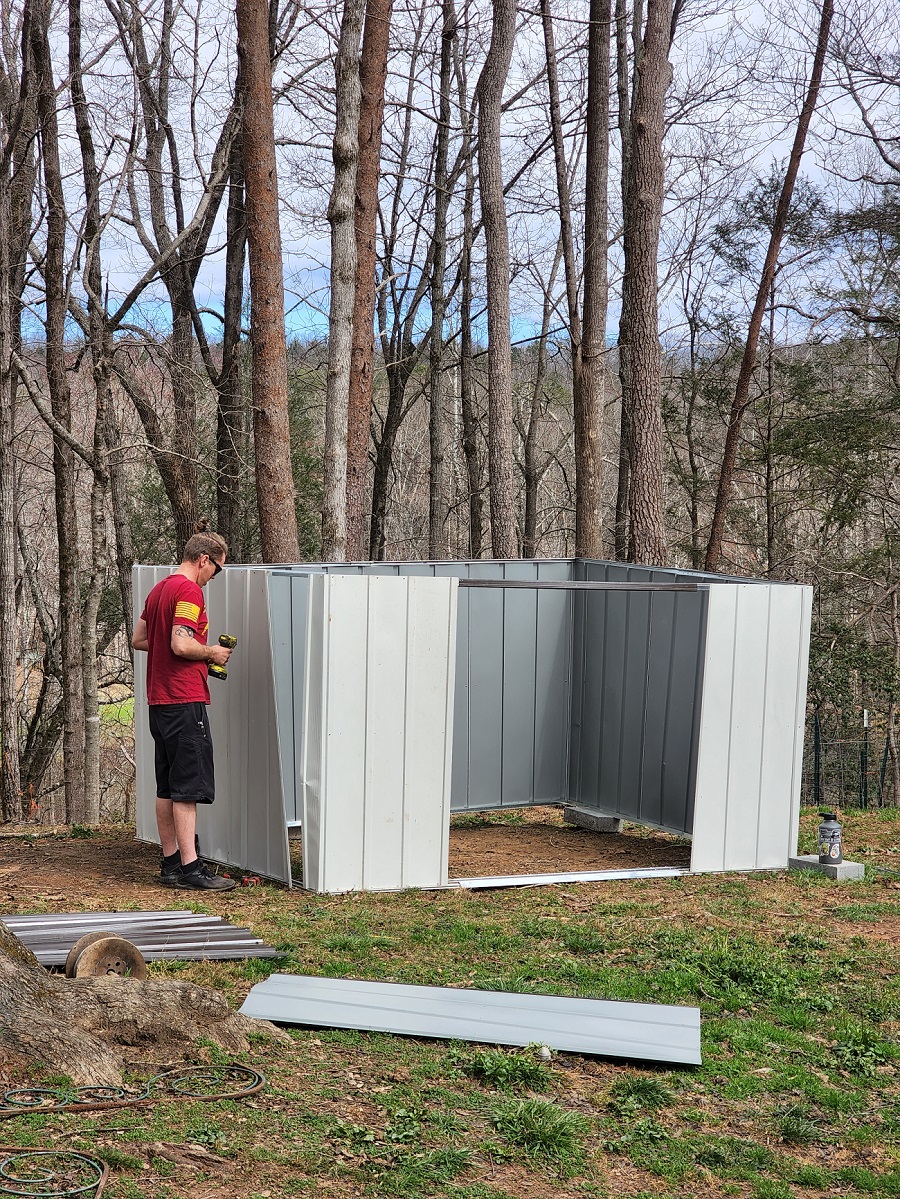
        Since, we will also be getting 20 ducks around the end of March AND the 36 chickens, we want to make sure there is plenty of room for all of them. I think this 8×10 metal shed will work great. It’s got plenty of space and if we can hang the new laying boxes and roosting bars, there will be plenty of room for the ducks to nest.

        Also since we allow them to free range throughout the day, there shouldn’t be any problems with space during the day.

        Now before anyone gets all up in arms about it, we know some of the problems with a shed like this as well as ducks and chickens in the same coop. First, we will be installing gables and vents to make sure that the heat can escape in the summer. They will also have frozen bottles on the ground to keep cool. Not to mention we made sure that the coop is in a shady area.

        Save on Seeds

        We will also be adding boards and hardware cloth to the bottoms to ensure it as predator proof as possible. The ducks and chickens can cohabitate in the same coop as long as they have their own spaces. The ducks will be on one side and the chickens on the other. I’m sure we will find more problems as we go but we will see.

        Jared working on the new Coop

        We will always be as transparent with our readers. In that vein, we want to make sure that you don’t make the same mistakes we have. Or if you decide to make the mistake, at least do it differently.

        You can also check out this from Redfin article as well! “Whether you’re planning to raise chickens at home in Asheville, NC, Eugene, OR, or Burlington, VT, check out this Redfin article we were featured in on 5 Chicken Coop Ideas For A Thriving Flock“

        Summer Update

        So this coop was built in the spring before it got really hot. What we have found is that the coop does not get super hot at night like we thought. Since we allow them to free range throughout the day and only put them inside the coop at night when the sun has gone down. We have not noticed a HUGE temperature increase.

        Don’t get me wrong, it’s still hot at night and it’s warm in the coop, but I was thinking like fatally hot and it’s not. We have been averaging 80* nights and the coop is 90* but also has fans blowing the hot air out.

        One of the things we have noticed is that NONE of the animals want to go in their respective houses at night. That includes the goats. I think a lot of it is that it’s just too hot. When they are outside they can move around and find cool ground.

        The chickens and ducks seem to prefer being outside during the summer and that’s fine. We have predator lights up around the property and so far we haven’t seen any signs of them being taken in the night.

        I’ll update back after winter and let you know how that goes. But for right now the coop is working.

        Winter Update

        We have moved the chickens and ducks back into the red coop. The metal shed has turned into a flop…. Well, not completely. The shed rusted from the ground up. No matter how much pine shavings we added, the odor was completely foul. The chickens also didn’t seem as healthy either. It seemed to take them longer to get through molt and they stopped laying eggs way sooner than they should have.

        When we moved them back to the red coop, their feathers seemed to get brighter and they seemed happier. Now, this is all speculation and we don’t have scientific proof, but I feel like the shed was not a good option for long term keeping.

        We plan to convert the shed back into a shed and just put our various building materials in it. I would suggest looking into different types of chicken coops and leave the metal shed alone.

        Using A Metal Shed For A Chicken Coop…. The Final Update

        As of this writing (2024), we have turned this shed into a home for broody hens and a brood coop for new chicks. For this purpose, the metal shed has turned out to be excellent. We went through and painted all the rust, patched holes, and general upkeep of the shed. We noticed that the broody hens and new chicks all thrived.

        I think the main problem with using a metal coop as a permanent coop is the severe lack of air flow, extremely low light, and everything tends to stay damp without a good heat source. Since we fixed everything and have made it a temporary home for these chicks/ hens, it has turned out VERY well and is something we will continue to do.

        If you like this post, feel free to share it and follow us below on our social media accounts!

        • Facebook
        • Pinterest
        • Instagram
        • YouTube
        • TikTok
        • Spotify
        • Threads

        Filed Under: Animals, Chickens, How To's, Projects Tagged With: chicken coop, Chickens, Chicks, Ducks, Eggs, Homestead, metal coop

        JOIN TO OUR MAILING LIST!

        Leave us your email to receive new posts and special offers for members only! Don't miss a thing!

        Recent Posts

        • Fall Garden Guide
        • Top Mistakes With Goats
        • How To Bond With Your Goats

        Welcome to The Homestead

        April 13, 2024 by Leigh Leave a Comment

        We are excited to bring you along for the journey. On this blog you will find a ton of posts about goats, gardening and homesteading. We wanted to let other people know that you don’t have to have hundreds of acres, tons of livestock or even generations of knowledge. We wanted our blog to be different. So welcome to the homestead!

        The Ultimate Homesteader’s Starter Bundle – Only $47!

        Get the tools you need to stay organized, track profits, and manage your homestead with ease!

        Includes:
        ✅ Schedule F Tracker – Simplify tax prep
        ✅ Profit Calculator – Track earnings
        ✅ Hay Calculator – Plan livestock feed
        ✅ Garden Journal – Digital & printable
        ✅ Herd Health Tracker – Monitor animal care
        ✅ Simple Budget – Manage finances
        ✅ Backyard Homestead eBook – Essential tips

        $99 value – now just $47! Start your homesteading journey today!

        Buy Now

        Welcome To The Homestead

        Both Jared and I grew up as city kids. The hustle and bustle something that we never really wanted. As time went on and we got older, we realized that city life is not what we wanted. It is not what we want for our boys. So we decided to do something about it. We were breaking our back trying to save as much money as possible to get our homestead. Since we are both paramedics and after working 36-60 hour straight shifts for two years, we finally did it. We purchased our homestead.

        We just celebrated 15 years of marriage

        Shortly after buying the homestead, we got our first chickens.  They are pretty cool little critters and really, what homestead is complete without a couple chickens. We started with 15 and lost a couple. Now we are in the ballpark of 50. But I wanted something a little different. So I started looking into other critters that would be low maintenance while also being semi profitable.

        George and His Ladies

        Enter the goats

        I’m not going to lie, I didn’t want goats. I had heard the horror stories. They are escape artists, they die easily, they can’t actually eat everything, and so on. They are pretty much everything BUT low maintenance and semi profitable. But Jared wanted goats, so we got the goats. Man, I was so wrong! I love those critters! They are seriously the best. Bella is a challenge and I am going to make her love me. But Champ? The girl below? She is the best girl. She is actually going to be giving us babies soon!

        Champ

        After adding our first couple goats, we wanted even more. So we added more goats, then some goats had babies and now we are at 12. We are hoping to have a few more and that will allow us to start milking regularly. That milk will then help us reduce our dependence on the grocery store.

        Since owning goats for several years now, we have decided to, temporarily, move away from registered lines and start working on building a resistant herd with great milk lines. We have also learned to deal with the question of what to do with boys.

        Sending bucks to processing has been a hard choice but definitely one that needed to be made. Unfortunately, when you breed animals, you have to face the hard reality of what to do with them if you can sell them. Livestock are not companion animals, although there are some exceptions, and treating them like pets will only break your heart.

        We have also created a Goat Crash Course for those that were in our same position. Brand new and with no mentor.

        goat kidding

        Before we get too far into this, I have a great course on the basics of goat care. I call it Goat Crash Course: Goat 101. In this course, I explain things like types of shelter, types of feeds and hays, basic assessments and so much more! Check it out!

        Buy Now

        On To The Ducks

        Ever since I was a kid, I have loved ducks. They are such cool creatures. Jared finally okayed a few ducks and meat ducks. While they are messy and their pool stinks to high heaven, no matter how often we drain it, I love those guys. We also gained our neighbors guinea. Apparently she was unhappy living with them.

        Tractor Supply

        Since owning the chickens and the ducks, we have come to realized a couple things. One, chickens get into EVERYTHING when they are not contained in some fashion. So free ranging chickens isn’t really a great idea. Two, ducks free range beautifully and don’t get into as much trouble as the chickens.

        While I am not a huge fan of duck eggs, their antics and meat keep them around the homestead.

        The Garden

        We have also been working hard on our gardens and general clean up of the property. Our property was not set up for homesteading before we bought it. So we have been slowly but surely working through the property and clearing out old debris, trash, and other things. We are hoping to have it safe enough soon to let the goats roam bigger areas to keep the brush in line.

        The Ultimate Homesteader’s Starter Bundle – Only $47!

        Get the tools you need to stay organized, track profits, and manage your homestead with ease!

        Includes:
        ✅ Schedule F Tracker – Simplify tax prep
        ✅ Profit Calculator – Track earnings
        ✅ Hay Calculator – Plan livestock feed
        ✅ Garden Journal – Digital & printable
        ✅ Herd Health Tracker – Monitor animal care
        ✅ Simple Budget – Manage finances
        ✅ Backyard Homestead eBook – Essential tips

        $99 value – now just $47! Start your homesteading journey today!

        Buy Now

        The garden has been a huge pain in the backside as well. Between not being able to get all my seedlings started and then the ducks eating what I managed to plant, the garden is finally in. I was also able to harvest our first cucumbers!

        We are gearing up to start our fall garden and I am ridiculously excited! Our summer harvest has been good, considering it’s our first garden here, but I’m hoping the fall garden will be even better. Our second garden was a bit better but not at all what we thought it was going to be. We have learned a ton about gardening in this area.

        One of the biggest things I learned about the garden is protecting the soil! I never really put much thought into the soil and how to build it. I just thought you put things in the ground and they grew. I didn’t realize that building healthy soil, naturally, helped to bring in better harvests. Who knew!?

        Our garden this year (2024) is set to be our best yet!

        Building A Greenhouse

        Last year, the major project was building a greenhouse. Jared absolutely nailed it and I love my greenhouse. It has become my sanctuary when things get hard. Jared poured so much love into that greenhouse and I can feel it every time I walk into it.

        Not everyone can build a greenhouse, or really need one. But I do highly recommend at least entertaining the subject if it is possible for you.

        Welcome To The Homestead

        We will be adding to our homestead as this blog progresses and we want you to be along for the ride. So share and follow us on social media and welcome to the Homestead!

        Are you getting overwhelmed in the garden? Stressed? Or just not enjoying the garden like you used to? Check out our garden prompts! We send out weekly emails that get you back in the garden and out of your head! Turn the garden back into a place of love and joy instead of frustration and headache!

        Subscribe Now!

        If you like the content I put out, feel free to buy us a coffee! It helps keep this site running, marketing and the goats in grain!

        Buy me a coffee

        If you like this post, feel free to share it and follow us below on our social media accounts!
        • Facebook
        • Pinterest
        • Instagram
        • YouTube
        • TikTok
        • Spotify
        • Threads

        Filed Under: Our Homestead Tagged With: beginners, Chickens, Ducks, Eggs, Goats, Homestead

        JOIN TO OUR MAILING LIST!

        Leave us your email to receive new posts and special offers for members only! Don't miss a thing!

        Recent Posts

        • Fall Garden Guide
        • Top Mistakes With Goats
        • How To Bond With Your Goats

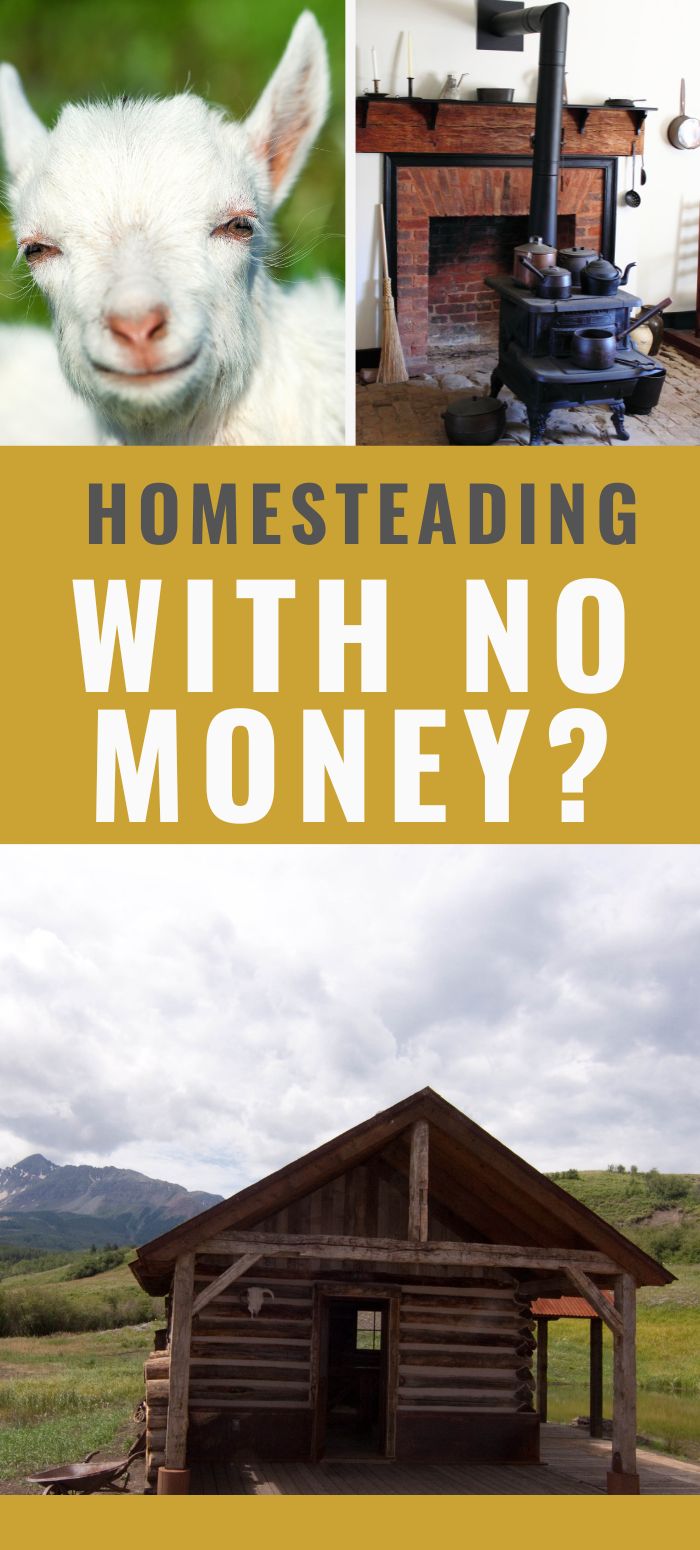
        Can You Start A Homestead With No Money?

        March 23, 2024 by Leigh 10 Comments

        The short answer is no. You do need some money but it might surprise you that you don’t need a ton of money to start a homestead. Ingenuity, hard work and a lot of sweat goes a long way. But at the end of the day, no, you can’t start a homestead with no money.

        The Ultimate Homesteader’s Starter Bundle – Only $47!

        Get the tools you need to stay organized, track profits, and manage your homestead with ease!

        Includes:
        ✅ Schedule F Tracker – Simplify tax prep
        ✅ Profit Calculator – Track earnings
        ✅ Hay Calculator – Plan livestock feed
        ✅ Garden Journal – Digital & printable
        ✅ Herd Health Tracker – Monitor animal care
        ✅ Simple Budget – Manage finances
        ✅ Backyard Homestead eBook – Essential tips

        $99 value – now just $47! Start your homesteading journey today!

        Buy Now

        When we started our homestead, we had about $2,000. Considering the amount of work we needed to do? It was not a lot of money and I was panicking. I thought we needed all the things to get everything done, RIGHT NOW. Thankfully, after working a ton of overtime we have been able to slowly grow our homestead over the next year. Keyword is slowly.

        Logo 468x60

        How much do you need?

        I would say a good rule of thumb to moderately build your homestead is $1,000 per acre to start. That doesn’t mean if you don’t have that $1,000 you can’t buy a homestead. But $1,000 is a good way to get started on a fair amount of projects without freaking out when you have to go back to the hardware store for the 15x in two days.

        Replacing the water heater only took 7 trips in two days.

        Also, depending on the state of your homestead, you may need to do a lot of manual labor before you can even get to work on any big projects. When we first moved in, we had to pull tons of debris from the homestead. Fencing, barbed wire, posts, random pieces of wood with nails sticking out of them, etc. Even a burned out freezer was just hanging out.

        Banner 468x60

        Can You Homestead With No Money: Animals

        It took us a month and a half before we brought goats to the homestead to help clear land. Even though you can get goats pretty cheap, it’s not ideal. Cheap goats tend to be problem goats. Even mix breed goats can be expensive. Then there’s medication, feed, hay, shelters, and basic supplies.

        Shelter

        Before bringing home new animals, make sure that you have shelter already figured out. When we brought home Bella and V, we thought one of those plastic dog crates would be fine…. Well, we live in the rainiest parts of Georgia and every summer afternoon we have a pop up shower. Which is great for the garden, but not so great for goats. Depending on your weather, a good, cheap option is a dog igloo.

        Fencing

        I will say is this, before you bring bigger livestock (goats, pigs, donkey, etc) to the homestead, make sure you have plenty of money set aside because your first fence probably sucks. Especially if you have never built fences for livestock. I’m not knocking your fence building skills, but those animals will find the weak points. We spent two hours chasing Bella between our property and our neighbors. So make sure you either have extra money on hand or someone who actually knows how to build livestock fencing.

        goat kidding

        Before we get too far into this, I have a great course on the basics of goat care. I call it Goat Crash Course: Goat 101. In this course, I explain things like types of shelter, types of feeds and hays, basic assessments and so much more! Check it out!

        Buy Now

        Can You Homestead With No Money: Gardening

        Gardening doesn’t necessarily have to be expensive. In fact, you could have an amazing garden on a shoestring budget. You really just need time, dirt, seed and some manual labor.

        This year we put in our kitchen garden beds. While I absolutely LOVE them and I’m so glad we did it, the reality is that it cost us around $2,000 between soil, materials, trellising, etc. And we’re not even done yet. We still have to add more trellising and a better fence.

        Are you getting overwhelmed in the garden? Stressed? Or just not enjoying the garden like you used to? Check out our garden prompts! We send out weekly emails that get you back in the garden and out of your head! Turn the garden back into a place of love and joy instead of frustration and headache!

        Subscribe Now!

        Putting in gardens is going to be hard work. You can do a lot of work by hand instead of relying on a tractor. I feel like it’s worth it to learn how to do it manually so you know how to till (if that’s what you’re doing), amend the beds, see the soil structure, etc. However, it would be really nice to have a tractor for pulling stumps and not spending two weeks working the soil.

        Can You Homestead With No Money: Get Creative

        If you can get creative with what is already on your property, you don’t need a ton of money to start a homestead. We had a ton of old material from various projects we did at our old house. We made sure to bring all of that with us. Since our new garage wasn’t big enough for the 2 sets of storage shelves we had in the old garage, we used the wood for something else.

        New Kidding Pens

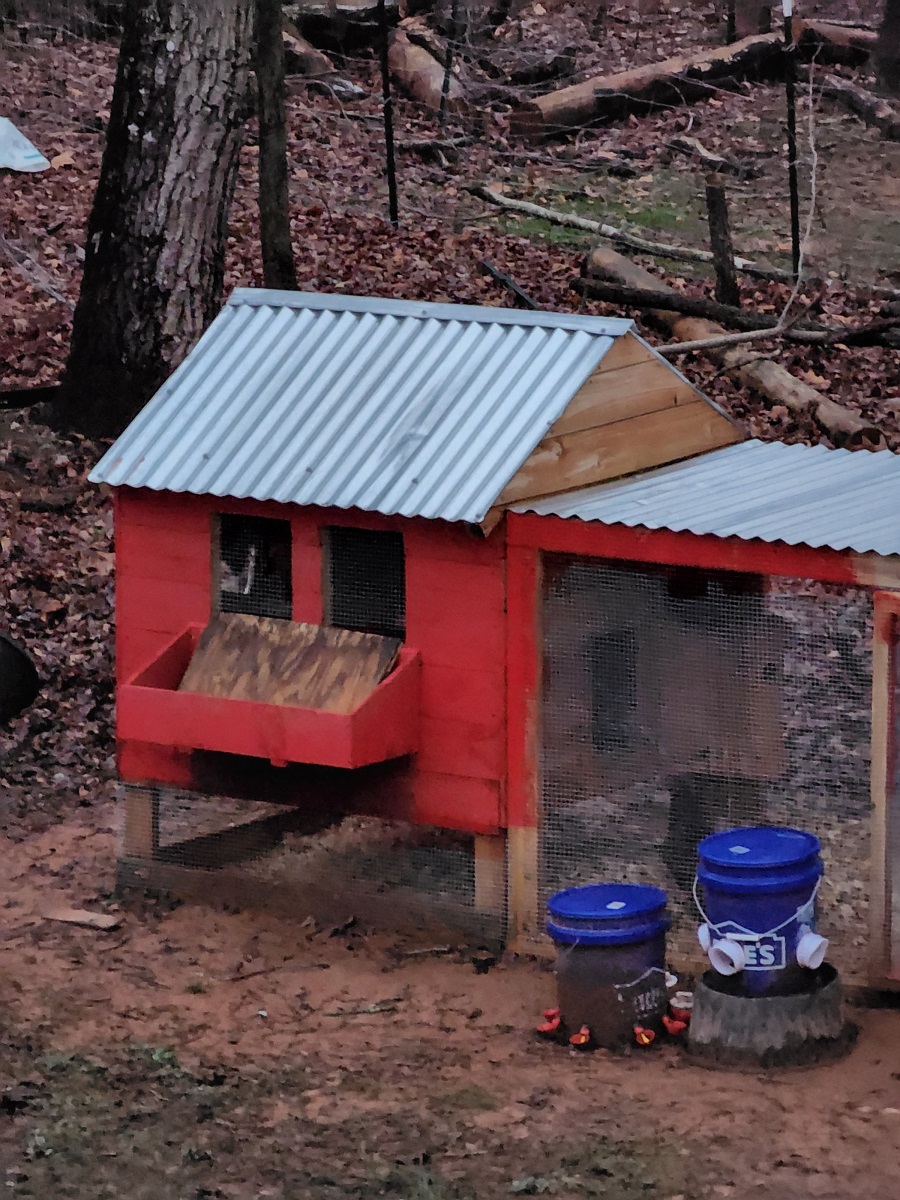
        Some of the debris on the property has yielded us a couple of goat shacks, a chicken coop, plenty of roosting bars, and much more all without spending a penny. And while it’s not pretty, it works really well. The goat shack above has about $2 worth of screws invested in it. Since it has been converted into a kidding pen it has another $10 worth of hinges and wood.

        Logo 468 x 60

        There have also been instances of numerous projects that need to be done, and we only have $1,000 to all of them. Things get really creative then but when I look around at all the things we have gotten done around here, I’m pretty impressed.

        Don’t be afraid of buying a property because you don’t have a ton of money to get started. It takes time to get a homestead up and running, not money. Hard work goes a lot further than a dollar so please don’t get hung up on that part.

        Banner 468x60

        It Doesn’t Have To Be Insta-Worthy

        With the rise of homesteading, I see tons and tons of Instagram or Pinterest boards of these perfectly curated gardens, chicken coops, barns, homes, etc. Please, please, please don’t fall into that trap! Those of us that have been homesteading for more than 5 minutes fully understand the reality of homesteading.

        You will wear yourself out trying to keep everything perfect.

        There was chicken poop all over our back deck before we got our chicken run set up. Before we renovated the living room, we had goat vomit on the ceiling. I have a trash pile that is almost as wide as my driveway. I have flies in my kitchen no matter what I do to get rid of them.

        Is my house dirty? No. It’s a working homestead. Syringes by the sink, coffee mugs on the deck, measuring tape on the picnic table, and boxes of garden harvest on every flat surface.

        It’s this life, I love so much.

        Sure, you could spend your entire day chasing after kids trying to keep those baseboards white….. Or you could enjoy the laughter as that child snuggles with a baby goat.

        You could spend 2 hours every day making sure the chicken coop is spotless. Or you could spend those same 2 hours playing in the garden.

        You could spend your day pulling every weed from the garden. Or you could cover it with some mulch and plant new things.

        It’s all a matter of perspective. I don’t need a perfectly clean house, coop/barn, or weed free garden. My happiness means more to me than an insta-worthy picture.

        If you like the content I put out, feel free to buy us a coffee! It helps keep this site running, marketing and the goats in grain!

        Buy me a coffee

        If you like this post, feel free to share it and follow us below on our social media accounts!
        • Facebook
        • Pinterest
        • Instagram
        • YouTube
        • TikTok
        • Spotify
        • Threads

        Filed Under: Frequently Asked Questions, Our Homestead Tagged With: Chickens, Goats, Homestead

        JOIN TO OUR MAILING LIST!

        Leave us your email to receive new posts and special offers for members only! Don't miss a thing!

        Recent Posts

        • Fall Garden Guide
        • Top Mistakes With Goats
        • How To Bond With Your Goats

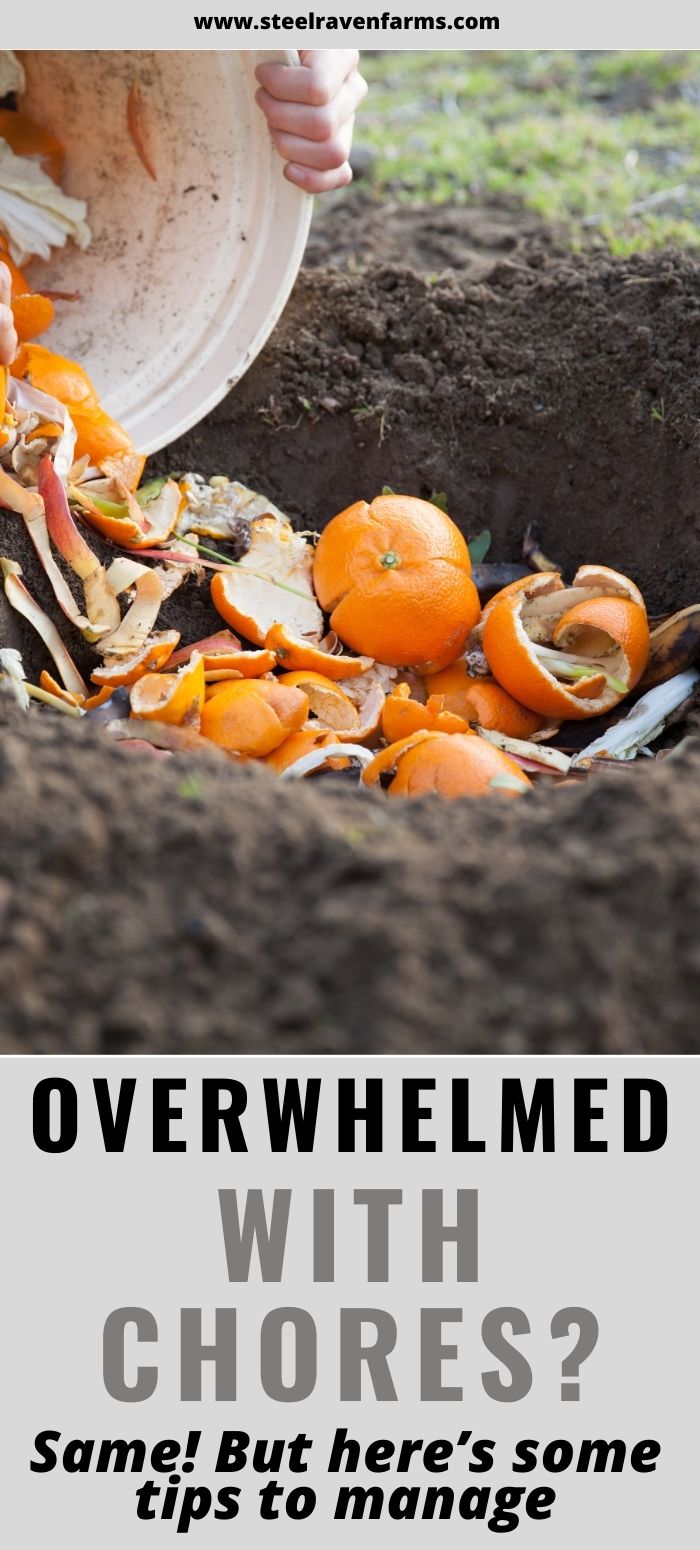
        Overwhelmed With Chores?

        March 12, 2024 by Leigh Leave a Comment

        It’s easy to get overwhelmed with chores on the homestead. Goats need milked, eggs collected, dogs let out, and ducks bedding changed AGAIN. On top of that everyone needs to be fed, including the children. By the time your day is done you’ve logged 9 million steps and are exhausted. But sleep is for the weak because you have to stay on alert for predators, the baby, and the sick goat in your living room. Chore management on the homestead is a really thing and it’s hard to get a handle on.

        Dealing With Overwhelming Chores

        Yes, I am overwhelmed and yes, I am tired. But I have found some pretty ingenious hacks to allow me to get some sleep without sacrificing my animals care. Below are my 5 hacks to keeping up with the homestead, while working full time, homeschooling, and running a several businesses.

        The Ultimate Homesteader’s Starter Bundle – Only $47!

        Get the tools you need to stay organized, track profits, and manage your homestead with ease!

        Includes:
        ✅ Schedule F Tracker – Simplify tax prep
        ✅ Profit Calculator – Track earnings
        ✅ Hay Calculator – Plan livestock feed
        ✅ Garden Journal – Digital & printable
        ✅ Herd Health Tracker – Monitor animal care
        ✅ Simple Budget – Manage finances
        ✅ Backyard Homestead eBook – Essential tips

        $99 value – now just $47! Start your homesteading journey today!

        Buy Now

        Get the kids involved

        I have found that there are two sides on this, and few people fall in the middle. Either kids do chores or they don’t. My boys do chores, and they do a lot of them. Every month they switch out, except for animals. We also help each other out. If I see the ducks need water, I fill it up. If Jaxson sees that the cats are out of food, he feeds them. Their current chore list looks like this:

        Chase- Goats, feeding dogs/cats, wiping up the counters, vacuuming, and cars

        Jaxson- Chickens/ducks, dishes, bathrooms, (yes, this seems off. But in our house, dishes get run 3x a day)

        Me- Goats, gardening, other seasonal work

        Jared- Building

        But I see no reason why kids can’t do chores. Especially when they want toys, electronics, etc.

        If you are interested in learning more about my favorite garden planner. I highly recommend Seedtime! This planner has been instrumental in helping me plan out my gardens with WAY more efficiency than I could ever expect! It has also reduced overwhelm, stress, and calmed my ADD/ADHD!

        More Info!

        Start small and grow

        When we started the homestead, we started with our dogs, cats, dragons, and snake. Then we added chickens. Once we were comfortable with that, we added goats, and so on. Before we add anything new, or more of them, we ask if everyone is on board. Since the kids handle most of the day to day animal care, we want to make sure that they are good with getting more.

        This means don’t start a 8,000 sq ft garden right out of the gate! Start a small garden and then grow it. This could mean starting a seeds inside before you build or buy a greenhouse.

        I am currently working on this right now with our soil and pasture building project. Our soil is so compacted from lack of care that I am working to regenerate the soil and set up a strong pasture so we no longer have to feed our goats off farm inputs.

        goat kidding

        Before we get too far into this, I have a great course on the basics of goat care. I call it Goat Crash Course: Goat 101. In this course, I explain things like types of shelter, types of feeds and hays, basic assessments and so much more! Check it out!

        Buy Now

        Get into a routine

        While this is tough at first, once you get into a routine of taking care of your chores, it’s easier to see where you have more time. Our routine goes something like this, I wake up, let my dogs out and shower. The boys get up, let their dogs out and start on their animals. If they are hustling they can get their morning chores done in about 10 minutes.

        Because we unschool, our homeschool doesn’t take hours and hours. We talk about what they are interested in and they do research on that. We also take time for the basics like math, reading, social studies, and science. They do Spanish on Friday.

        During garden season (Mid February to Mid November), I can usually be found outside until the weather drives me inside. I have a list of “rainy day chores” that I work on whenever the weather drives me inside. Like record podcasts or videos, write blog posts, planning days, etc.

        Banner 468x60

        Delegate

        One of the first things I was taught in Paramedic school is delegation, and it’s not something I do well at work. But at home, I’ve got it covered. After talking with Jared about our goals and what we want to accomplish, I come up with the To Do lists and plans and delegate it out. This helps everyone figure out where they need to be, what they need to be doing and how to finance it. It’s not a hard fast rules/ to do lists, but it helps everyone know what they need to do.

        Save on Seeds

        It also extends to chores. Since keeping up the house is everyone’s chore, we split the chores as evenly as we can. I hate doing the dishes, so the other 3 handle it. They hate doing laundry so that usually falls to me. I handle the grocery shopping and bill paying. Jared handles building. Chase handles the goats, and Jaxson handles to poultry. Then we help each other out as needed to make sure that everything actually gets done.

        Cleaning

        I could write an entire blog post about cleaning up the house and the homestead. I would be lying if I said my house was spick and span. It’s not. I’ve got 4 huge dogs, and kids living inside my house. Not to mention the occasional goat, chicken, duck, etc. My house is never clean. But I clean up as I go and everyone else helps a lot.

        Don’t get hung up in the details. My kitchen is a prime example. That little ledge behind the sink that collects all manner of nasty things is constantly dirty. I have tried everything in my power to keep that area clean but it’s not happening and you know what? That’s fine. My counters and stove are clean and the sink is mostly empty. Pick your battles and move on.

        Grace

        At the end of the day, you are simply human. Give yourself grace when you can’t get your kitchen scrubbed or the laundry done. The animals have food and water and the kids aren’t dead or hurt? You’ve done just fine.

        Overwhelmed With Chores?

        One of the biggest lessons that I’ve learned on the homestead is that there is always tomorrow. We have been conditioned to believe that tomorrow isn’t guaranteed. And yes, that’s absolutely true. But if you run yourself, spouse or kids into the ground trying to get everything done TODAY, you will burnout everyone out.

        I have a saying that I have adopted since hitting homestead burnout…. If I die tomorrow, it’s not my problem. This may sound very off handed or too laid back way of looking at life, but it’s the honest reality. If I drop dead tomorrow, it’s not going to matter if I took a nap instead of starting seeds. It doesn’t matter if I put tomatoes in the freezer instead of running them through the canner.

        I’m not saying that you have to have that mindset. But what I AM saying is that you have to give yourself and your family grace and kindness when it comes to this stuff. To give an example, I was supposed to be done with this blog post about 3 hours ago. But instead, I took a nap because I was exhausted from working a 36 hour shift on the ambulance…. And that’s fine.

        If you like the content I put out, feel free to buy us a coffee! It helps keep this site running, marketing and the goats in grain!

        Buy me a coffee

        If you like this post, feel free to share it and follow us below on our social media accounts!
        • Facebook
        • Pinterest
        • Instagram
        • YouTube
        • TikTok
        • Spotify
        • Threads

        Filed Under: Animals, Garden Tagged With: Chickens, Chores, Ducks, Goats, Homestead, Overhelmed, stress

        JOIN TO OUR MAILING LIST!

        Leave us your email to receive new posts and special offers for members only! Don't miss a thing!

        Recent Posts

        • Fall Garden Guide
        • Top Mistakes With Goats
        • How To Bond With Your Goats

        Goats Are Not Beginner Livestock

        March 9, 2024 by Leigh Leave a Comment

        I have recently been asked “If you love goats so much, why do you tell people not to get them?” The answer is simple, if more people would educate themselves before buying animals, I wouldn’t tell them not to buy goats. Most people do not do the research, and they end up getting a bunch of animals that they are not prepared to care for. But the reality is that goats are not for the feint of heart and they are not beginner livestock.

        goat kidding

        Before we get too far into this, I have a great course on the basics of goat care. I call it Goat Crash Course: Goat 101. In this course, I explain things like types of shelter, types of feeds and hays, basic assessments and so much more! Check it out!

        Buy Now

        Goats are NOT beginner livestock

        I wrote my post about goats coming to the homestead and I will be honest, I left a lot of information out. Mainly because it was a piece designed to give a brief snap shot of why and how we have come to love our goats. But I feel, especially after what I said above, that I needed to be a little more clear about why I feel this way.

        The plan truth is that it is easier to kill a goat than keep it alive when you are just starting out. When we first bought Bella and Voldemort, we knew that he had worms. But we had absolutely no idea what that actually meant. If a dog has worms, you give it a pill and repeat again in a week. After that you should be good to go. With goats it’s not that easy. In fact, goats will easily die from worms and quickly.

        Banner 468x60

        Goats Die Easily

        There is a treatment protocol that is now in place because farmers have overtreated for parasites and it has caused resistance to these dewormers. Instead of two doses of one dewormer, it is multiple doses of several dewormers over several days/weeks. If you don’t know these things, you will lose goats before you are ever really comfortable with them.

        Banner 468x60

        Then there are plants are toxic that can kill them or the predators out there. Or that if their rumen gets out of whack, they could die. I have an entire book of treatment protocols that I have gone over with my vet to make sure I am doing the right thing.

        That being said, once you understand what you are doing and why, it is extremely easy to keep them going. With regular herd checks and individual checks, your herd can thrive. We’ve had some touch and go moments since owning goats and we have managed to pull most of them through.

        goat kidding

        Before we get too far into this, I have a great course on the basics of goat care. I call it Goat Crash Course: Goat 101. In this course, I explain things like types of shelter, types of feeds and hays, basic assessments and so much more! Check it out!

        Buy Now

        Having Medications On Hand

        Unlike your dog, cat or even chickens, you need to have medications on hand for goats and know how to use them. Goats can take Aspirin, but if you don’t know how often or the dosage you could kill them. You need to have antibiotics on hand for things like pneumonia, antitoxin for injuries, thermometers for temp checks and minerals for their general health.

        Good luck finding a vet that will treat your goat. Seriously, we got incredibly lucky that not only does our vet treat ALL of our animals, they are goat owners themselves. So they know how to take care of small ruminants, which is huge when figuring out how to take care of these creatures.

        I have a tool box that I carry when doing herd checks. It is packed to the brim and a binder that lists medications, FAMACHA scores, weights and much more. I conduct herd checks weekly to make sure that we catch any possible illness before they happen. Even with all that, we ended up with two pregnant goats that we didn’t catch until a few weeks before delivery.

        But once you learn what you need to do to care for them appropriately, they are worth it. Every time they bleat when you come into their pen. Their antics when they are playing fighting, and more is so worth every ounce of heartbreak when you lose one.

        Goat People vs Everyone Else

        There are two types of people when it comes to goats. There are people who have goats and people who love their goats. I know many people who have goats and they are just that, a goat. Goat people truly love their goats. I have chickens, I like them and they’re pretty cool but I don’t love them. I am not a chicken person. I’m not going to snuggle my chickens. I’m not going to check on them constantly. If one goes missing? I’m not going to be upset.

        Save on Seeds

        My goats? I cried when we lost Voldemort and Texas. My kids bawled with Texas. I refused to entertain the notion of another goat after that for about 5 minutes because I love these goats. I am a goat person. I have spent untold hours researching everything I can about them. I have spent more money on them then I care to admit, but they are my babies.

        So No Goats are NOT beginner livestock

        They just aren’t. But that is coming from a goat person. Someone who truly loves these animals and wants you to love them too. So if you want goats, by all means, get goats. They are really cool critters that have absolutely stolen my heart. But understand what you are getting into. It’s not all sunshine and roses.

        goat kidding

        Before we get too far into this, I have a great course on the basics of goat care. I call it Goat Crash Course: Goat 101. In this course, I explain things like types of shelter, types of feeds and hays, basic assessments and so much more! Check it out!

        Buy Now

        Sometimes it’s recognizing that your goat isn’t acting right and getting in there with a thermometer, FAMACHA chart and figuring it out. Or collecting poop and storing it in your fridge until you can get it to the vet. It’s keeping goats in your house because they could die at any minute and you need to be there to try and stop it. It’s realizing that despite your best efforts some may die and there’s not a lot you can do to stop it.

        But it’s also having your goats sing to you as you come down your driveway- RIP Texas

        It’s getting snuggles from your best girl- Champ

        It’s playing, getting headbutts, and dodging a buck in full rut- Midas

        It’s slowly, so slowly winning the affection of Queen Bee- Bella

        It’s watching two girls grow and start to play and call out for you- Oakley and Bailey

        It’s helping deliver the first goat born on your homestead- Stella

        It’s wethering your first buck- BeeBee

        It’s being surprised by a new kid on the ground and not realizing your girl was that close- Bailey and Sebastian

        It’s doctoring a sore shoulder because he jumped off a log- Finnegan

        It’s listening to a tiny bleat from a huge goat with a comb over- Spike

        It’s watching 2 little girls melt my husbands heart with every whiny bleat and nibble- Jade and Sapphire

        Logo 468 x 60

        So while they may not be beginner livestock, they are absolutely worth the time, energy, effort and money that goes into their care and keeping.

        If you like the content I put out, feel free to buy us a coffee! It helps keep this site running, marketing and the goats in grain!

        Buy me a coffee

        If you like this post, feel free to share it and follow us below on our social media accounts!
        • Facebook
        • Pinterest
        • Instagram
        • YouTube
        • TikTok
        • Spotify
        • Threads

        Filed Under: Animals, Goats, How To's, Our Homestead Tagged With: Chickens, Goats, Homestead

        JOIN TO OUR MAILING LIST!

        Leave us your email to receive new posts and special offers for members only! Don't miss a thing!

        Recent Posts

        • Fall Garden Guide
        • Top Mistakes With Goats
        • How To Bond With Your Goats

        Best Chickens For A Homestead

        March 5, 2024 by Leigh Leave a Comment

        You’ve closed on your new homestead and are itching to get your first set of livestock. Or, you have made the determination that you need chickens on the homestead to help close some holes in food security. What are the best chickens for a homestead? The short answer is: that depends. The real question you should be asking yourself is, why do you want chickens on the homestead?

        The Ultimate Homesteader’s Starter Bundle – Only $47!

        Get the tools you need to stay organized, track profits, and manage your homestead with ease!

        Includes:
        ✅ Schedule F Tracker – Simplify tax prep
        ✅ Profit Calculator – Track earnings
        ✅ Hay Calculator – Plan livestock feed
        ✅ Garden Journal – Digital & printable
        ✅ Herd Health Tracker – Monitor animal care
        ✅ Simple Budget – Manage finances
        ✅ Backyard Homestead eBook – Essential tips

        $99 value – now just $47! Start your homesteading journey today!

        Buy Now

        What Do You Want Out of Your Chickens

        If you simply want chickens to have chickens then really any breed will do. It doesn’t matter how many eggs they lay, or if they are good for meat. You could get any breed and be happy with that choice. However, if you are looking for a high producing egg layer that is going to give you a ton of different colored eggs to sell at the farmers market, a Cornish Cross is not your answer. So here are our top favorites for bringing chickens to the homestead.

        Best Egg Laying Birds

        • Australorps- Lay large brown eggs and a heritage breed. They will lay about 250-365 eggs a year. They are also considered meat birds which is why our rooster may end up in the stock pot if he doesn’t start being nicer.
        • Black Star- This is not a heritage breed and can’t beat the Australorps with egg production, but they can usually lay about 200 large brown eggs a year. They will hit maturity about 2 weeks faster. They are also a good meat bird.
        • Red Star- The red start is up there with the Australorp when it comes to egg production with the same 250-365 eggs per year. Plus, they reach maturity faster which means faster eggs. And they are a decent meat bird.
        • Rhode Island Red- The RI Red also lays large brown eggs and will lay 250-365 eggs a year. They are also good meat birds.

        Banner 468x60

        All of these birds are good to free range which means that you can let them run your property and they will probably not run away. That being said, we ordered 15 birds for our first batch, and we only have 9 left.

        Best Meat Birds

        Before we delve too deep into the world of meat birds there are some things to consider. First, are you ONLY raising these birds for meat? If so, the Cornish Cross or Freedom Ranger are the birds you are looking for. If you are looking for something that will grow slower and you can maybe get some eggs out of? Then a Delaware or Rock may be a better option.

        • Cornish Cross- These are the big white birds that the chicken industry is known for. They mature quickly and hit butcher weight at around 8 weeks old.
        • Freedom Ranger- These are a big red bird that are slower to mature but are said to be more tender. They usually reach butcher weight around 12-15 weeks. We raise these guys for our meat birds.
        • Delaware Broiler- This is one of the better tasting meat birds but tend to be about 3# female and 4# male at 12 weeks old.
        • The Giants- I have to put these guys in here, but I’m not a fan. The meat to feed ratio and meat to bone ratio is WAY off for me. They should reach butcher weight around 20 weeks but because they get so big, their feed bill is as impressive as they are. They lay a decent amount of eggs,150 or so a year, that are large and brown.

        Logo 468 x 60

        Best Brooding Birds

        Brooding hens are chickens that are most likely to sit on eggs. That doesn’t meant that they WILL but they are more likely. I added them to this list because we are moving towards hatching our own chicks and would like to have the birds do the work for us. Especially since unexpected power outages can render those eggs useless.

        • Dark Brahma- These are impressive birds that will fit pretty much any need you have. Unfortunately they are poor free rangers but they are excellent mothers and lay about 150-200 eggs a year.
        • The Cochins- These chickens come in many different colors and sizes but we have the standard black and they are more likely to sit on eggs for us, as well as give us a good amount of them. They are also good for meat with a solid meat to bone ratio.
        • Sussex- We absolutely love the Sussex. Every single one we have went broody and actually hatched out all of their chicks.

        Best All Around Birds

        • Australorps- Solid egg production, good meat weights, and foragers. This is a homestead favorite. George is an Australorp and while most of these guys have a great disposition, he does not.
        • Plymouth Rocks- These guys come in several different colors and are great birds. They can usually be butchered around 18-20 weeks. They lay large brown eggs and should lay about 200 or so a year.
        • Sussex- The other two birds on this list are not likely to sit, the Sussex is the most likely to sit and in my opinion is the best chicken for our homestead. They are excellent meat birds, egg layers AND mothers.

        If you are new to heating with firewood and are looking to master the finer points of it. We’ve got a great eBook that goes in depth of what tools you should consider, how and where to stack, how to build a fire and so much more!

        Buy Now

        Things That Most Chickens Are Going To Do

        Before you end up thinking “This breed is good for this, and that for that”, here is a list of traits that 99% of chickens have. We call it chickens doing chicken shi…stuff.

        • Scratch and peck- All chickens will forage for bugs, grubs, and greens. They will decrease your bug population by half if you let them. They will also forage on all the goodness around your property and that helps reduce your feed bill.
        • Free range- Yes, technically speaking all chickens will free range. If you have a good rooster, even the worst free ranger will come back home. For all George’s faults, he takes excellent care of his girls. When that changes, he’s going in the stock pot.
        • Make a mess- All chickens are going to wreck havoc on your homestead. They are going to get into to your garage and break a $100 bottle of goat antibiotics. They are going to poop EVERYWHERE. That is the trade off for “free” eggs.
        Save on Seeds

        On our homestead we absolutely love our chickens. Not to the point that they are pets, but we love that they don’t require a ton of feed because they free range. We love that they are a meat source if necessary. And to be fair, they are pretty cool critters that allow you to hang out with them, if you’ve socialized them.

        If you like the content I put out, feel free to buy us a coffee! It helps keep this site running, marketing and the goats in grain!

        Buy me a coffee

        If you like this post, feel free to share it and follow us below on our social media accounts!

        • Facebook
        • Pinterest
        • Instagram
        • YouTube
        • TikTok
        • Spotify
        • Threads

        Filed Under: Animals, Chickens Tagged With: Chickens, Chicks, Eggs, Homestead

        JOIN TO OUR MAILING LIST!

        Leave us your email to receive new posts and special offers for members only! Don't miss a thing!

        Recent Posts

        • Fall Garden Guide
        • Top Mistakes With Goats
        • How To Bond With Your Goats

        Our Best Dual Purpose Chickens

        February 17, 2024 by Leigh Leave a Comment

        When we first brought chickens to the homestead, we started with 25 chicks. As we became victims of chicken math, we have grown our flock to about 50-75…. They are really hard to count. While I don’t LOVE the thought of dual purpose chickens, there is a need to have a good solid laying hen, that can produce good meat animals. So, these are our best dual purpose chicken breeds.

        The Ultimate Homesteader’s Starter Bundle – Only $47!

        Get the tools you need to stay organized, track profits, and manage your homestead with ease!

        Includes:
        ✅ Schedule F Tracker – Simplify tax prep
        ✅ Profit Calculator – Track earnings
        ✅ Hay Calculator – Plan livestock feed
        ✅ Garden Journal – Digital & printable
        ✅ Herd Health Tracker – Monitor animal care
        ✅ Simple Budget – Manage finances
        ✅ Backyard Homestead eBook – Essential tips

        $99 value – now just $47! Start your homesteading journey today!

        Buy Now

        Why More Chickens?

        Bringing more chickens home is a multi-layered answer. First, we sell eggs. That means that we need more eggs than our current eight hens can keep up with. Seriously, I’ve got a wait list going on. Second, we want to be able to hatch chicks and sell those babies to others. Third, and most sensitive to people, we want meat. Having the additional 24 laying hens will up our production in all of those areas. Since the third reason is so controversial I want to briefly touch on it.

        We eat meat, as I am sure many of us do. But with the rising prices of everything, the cost of meat is skyrocketing. I don’t know about you but I can’t afford to keep having to fork out hundreds of dollars a month on meat. And going vegetarian is not a viable option either. Let’s not mention the living conditions of some of these chicken houses. You can read more about my choice to raise our own meat chickens here.

        But to expand a little more, when you raise meat chickens you normally hear about the Cornish X. These birds are not genetically modified but they have been bred from several other breeds of chickens to get big as fast as possible. That’s fine with me. We raised fifty of them over winter. But I’m not going to lie, they don’t taste good.

        I’m not sure if it’s because they were allowed to free range, we waited to butcher a little too long or what, but I’m not a fan of the meat. But to keep with the point, my issue with the Cornish X is: what happens when I can’t order them? I want to close the holes in our food security as much as possible. So having to order them from a hatchery doesn’t make a lot of sense.

        Banner 468x60

        So we made sure to order chicks that are all dual purpose breeds. We have Dark Brahmas, Sussex, Ancona, Dorking, Black Cochins, and New Hampshire’s. They are also pretty good egg producers with a mix of cream, white, and brown eggs. Lastly, we made sure to get a couple of breeds that are good mothers. We wanted to have the ability to leave the eggs and let them hatch them out.

        cropped-3.jpg

        Are you looking for garden journal prompts, but aren’t interested in a weekly email? Check out our 365 Garden Journal Prompts! This is an amazing, all in one, yearly product that you only pay for once.

        Buy Now!

        Our thinking was, if the power goes out for several days (which we are prone to here), we don’t want to rely completely on an incubator. I’ll keep you up to date on how they are doing but for now, they are warm, happy, and loving their box.

        Our Best Dual Purpose Chickens

        Speckled Sussex- Our Sussex’s have been absolute rockstars when it comes to doing chicken things. They have been fantastic in the garden and have single “winged” taken out about half of our Japanese Beatle population. They are also fantastic mothers. Sussex are a fairly fast growing chicken with good meat to bone ratio. But be forewarned, it takes them about 6-8 months to get to a decent size.

        Black Australorp- I have to say, I don’t really care for the Australorp. They are not very friendly and tend to be pretty flighty. But they produce great eggs and hit a good butcher weight faster than the Sussex. Honestly, I would love to get more of these guys, but having them panic and run away from us is a big sticking point for me.

        Barred Rock- This is my second favorite dual purpose chicken. The biggest down side is that they really are a laying chicken more than a meat chicken. They take forever to get to a decent butcher weight. But they will absolutely rock it with eggs. Plus they are a classic sight on the farm.

        At the end of the day, any animal is a meat animal. The question becomes is it worth it to butcher them? Because if they are laying a ton of eggs but they are tiny? Keep letting them lay eggs. You could get more meals out of the eggs than the meat. But if they are eating a ton of food and only producing a couple eggs a week? It’s to the freezer.

        You have to make that distinction.

        The Next Generation

        Since the original publication of this blog post, all of the girls are doing fantastic. We’ve had a few issues with predators, but nothing since losing our favorite fluffy foot (black cochin). We are starting to get some eggs from them as well.

        We’ve also had a lot of success with our incubator and it has yielded us several roosters which will be butchered with the meat ducks… If I can get Jared to do it. If he can’t, I’m not really sure what we are going to do. I guess in the end we will have 10 jumbo pekins that we have to keep a close eye on for health issues.

        The best part about this next generation is the peace of mind. I knew what I was trying to do when I ordered them. I wanted to create a system that reduced our dependence not only on the grocery store, but also hatcheries. To see that actually happening is pretty awesome.

        The Ultimate Homesteader’s Starter Bundle – Only $47!

        Get the tools you need to stay organized, track profits, and manage your homestead with ease!

        Includes:
        ✅ Schedule F Tracker – Simplify tax prep
        ✅ Profit Calculator – Track earnings
        ✅ Hay Calculator – Plan livestock feed
        ✅ Garden Journal – Digital & printable
        ✅ Herd Health Tracker – Monitor animal care
        ✅ Simple Budget – Manage finances
        ✅ Backyard Homestead eBook – Essential tips

        $99 value – now just $47! Start your homesteading journey today!

        Buy Now

        If you have any questions feel free to ask and I’ll get back to you. If you like this post feel free to share it on all your social media.

        If you like the content I put out, feel free to buy us a coffee! It helps keep this site running, marketing and the goats in grain!

        Buy me a coffee

        If you like this post, feel free to share it and follow us below on our social media accounts!

        • Facebook
        • Pinterest
        • Instagram
        • YouTube
        • TikTok
        • Spotify
        • Threads

        Filed Under: Animals, Chickens Tagged With: Chickens, Chicks, Eggs, Homestead, kitchen

        JOIN TO OUR MAILING LIST!

        Leave us your email to receive new posts and special offers for members only! Don't miss a thing!

        Recent Posts

        • Fall Garden Guide
        • Top Mistakes With Goats
        • How To Bond With Your Goats
        • « Go to Previous Page
        • Page 1
        • Page 2
        • Page 3
        • Page 4
        • Page 5
        • Page 6
        • Page 7
        • Go to Next Page »

        Primary Sidebar

        WELCOME

        WELCOME

        My name is Leigh and I am the lead chaos creator here at Steel Raven Farms. You will see throughout this blog that I am the crazy goat lady.

        I am married to my high school sweetheart, Jared and we have two amazing boys.

        FOLLOW ME

        • Amazon
        • Facebook
        • Instagram
        • Pinterest
        • TikTok

        GET UPDATES!

        Leave us your email to receive new posts and special offers for members only! Don't miss a thing!

        In all the years that I’ve been growing a garden, the fall garden has steadily remained my favorite. Which is funny because I don’t really like any of the brassicas, which is what most people know the fall garden for. I prefer the root vegetables and cool air. But I have learned over the years…

        Read More

        • Animals
          • Chickens
          • Farm Dogs
          • Goats
        • Garden
          • Compost
          • Garden Projects
          • Seeds and Plants
          • Garden Journal
          • Working With Food
            • Recipes
            • Freezing Foods
            • Dehydrating Foods
            • Canning Tips And Tricks
              • Canning Inventory Sheets
        • Helpful Info
          • Welcome to the Homestead!
          • Emergency Preparedness
          • Frequently Asked Questions
          • Goal Setting
          • Project List
          • Shop Digital Products
            • Hay Calculator
            • Farm Expense And Income Tracker
            • Goat Crash Course: 101
            • Garden Journal Prompts
            • Schedule C Tracker
            • Schedule C Tracker
            • The Homestead Bundle
        • The Truths
        • Episode List
        • Start Here
          • Privacy Policy
          • Affiliate Disclosure
          • Let’s Get in Touch
          • Members Only Library
          • Welcome To Our Homestead

        Footer

        • Email
        • Facebook
        • Instagram
        • Pinterest

        COME AND GET IT!

        Leave us your email to receive new posts and special offers for members only! Don't miss a thing!

        · Midnight Theme

        Copyright © 2026 · Midnight Theme on Genesis Framework · WordPress · Log in