• Skip to primary navigation
  • Skip to main content
  • Skip to primary sidebar
  • Skip to footer

Steel Raven Farms

Where muck boots meet ground.

  • Animals
    • Chickens
    • Farm Dogs
    • Goats
  • Garden
    • Compost
    • Garden Projects
    • Seeds and Plants
    • Garden Journal
    • Working With Food
      • Recipes
      • Freezing Foods
      • Dehydrating Foods
      • Canning Tips And Tricks
        • Canning Inventory Sheets
  • Helpful Info
    • Welcome to the Homestead!
    • Emergency Preparedness
    • Frequently Asked Questions
    • Goal Setting
    • Project List
    • Shop Digital Products
      • Hay Calculator
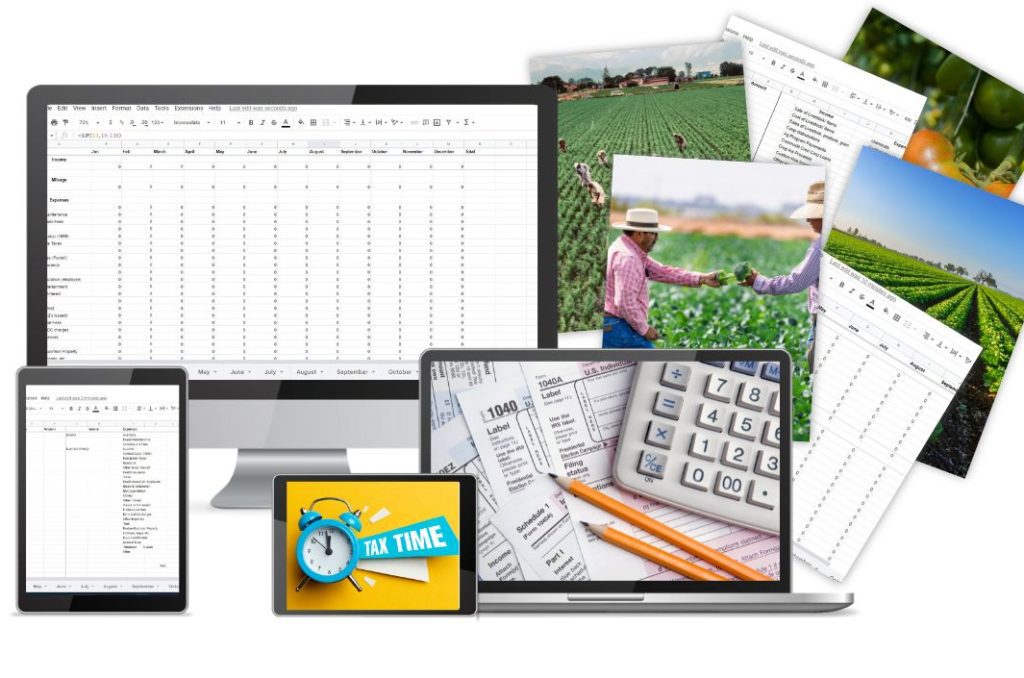
      • Farm Expense And Income Tracker
      • Goat Crash Course: 101
      • Garden Journal Prompts
      • Schedule C Tracker
      • Schedule C Tracker
      • The Homestead Bundle
  • The Truths
  • Episode List
  • Start Here
    • Privacy Policy
    • Affiliate Disclosure
    • Let’s Get in Touch
    • Members Only Library
    • Welcome To Our Homestead

Animals

Overwhelmed With Chores?

March 12, 2024 by Leigh Leave a Comment

It’s easy to get overwhelmed with chores on the homestead. Goats need milked, eggs collected, dogs let out, and ducks bedding changed AGAIN. On top of that everyone needs to be fed, including the children. By the time your day is done you’ve logged 9 million steps and are exhausted. But sleep is for the weak because you have to stay on alert for predators, the baby, and the sick goat in your living room. Chore management on the homestead is a really thing and it’s hard to get a handle on.
Dealing With Overwhelming Chores

Yes, I am overwhelmed and yes, I am tired. But I have found some pretty ingenious hacks to allow me to get some sleep without sacrificing my animals care. Below are my 5 hacks to keeping up with the homestead, while working full time, homeschooling, and running a several businesses.

The Ultimate Homesteader’s Starter Bundle – Only $47!

Get the tools you need to stay organized, track profits, and manage your homestead with ease!

Includes:
✅ Schedule F Tracker – Simplify tax prep
✅ Profit Calculator – Track earnings
✅ Hay Calculator – Plan livestock feed
✅ Garden Journal – Digital & printable
✅ Herd Health Tracker – Monitor animal care
✅ Simple Budget – Manage finances
✅ Backyard Homestead eBook – Essential tips

$99 value – now just $47! Start your homesteading journey today!

Buy Now

Get the kids involved

I have found that there are two sides on this, and few people fall in the middle. Either kids do chores or they don’t. My boys do chores, and they do a lot of them. Every month they switch out, except for animals. We also help each other out. If I see the ducks need water, I fill it up. If Jaxson sees that the cats are out of food, he feeds them. Their current chore list looks like this:

Chase- Goats, feeding dogs/cats, wiping up the counters, vacuuming, and cars

Jaxson- Chickens/ducks, dishes, bathrooms, (yes, this seems off. But in our house, dishes get run 3x a day)

Me- Goats, gardening, other seasonal work

Jared- Building

But I see no reason why kids can’t do chores. Especially when they want toys, electronics, etc.

If you are interested in learning more about my favorite garden planner. I highly recommend Seedtime! This planner has been instrumental in helping me plan out my gardens with WAY more efficiency than I could ever expect! It has also reduced overwhelm, stress, and calmed my ADD/ADHD!

More Info!

Start small and grow

When we started the homestead, we started with our dogs, cats, dragons, and snake. Then we added chickens. Once we were comfortable with that, we added goats, and so on. Before we add anything new, or more of them, we ask if everyone is on board. Since the kids handle most of the day to day animal care, we want to make sure that they are good with getting more.

This means don’t start a 8,000 sq ft garden right out of the gate! Start a small garden and then grow it. This could mean starting a seeds inside before you build or buy a greenhouse.

I am currently working on this right now with our soil and pasture building project. Our soil is so compacted from lack of care that I am working to regenerate the soil and set up a strong pasture so we no longer have to feed our goats off farm inputs.

goat kidding

Before we get too far into this, I have a great course on the basics of goat care. I call it Goat Crash Course: Goat 101. In this course, I explain things like types of shelter, types of feeds and hays, basic assessments and so much more! Check it out!

Buy Now

Get into a routine

While this is tough at first, once you get into a routine of taking care of your chores, it’s easier to see where you have more time. Our routine goes something like this, I wake up, let my dogs out and shower. The boys get up, let their dogs out and start on their animals. If they are hustling they can get their morning chores done in about 10 minutes.

Because we unschool, our homeschool doesn’t take hours and hours. We talk about what they are interested in and they do research on that. We also take time for the basics like math, reading, social studies, and science. They do Spanish on Friday.

During garden season (Mid February to Mid November), I can usually be found outside until the weather drives me inside. I have a list of “rainy day chores” that I work on whenever the weather drives me inside. Like record podcasts or videos, write blog posts, planning days, etc.

Banner 468x60

Delegate

One of the first things I was taught in Paramedic school is delegation, and it’s not something I do well at work. But at home, I’ve got it covered. After talking with Jared about our goals and what we want to accomplish, I come up with the To Do lists and plans and delegate it out. This helps everyone figure out where they need to be, what they need to be doing and how to finance it. It’s not a hard fast rules/ to do lists, but it helps everyone know what they need to do.

Save on Seeds

It also extends to chores. Since keeping up the house is everyone’s chore, we split the chores as evenly as we can. I hate doing the dishes, so the other 3 handle it. They hate doing laundry so that usually falls to me. I handle the grocery shopping and bill paying. Jared handles building. Chase handles the goats, and Jaxson handles to poultry. Then we help each other out as needed to make sure that everything actually gets done.

Cleaning

I could write an entire blog post about cleaning up the house and the homestead. I would be lying if I said my house was spick and span. It’s not. I’ve got 4 huge dogs, and kids living inside my house. Not to mention the occasional goat, chicken, duck, etc. My house is never clean. But I clean up as I go and everyone else helps a lot.

Don’t get hung up in the details. My kitchen is a prime example. That little ledge behind the sink that collects all manner of nasty things is constantly dirty. I have tried everything in my power to keep that area clean but it’s not happening and you know what? That’s fine. My counters and stove are clean and the sink is mostly empty. Pick your battles and move on.

Grace

At the end of the day, you are simply human. Give yourself grace when you can’t get your kitchen scrubbed or the laundry done. The animals have food and water and the kids aren’t dead or hurt? You’ve done just fine.

Overwhelmed With Chores?

One of the biggest lessons that I’ve learned on the homestead is that there is always tomorrow. We have been conditioned to believe that tomorrow isn’t guaranteed. And yes, that’s absolutely true. But if you run yourself, spouse or kids into the ground trying to get everything done TODAY, you will burnout everyone out.

I have a saying that I have adopted since hitting homestead burnout…. If I die tomorrow, it’s not my problem. This may sound very off handed or too laid back way of looking at life, but it’s the honest reality. If I drop dead tomorrow, it’s not going to matter if I took a nap instead of starting seeds. It doesn’t matter if I put tomatoes in the freezer instead of running them through the canner.

I’m not saying that you have to have that mindset. But what I AM saying is that you have to give yourself and your family grace and kindness when it comes to this stuff. To give an example, I was supposed to be done with this blog post about 3 hours ago. But instead, I took a nap because I was exhausted from working a 36 hour shift on the ambulance…. And that’s fine.

If you like the content I put out, feel free to buy us a coffee! It helps keep this site running, marketing and the goats in grain!

Buy me a coffee

If you like this post, feel free to share it and follow us below on our social media accounts!

  • Facebook
  • Pinterest
  • Instagram
  • YouTube
  • TikTok
  • Spotify
  • Threads

Filed Under: Animals, Garden Tagged With: Chickens, Chores, Ducks, Goats, Homestead, Overhelmed, stress

JOIN TO OUR MAILING LIST!

Leave us your email to receive new posts and special offers for members only! Don't miss a thing!

Recent Posts

  • Fall Garden Guide
  • Top Mistakes With Goats
  • How To Bond With Your Goats

Goats Are Not Beginner Livestock

March 9, 2024 by Leigh Leave a Comment

I have recently been asked “If you love goats so much, why do you tell people not to get them?” The answer is simple, if more people would educate themselves before buying animals, I wouldn’t tell them not to buy goats. Most people do not do the research, and they end up getting a bunch of animals that they are not prepared to care for. But the reality is that goats are not for the feint of heart and they are not beginner livestock.

goat kidding

Before we get too far into this, I have a great course on the basics of goat care. I call it Goat Crash Course: Goat 101. In this course, I explain things like types of shelter, types of feeds and hays, basic assessments and so much more! Check it out!

Buy Now

Goats are NOT beginner livestock

I wrote my post about goats coming to the homestead and I will be honest, I left a lot of information out. Mainly because it was a piece designed to give a brief snap shot of why and how we have come to love our goats. But I feel, especially after what I said above, that I needed to be a little more clear about why I feel this way.

The plan truth is that it is easier to kill a goat than keep it alive when you are just starting out. When we first bought Bella and Voldemort, we knew that he had worms. But we had absolutely no idea what that actually meant. If a dog has worms, you give it a pill and repeat again in a week. After that you should be good to go. With goats it’s not that easy. In fact, goats will easily die from worms and quickly.

Banner 468x60

Goats Die Easily

There is a treatment protocol that is now in place because farmers have overtreated for parasites and it has caused resistance to these dewormers. Instead of two doses of one dewormer, it is multiple doses of several dewormers over several days/weeks. If you don’t know these things, you will lose goats before you are ever really comfortable with them.

Banner 468x60

Then there are plants are toxic that can kill them or the predators out there. Or that if their rumen gets out of whack, they could die. I have an entire book of treatment protocols that I have gone over with my vet to make sure I am doing the right thing.

That being said, once you understand what you are doing and why, it is extremely easy to keep them going. With regular herd checks and individual checks, your herd can thrive. We’ve had some touch and go moments since owning goats and we have managed to pull most of them through.

goat kidding

Before we get too far into this, I have a great course on the basics of goat care. I call it Goat Crash Course: Goat 101. In this course, I explain things like types of shelter, types of feeds and hays, basic assessments and so much more! Check it out!

Buy Now

Having Medications On Hand

Unlike your dog, cat or even chickens, you need to have medications on hand for goats and know how to use them. Goats can take Aspirin, but if you don’t know how often or the dosage you could kill them. You need to have antibiotics on hand for things like pneumonia, antitoxin for injuries, thermometers for temp checks and minerals for their general health.

Good luck finding a vet that will treat your goat. Seriously, we got incredibly lucky that not only does our vet treat ALL of our animals, they are goat owners themselves. So they know how to take care of small ruminants, which is huge when figuring out how to take care of these creatures.

I have a tool box that I carry when doing herd checks. It is packed to the brim and a binder that lists medications, FAMACHA scores, weights and much more. I conduct herd checks weekly to make sure that we catch any possible illness before they happen. Even with all that, we ended up with two pregnant goats that we didn’t catch until a few weeks before delivery.

But once you learn what you need to do to care for them appropriately, they are worth it. Every time they bleat when you come into their pen. Their antics when they are playing fighting, and more is so worth every ounce of heartbreak when you lose one.

Goat People vs Everyone Else

There are two types of people when it comes to goats. There are people who have goats and people who love their goats. I know many people who have goats and they are just that, a goat. Goat people truly love their goats. I have chickens, I like them and they’re pretty cool but I don’t love them. I am not a chicken person. I’m not going to snuggle my chickens. I’m not going to check on them constantly. If one goes missing? I’m not going to be upset.

Save on Seeds

My goats? I cried when we lost Voldemort and Texas. My kids bawled with Texas. I refused to entertain the notion of another goat after that for about 5 minutes because I love these goats. I am a goat person. I have spent untold hours researching everything I can about them. I have spent more money on them then I care to admit, but they are my babies.

So No Goats are NOT beginner livestock

They just aren’t. But that is coming from a goat person. Someone who truly loves these animals and wants you to love them too. So if you want goats, by all means, get goats. They are really cool critters that have absolutely stolen my heart. But understand what you are getting into. It’s not all sunshine and roses.

goat kidding

Before we get too far into this, I have a great course on the basics of goat care. I call it Goat Crash Course: Goat 101. In this course, I explain things like types of shelter, types of feeds and hays, basic assessments and so much more! Check it out!

Buy Now

Sometimes it’s recognizing that your goat isn’t acting right and getting in there with a thermometer, FAMACHA chart and figuring it out. Or collecting poop and storing it in your fridge until you can get it to the vet. It’s keeping goats in your house because they could die at any minute and you need to be there to try and stop it. It’s realizing that despite your best efforts some may die and there’s not a lot you can do to stop it.

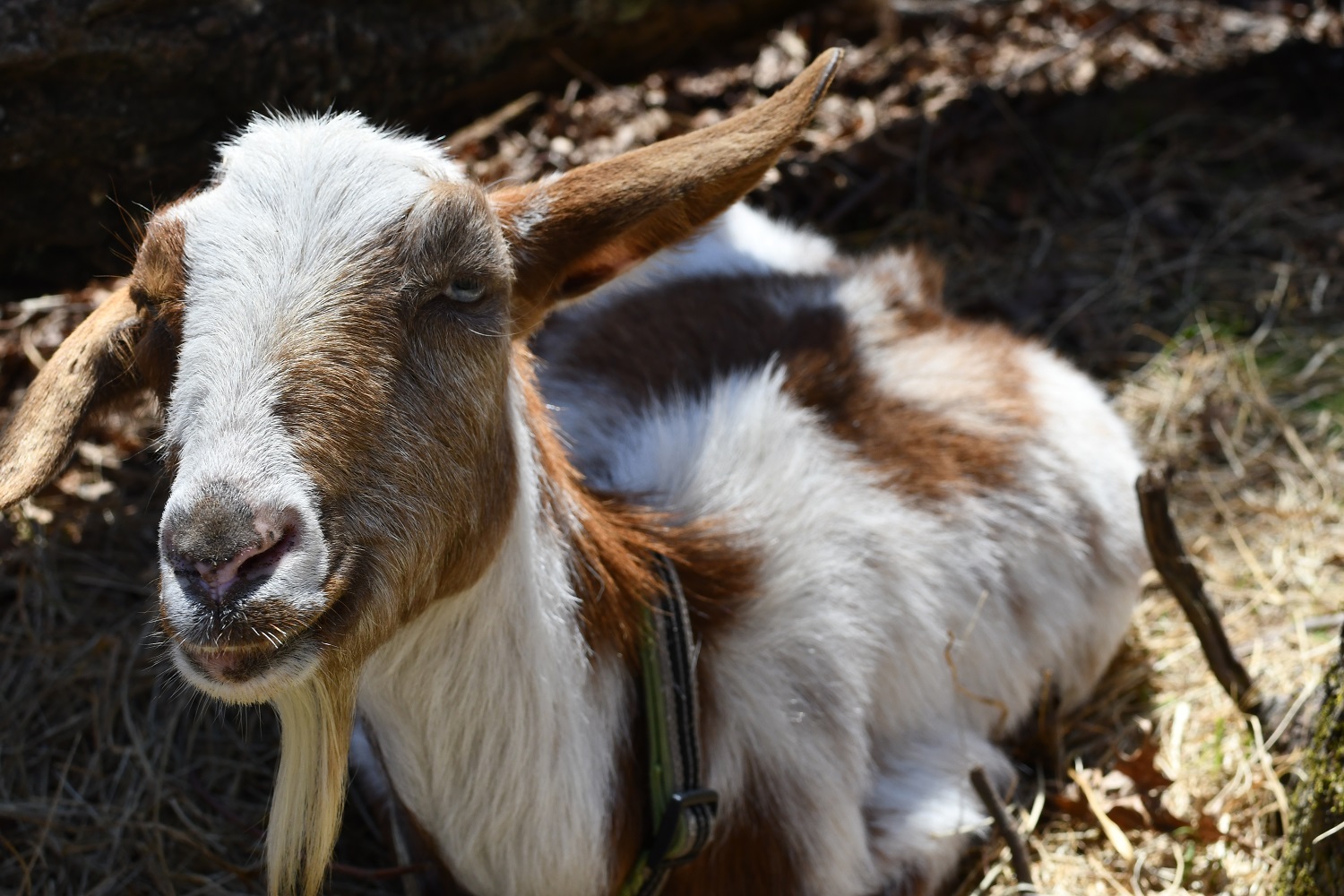
But it’s also having your goats sing to you as you come down your driveway- RIP Texas

It’s getting snuggles from your best girl- Champ

It’s playing, getting headbutts, and dodging a buck in full rut- Midas

It’s slowly, so slowly winning the affection of Queen Bee- Bella

It’s watching two girls grow and start to play and call out for you- Oakley and Bailey

It’s helping deliver the first goat born on your homestead- Stella

It’s wethering your first buck- BeeBee

It’s being surprised by a new kid on the ground and not realizing your girl was that close- Bailey and Sebastian

It’s doctoring a sore shoulder because he jumped off a log- Finnegan

It’s listening to a tiny bleat from a huge goat with a comb over- Spike

It’s watching 2 little girls melt my husbands heart with every whiny bleat and nibble- Jade and Sapphire

Logo 468 x 60

So while they may not be beginner livestock, they are absolutely worth the time, energy, effort and money that goes into their care and keeping.

If you like the content I put out, feel free to buy us a coffee! It helps keep this site running, marketing and the goats in grain!

Buy me a coffee

If you like this post, feel free to share it and follow us below on our social media accounts!
  • Facebook
  • Pinterest
  • Instagram
  • YouTube
  • TikTok
  • Spotify
  • Threads

Filed Under: Animals, Goats, How To's, Our Homestead Tagged With: Chickens, Goats, Homestead

JOIN TO OUR MAILING LIST!

Leave us your email to receive new posts and special offers for members only! Don't miss a thing!

Recent Posts

  • Fall Garden Guide
  • Top Mistakes With Goats
  • How To Bond With Your Goats

Best Chickens For A Homestead

March 5, 2024 by Leigh Leave a Comment

You’ve closed on your new homestead and are itching to get your first set of livestock. Or, you have made the determination that you need chickens on the homestead to help close some holes in food security. What are the best chickens for a homestead? The short answer is: that depends. The real question you should be asking yourself is, why do you want chickens on the homestead?

The Ultimate Homesteader’s Starter Bundle – Only $47!

Get the tools you need to stay organized, track profits, and manage your homestead with ease!

Includes:
✅ Schedule F Tracker – Simplify tax prep
✅ Profit Calculator – Track earnings
✅ Hay Calculator – Plan livestock feed
✅ Garden Journal – Digital & printable
✅ Herd Health Tracker – Monitor animal care
✅ Simple Budget – Manage finances
✅ Backyard Homestead eBook – Essential tips

$99 value – now just $47! Start your homesteading journey today!

Buy Now

What Do You Want Out of Your Chickens

If you simply want chickens to have chickens then really any breed will do. It doesn’t matter how many eggs they lay, or if they are good for meat. You could get any breed and be happy with that choice. However, if you are looking for a high producing egg layer that is going to give you a ton of different colored eggs to sell at the farmers market, a Cornish Cross is not your answer. So here are our top favorites for bringing chickens to the homestead.

Best Egg Laying Birds

  • Australorps- Lay large brown eggs and a heritage breed. They will lay about 250-365 eggs a year. They are also considered meat birds which is why our rooster may end up in the stock pot if he doesn’t start being nicer.
  • Black Star- This is not a heritage breed and can’t beat the Australorps with egg production, but they can usually lay about 200 large brown eggs a year. They will hit maturity about 2 weeks faster. They are also a good meat bird.
  • Red Star- The red start is up there with the Australorp when it comes to egg production with the same 250-365 eggs per year. Plus, they reach maturity faster which means faster eggs. And they are a decent meat bird.
  • Rhode Island Red- The RI Red also lays large brown eggs and will lay 250-365 eggs a year. They are also good meat birds.

Banner 468x60

All of these birds are good to free range which means that you can let them run your property and they will probably not run away. That being said, we ordered 15 birds for our first batch, and we only have 9 left.

Best Meat Birds

Before we delve too deep into the world of meat birds there are some things to consider. First, are you ONLY raising these birds for meat? If so, the Cornish Cross or Freedom Ranger are the birds you are looking for. If you are looking for something that will grow slower and you can maybe get some eggs out of? Then a Delaware or Rock may be a better option.

  • Cornish Cross- These are the big white birds that the chicken industry is known for. They mature quickly and hit butcher weight at around 8 weeks old.
  • Freedom Ranger- These are a big red bird that are slower to mature but are said to be more tender. They usually reach butcher weight around 12-15 weeks. We raise these guys for our meat birds.
  • Delaware Broiler- This is one of the better tasting meat birds but tend to be about 3# female and 4# male at 12 weeks old.
  • The Giants- I have to put these guys in here, but I’m not a fan. The meat to feed ratio and meat to bone ratio is WAY off for me. They should reach butcher weight around 20 weeks but because they get so big, their feed bill is as impressive as they are. They lay a decent amount of eggs,150 or so a year, that are large and brown.

Logo 468 x 60

Best Brooding Birds

Brooding hens are chickens that are most likely to sit on eggs. That doesn’t meant that they WILL but they are more likely. I added them to this list because we are moving towards hatching our own chicks and would like to have the birds do the work for us. Especially since unexpected power outages can render those eggs useless.

  • Dark Brahma- These are impressive birds that will fit pretty much any need you have. Unfortunately they are poor free rangers but they are excellent mothers and lay about 150-200 eggs a year.
  • The Cochins- These chickens come in many different colors and sizes but we have the standard black and they are more likely to sit on eggs for us, as well as give us a good amount of them. They are also good for meat with a solid meat to bone ratio.
  • Sussex- We absolutely love the Sussex. Every single one we have went broody and actually hatched out all of their chicks.

Best All Around Birds

  • Australorps- Solid egg production, good meat weights, and foragers. This is a homestead favorite. George is an Australorp and while most of these guys have a great disposition, he does not.
  • Plymouth Rocks- These guys come in several different colors and are great birds. They can usually be butchered around 18-20 weeks. They lay large brown eggs and should lay about 200 or so a year.
  • Sussex- The other two birds on this list are not likely to sit, the Sussex is the most likely to sit and in my opinion is the best chicken for our homestead. They are excellent meat birds, egg layers AND mothers.

If you are new to heating with firewood and are looking to master the finer points of it. We’ve got a great eBook that goes in depth of what tools you should consider, how and where to stack, how to build a fire and so much more!

Buy Now

Things That Most Chickens Are Going To Do

Before you end up thinking “This breed is good for this, and that for that”, here is a list of traits that 99% of chickens have. We call it chickens doing chicken shi…stuff.

  • Scratch and peck- All chickens will forage for bugs, grubs, and greens. They will decrease your bug population by half if you let them. They will also forage on all the goodness around your property and that helps reduce your feed bill.
  • Free range- Yes, technically speaking all chickens will free range. If you have a good rooster, even the worst free ranger will come back home. For all George’s faults, he takes excellent care of his girls. When that changes, he’s going in the stock pot.
  • Make a mess- All chickens are going to wreck havoc on your homestead. They are going to get into to your garage and break a $100 bottle of goat antibiotics. They are going to poop EVERYWHERE. That is the trade off for “free” eggs.
Save on Seeds

On our homestead we absolutely love our chickens. Not to the point that they are pets, but we love that they don’t require a ton of feed because they free range. We love that they are a meat source if necessary. And to be fair, they are pretty cool critters that allow you to hang out with them, if you’ve socialized them.

If you like the content I put out, feel free to buy us a coffee! It helps keep this site running, marketing and the goats in grain!

Buy me a coffee

If you like this post, feel free to share it and follow us below on our social media accounts!
  • Facebook
  • Pinterest
  • Instagram
  • YouTube
  • TikTok
  • Spotify
  • Threads

Filed Under: Animals, Chickens Tagged With: Chickens, Chicks, Eggs, Homestead

JOIN TO OUR MAILING LIST!

Leave us your email to receive new posts and special offers for members only! Don't miss a thing!

Recent Posts

  • Fall Garden Guide
  • Top Mistakes With Goats
  • How To Bond With Your Goats

How Much Hay Does Your Goat Need?

March 2, 2024 by Leigh Leave a Comment

No matter where you live, there’s a really good chance that you will need to feed your goats hay to get them through winter. If you live in the south, you probably won’t need a ton. But if you have an actual winter, you probably want to make sure you have enough. To figure out how much hay you need, we’ll need to ask some questions first.

goat kidding

Before we get too far into this, I have a great course on the basics of goat care. I call it Goat Crash Course: Goat 101. In this course, I explain things like types of shelter, types of feeds and hays, basic assessments and so much more! Check it out!

Buy Now

Questions to ask yourself

How many goats do you have? How long do you need to hay your goat? Are you breeding your goats? What kind of storage do you have for hay?

I wish it was a simple equation but the reality is you don’t want to find out you were wrong in the middle of a snow storm. But I am going to give you the high points and what we do with our goats. By the end of this post, you can go into fall and winter with a rough idea of how much hay you’ll need.

Oakley and Bailey the goats
Oakley and Bailey

Before we get started I want to address something. Yes, I am writing this post in March. Why am I writing a post about how much hay you need for winter in the spring? Because being prepared is key for getting your livestock through winter. It doesn’t matter if you are in a mild winter climate like Georgia, or being buried in feet of snow every winter like Alaska. Knowing how much hay your goats need will get your goats through winter without losing body condition or worst case, a goat.

Save on Seeds

How Many Goats Do You Have? And Are You Breeding?

The key to successfully getting your animals through winter is know how many mouths you are feeding and how much they should eat. While this may seem like a no brainer, you must also consider how many additional animals may be coming to your homestead. We ended up picking up two more goats in January, had we not planned for extra hay, we would have been short because we now have two more mouths to feed.

Bella scratching her side because her pregnant belly gets in the way

You also need to consider if any of your does are pregnant, or could become pregnant. If you only get the minimum needed for each goat, and now your doe needs more hay because she is pregnant, you will be short. Or worse case, you don’t have enough for when the babies are ready to eat.

Logo 468x60

How Long Is Your Winter? Where Are You Storing Your Hay?

In Georgia, we have an extremely mild winter. Sure it gets cold and wet, but it doesn’t snow a lot and we usually have some sort of greenery for goats to eat. It is certainly not enough for them to eat throughout winter, but we do have some grasses that will grow year round here. When we start figuring up how much hay we need, we look at how much we got last year, and how long that lasted us. We also figure up how many months we will use hay.

For us, we want the ability to start giving them hay by mid to end October and have enough to carry them to the end of April. Now, we don’t start getting cold enough for our pastures to start hibernating until probably November. Our grass also usually starts growing in March, but having that extra cushion allows us to not worry if we get a freak snow storm in March, which has happened.

Jared also built a hay barn that is about fifty feet from our goat barn. While that is certainly a pain some days, especially when it is raining. It adds a layer of security that if the hay catches fire, which it’s prone to doing, our goats are safe. We tweaked his original design so that it’s easier to load. He’s also going to make an opening so that the goats can still get hay if they run out.

So How Much Hay Do You Need?

The general rule of thumb is 2-4 pounds of hay per day per goat. Or if you know their weight, 2-4% of their weight per day. Before we start looking at how much hay you need, I have a hay calculator in our general store that will make all this math a LOT easier. All you have to do is put the weight of your animal (estimating is fine), the percentage you want to feed per day and the amount of days you want to feed for. On the second page, there is a hay tracker that allows you to see where you bought your hay previously, how much you bought, how much you spent and so on.

The Hay Calculator:

If you aren’t math-y (don’t worry I’m not either), check out our Hay Calculator. It literally does ALL of the math for you and gives you totals based on what you want your goals.

On the second page, you can track where you’ve bought hay, what you spent and how long it lasted.

Buy the Hay Calculator

So let’s crunch some numbers. When we ordered our hay this year we got fescue/ Bermuda mix and we got two strand square bales. We had four goats, but our Texas died before we actually started using the hay. But we figured that each goat weighed 50# and we wanted to make sure that we had plenty of hay. So our equation looked like this

50# x .04= 2#/ day

2#x4 goats= 8#/ day

30 days in a month x 8 months= 240 days

8#x 240 days=1920# of hay

Tractor Supply

I know two tons of hay sounds like a lot, and it is. But if we had minimized what we needed:

30# x .02= .6#/ day

.6#x4 goats= 2.4#/ day

30 days in a month x 8 months= 240 days

2.4#x 240 days=576# of hay

We would have run out of hay in December. Let’s not mention that we wouldn’t have had enough to feed the two new goats we got in January. So knowing these figures allowed us to figure out how much hay we needed and we actually rounded down to about 1600# of hay.

The Hay Calculator:

If you aren’t math-y (don’t worry I’m not either), check out our Hay Calculator. It literally does ALL of the math for you and gives you totals based on what you want your goals.

On the second page, you can track where you’ve bought hay, what you spent and how long it lasted.

Buy the Hay Calculator

Now the second question of where to put the hay comes into question. Because we didn’t have a place to put a round bale of hay, nor anyway to move it into the pens, we opted for 2 strand square bales. Not only did we not have space, but putting all our eggs in that basket seemed like a bad idea. If any portion of that round bale molded and we fed it to the goats, they could all die. So we went with square bales.

Jared built our hay barn so that we could house the hay without it getting wet but still had plenty of ventilation, which decreases the chances of it molding, composting, or any other nasty that would make it unusable. When we ordered our hay we ordered 28 bales of hay to get everyone though winter. That’s about 1600# and we only paid $200 for it.

Tractor Supply

This year we will have twelve goats to get through winter and we have been seeding our pasture to make sure they had plenty of options, especially in winter. To give you a break down of how much hay we are planning for and the corresponding math.

Our seven girls total weight= approximately 525#

Our five bucks/wether= approximately 600#

1125# goat x .04 & .02= 45# of hay/ day or 22# of hay/day

30 days x 45 (and 22)= 1350# or 660#

Logo 468x60

Long feed (September to April) X High Weight= 10,800#

Long Feed X Low Weight=5280#

Short Feed (November to March) X High Weight=6750#

Short Feed X Low Weight=3330#

If all of that is just a lot of information and hard to keep up with? Just head over to our hay calculator and you can purchase the much easier version.

Save on Seeds

Now we average the highest number and the lowest number: 10,800# and 3,300#= 7,050# of hay.

Why do we average it? Because they aren’t only going to eat hay. They get alfalfa pellets and grain as well. Plus they will eat branches, dead leaves, etc. So they won’t need the full 45# of hay per day. But they might. And as I said before, I would rather have too much than not enough. And let’s face it, they are going to waste a fair amount of it.

Is there an easier way to do this? Absolutely. I could just multiply by .03 instead but I like having the high and low numbers. If I am aiming for 10k # of feed and only hit 5k #, then I know I will have to buy extra grain, alfalfa pellets, or beet pulp.

So how much hay do you need to get through winter? Use the formula above to figure it out and remember, it is better to have too much than not enough.

If that was a little too much to handle, don’t forget you can use the hay calculator to make it a TON easier

The Hay Calculator:

If you aren’t math-y (don’t worry I’m not either), check out our Hay Calculator. It literally does ALL of the math for you and gives you totals based on what you want your goals.

On the second page, you can track where you’ve bought hay, what you spent and how long it lasted.

Buy the Hay Calculator

If you like the content I put out, feel free to buy us a coffee! It helps keep this site running, marketing and the goats in grain!

Buy me a coffee

If you like this post, feel free to share it and follow us below on our social media accounts!
  • Facebook
  • Pinterest
  • Instagram
  • YouTube
  • TikTok
  • Spotify
  • Threads

Filed Under: Animals, Frequently Asked Questions, Goats Tagged With: Goats, hay, Homestead

JOIN TO OUR MAILING LIST!

Leave us your email to receive new posts and special offers for members only! Don't miss a thing!

Recent Posts

  • Fall Garden Guide
  • Top Mistakes With Goats
  • How To Bond With Your Goats

What Does Homestead Mean?

February 27, 2024 by Leigh Leave a Comment

There is no hard fast definition for what homestead means. For some people a homestead means completely off grid with no reliance on anyone but themselves. Others believe that homesteading means growing their own vegetables. But as time goes on, the meaning changes for those people as well. Regardless of what this means to others, I am going to tell you what homesteading means to me and what it has come mean as well.

The Ultimate Homesteader’s Starter Bundle – Only $47!

Get the tools you need to stay organized, track profits, and manage your homestead with ease!

Includes:
✅ Schedule F Tracker – Simplify tax prep
✅ Profit Calculator – Track earnings
✅ Hay Calculator – Plan livestock feed
✅ Garden Journal – Digital & printable
✅ Herd Health Tracker – Monitor animal care
✅ Simple Budget – Manage finances
✅ Backyard Homestead eBook – Essential tips

$99 value – now just $47! Start your homesteading journey today!

Buy Now

What Does Homestead Mean

Well, the formal definition of homestead I pulled from Oxford Dictionary is:

“A house, especially farm, and outbuildings.”

The good thing about that definition is that it’s as broad and vague as how homesteaders, or aspiring homesteaders define homesteading.

Really, any piece of property can be a homestead! You don’t HAVE to have hundreds of acres. You can homestead on a city lot or out in the country.

What Does Homestead Mean To Me?

At first, homesteading meant a way to take care of my family without relying so much on others. The thought of being at the mercy of grocery stores to have my food was slightly worrisome. If we couldn’t get food, where would we be? Not having access meat, veggies, fruit, dog or cat food, has the potential for disaster. There were a ton of holes in our food security.

It meant learning skills and building a legacy for my children. Things like building barns, fences, and gardens. It meant learning how to cook from scratch.

Delicious biscuits

Learning Skills Ma Ingle Would Have Been Proud Of

From scratch cooking is surprisingly easy. I wonder if we were raised to believe that it was so much harder so that there was more reliance on boxed and canned meals. Since being on the homestead, we have learned a ton when it comes to cooking, canning, and other food related skills.

Homesteading can mean bringing animals into this world, learning how to milk and make cheese and processing animals. It means learning to depend on yourself in ways that you never really valued or thought you could do.

I learned that if I can raise my own hens, I can get eggs that I don’t have to go to the store for. I could raise my own meat birds and rabbits to help save on meat costs. Also, I learned that if I learn to preserve those things, I can have them on stand by and make everything easier.

Save on Seeds

Sometimes meanings change

But as time has gone by and the continued strain on our supply chain, homestead has come to mean other things as well. It means being prepared and stocking up on items that we use a lot of: coffee, tea, noodles, canning jars and lids, and other necessities. Making sure that we have enough supplies if another snow storm hits. Will we have plenty of firewood, canned food, and fuel for the chainsaws and other equipment?

If you are a farmer/ homesteader and looking for a way to track your income and expenses, I highly recommend our Schedule F Tracker! We have been using it for years and it is the easiest, fastest and best way that we have found to keep track of the money spent on the homestead.

Buy Now

Homesteading means community. We realize that we are stronger together and we stand with our neighbors when times are good and we help pick them up when they have hard times. It’s knowing that they will stand with us in our hard times too.

Logo 468x60

It has also come to mean finding random eggs in the hay barn, playing with goats, and impatiently awaiting the arrival of Champ’s babies.

Update: She gave us a beautiful doeling that we named Stella.

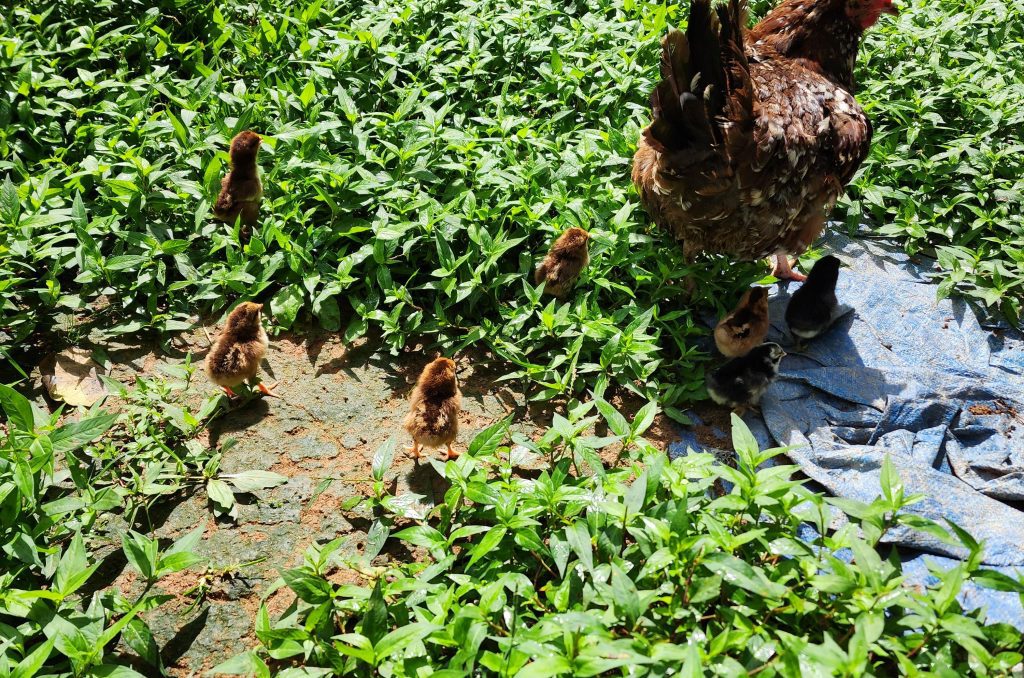
It means caring for the new chicks that will not only give us eggs but also lay our next meat chickens. Homesteading means learning new skills, facing challenges, and not giving up. It means doing the things you thought you couldn’t, only to realize that you are more than capable of building fences, buildings, and fixing all the things.

Poor Champ is uncomfortable as she comes to the end of her pregnancy.

What Homesteading Doesn’t Mean

I can tell you that homesteading doesn’t mean judging others. Whether you have a quarter acre in the city or a hundred acres in the country, you are still homesteading regardless of if you purchase your food from a grocery store or farmers market, or if you grow your own.

It doesn’t mean being unaffected when creatures die or need to be butchered. For some people, taking the life of a chicken is okay, but it still affects them in some way, even if it’s only gratitude.

The Hay Calculator:

If you aren’t math-y (don’t worry I’m not either), check out our Hay Calculator. It literally does ALL of the math for you and gives you totals based on what you want your goals.

On the second page, you can track where you’ve bought hay, what you spent and how long it lasted.

Buy the Hay Calculator

Homesteading doesn’t mean easy. There is no part of this life that is easy. If you are hauling lumber for a barn or feed to your animals, homesteading is hard work. It can be heart and back breaking when you have to put down your favorite bottle baby because she got sick.

You can’t be lazy and a homesteader. There is simply too much to do. Gardening, canning, working with livestock and more, there is not a ton of downtime. But when you see the fruits of your labor? It’s worth every aching joint, pulled muscle, cut and bruise.

New Chicks

What Does Homestead Mean?

I don’t know that homesteading has a meaning. I think homesteading is a spirit. It’s the spirit of being less dependent on the power grids, grocery stores, and other commodities. These people who want to homestead do it because they want to be independent. Whether that is a completely or partially independent, is not the point. Homesteaders simply want to take care of themselves and their community. Which is what homestead means to us.

Banner 468x60

I think that as long as people want to take ownership of their little plot of land, we will keep the spirit of homesteading alive. I think as long as people desperately want to learn the skills of their ancestors, they will lead a full and productive life. And I think that as long as we are here fighting for our community and independence, we will see the resurgence of a way of life that mixes the old with the new. And we will be better for it.

What does homesteading mean to you?

If you like the content I put out, feel free to buy us a coffee! It helps keep this site running, marketing and the goats in grain!

Buy me a coffee

If you like this post, feel free to share it and follow us below on our social media accounts!

  • Facebook
  • Pinterest
  • Instagram
  • YouTube
  • TikTok
  • Spotify
  • Threads

Filed Under: Animals, Canning, Chickens, Garden, Goats, How To's, Our Homestead, Pigs Tagged With: Animals, Homestead

JOIN TO OUR MAILING LIST!

Leave us your email to receive new posts and special offers for members only! Don't miss a thing!

Recent Posts

  • Fall Garden Guide
  • Top Mistakes With Goats
  • How To Bond With Your Goats

Our Best Dual Purpose Chickens

February 17, 2024 by Leigh Leave a Comment

When we first brought chickens to the homestead, we started with 25 chicks. As we became victims of chicken math, we have grown our flock to about 50-75…. They are really hard to count. While I don’t LOVE the thought of dual purpose chickens, there is a need to have a good solid laying hen, that can produce good meat animals. So, these are our best dual purpose chicken breeds.

The Ultimate Homesteader’s Starter Bundle – Only $47!

Get the tools you need to stay organized, track profits, and manage your homestead with ease!

Includes:
✅ Schedule F Tracker – Simplify tax prep
✅ Profit Calculator – Track earnings
✅ Hay Calculator – Plan livestock feed
✅ Garden Journal – Digital & printable
✅ Herd Health Tracker – Monitor animal care
✅ Simple Budget – Manage finances
✅ Backyard Homestead eBook – Essential tips

$99 value – now just $47! Start your homesteading journey today!

Buy Now

Why More Chickens?

Bringing more chickens home is a multi-layered answer. First, we sell eggs. That means that we need more eggs than our current eight hens can keep up with. Seriously, I’ve got a wait list going on. Second, we want to be able to hatch chicks and sell those babies to others. Third, and most sensitive to people, we want meat. Having the additional 24 laying hens will up our production in all of those areas. Since the third reason is so controversial I want to briefly touch on it.

We eat meat, as I am sure many of us do. But with the rising prices of everything, the cost of meat is skyrocketing. I don’t know about you but I can’t afford to keep having to fork out hundreds of dollars a month on meat. And going vegetarian is not a viable option either. Let’s not mention the living conditions of some of these chicken houses. You can read more about my choice to raise our own meat chickens here.

But to expand a little more, when you raise meat chickens you normally hear about the Cornish X. These birds are not genetically modified but they have been bred from several other breeds of chickens to get big as fast as possible. That’s fine with me. We raised fifty of them over winter. But I’m not going to lie, they don’t taste good.

I’m not sure if it’s because they were allowed to free range, we waited to butcher a little too long or what, but I’m not a fan of the meat. But to keep with the point, my issue with the Cornish X is: what happens when I can’t order them? I want to close the holes in our food security as much as possible. So having to order them from a hatchery doesn’t make a lot of sense.

Banner 468x60

So we made sure to order chicks that are all dual purpose breeds. We have Dark Brahmas, Sussex, Ancona, Dorking, Black Cochins, and New Hampshire’s. They are also pretty good egg producers with a mix of cream, white, and brown eggs. Lastly, we made sure to get a couple of breeds that are good mothers. We wanted to have the ability to leave the eggs and let them hatch them out.

cropped-3.jpg

Are you looking for garden journal prompts, but aren’t interested in a weekly email? Check out our 365 Garden Journal Prompts! This is an amazing, all in one, yearly product that you only pay for once.

Buy Now!

Our thinking was, if the power goes out for several days (which we are prone to here), we don’t want to rely completely on an incubator. I’ll keep you up to date on how they are doing but for now, they are warm, happy, and loving their box.

Our Best Dual Purpose Chickens

Speckled Sussex- Our Sussex’s have been absolute rockstars when it comes to doing chicken things. They have been fantastic in the garden and have single “winged” taken out about half of our Japanese Beatle population. They are also fantastic mothers. Sussex are a fairly fast growing chicken with good meat to bone ratio. But be forewarned, it takes them about 6-8 months to get to a decent size.

Black Australorp- I have to say, I don’t really care for the Australorp. They are not very friendly and tend to be pretty flighty. But they produce great eggs and hit a good butcher weight faster than the Sussex. Honestly, I would love to get more of these guys, but having them panic and run away from us is a big sticking point for me.

Barred Rock- This is my second favorite dual purpose chicken. The biggest down side is that they really are a laying chicken more than a meat chicken. They take forever to get to a decent butcher weight. But they will absolutely rock it with eggs. Plus they are a classic sight on the farm.

At the end of the day, any animal is a meat animal. The question becomes is it worth it to butcher them? Because if they are laying a ton of eggs but they are tiny? Keep letting them lay eggs. You could get more meals out of the eggs than the meat. But if they are eating a ton of food and only producing a couple eggs a week? It’s to the freezer.

You have to make that distinction.

The Next Generation

Since the original publication of this blog post, all of the girls are doing fantastic. We’ve had a few issues with predators, but nothing since losing our favorite fluffy foot (black cochin). We are starting to get some eggs from them as well.

We’ve also had a lot of success with our incubator and it has yielded us several roosters which will be butchered with the meat ducks… If I can get Jared to do it. If he can’t, I’m not really sure what we are going to do. I guess in the end we will have 10 jumbo pekins that we have to keep a close eye on for health issues.

The best part about this next generation is the peace of mind. I knew what I was trying to do when I ordered them. I wanted to create a system that reduced our dependence not only on the grocery store, but also hatcheries. To see that actually happening is pretty awesome.

The Ultimate Homesteader’s Starter Bundle – Only $47!

Get the tools you need to stay organized, track profits, and manage your homestead with ease!

Includes:
✅ Schedule F Tracker – Simplify tax prep
✅ Profit Calculator – Track earnings
✅ Hay Calculator – Plan livestock feed
✅ Garden Journal – Digital & printable
✅ Herd Health Tracker – Monitor animal care
✅ Simple Budget – Manage finances
✅ Backyard Homestead eBook – Essential tips

$99 value – now just $47! Start your homesteading journey today!

Buy Now

If you have any questions feel free to ask and I’ll get back to you. If you like this post feel free to share it on all your social media.

If you like the content I put out, feel free to buy us a coffee! It helps keep this site running, marketing and the goats in grain!

Buy me a coffee

If you like this post, feel free to share it and follow us below on our social media accounts!

  • Facebook
  • Pinterest
  • Instagram
  • YouTube
  • TikTok
  • Spotify
  • Threads

Filed Under: Animals, Chickens Tagged With: Chickens, Chicks, Eggs, Homestead, kitchen

JOIN TO OUR MAILING LIST!

Leave us your email to receive new posts and special offers for members only! Don't miss a thing!

Recent Posts

  • Fall Garden Guide
  • Top Mistakes With Goats
  • How To Bond With Your Goats

Dealing With Death On The Homestead

February 9, 2024 by Leigh 4 Comments

I really struggled with writing this post. I am the person that takes an animal death way harder than a human one. I don’t know why, maybe it’s my job or that I have attachment issues. But when an animal dies, I am a sobbing mess. It hurts in ways that I can’t describe. If you are reading this post, you probably feel similar. While death is a normal part of life, there is no easy way to handle it. Dealing with death on the homestead for those of us that feel it deeper, it’s a lot harder.

The Ultimate Homesteader’s Starter Bundle – Only $47!

Get the tools you need to stay organized, track profits, and manage your homestead with ease!

Includes:
✅ Schedule F Tracker – Simplify tax prep
✅ Profit Calculator – Track earnings
✅ Hay Calculator – Plan livestock feed
✅ Garden Journal – Digital & printable
✅ Herd Health Tracker – Monitor animal care
✅ Simple Budget – Manage finances
✅ Backyard Homestead eBook – Essential tips

$99 value – now just $47! Start your homesteading journey today!

Buy Now

Dealing With Death On The Homestead

We have lost more than our share of animals on the homestead and it never gets easier. We have lost goats, chickens, our dogs, and today a duckling. To be honest, the duckling was up there with the goats. I have always wanted a duck and now that I finally have 20, it tears my heart to know that she died. But knowing why they died and how to prevent it really helps me heal from it.

Dealing with death on the homestead is understanding that livestock are not pets. But it’s also understanding that animals will die. While that doesn’t absolve the guilt or heartache, understanding that when you farm you are going to do everything you can, and animals will die anyways. But at the same time, knowing that you are going to do everything in your power to help anyways.

goat kidding

Before we get too far into this, I have a great course on the basics of goat care. I call it Goat Crash Course: Goat 101. In this course, I explain things like types of shelter, types of feeds and hays, basic assessments and so much more! Check it out!

Buy Now

Understanding The Role Of Your Animal

While this may seem odd, when you understand the role of your animal, it really helps you plan their existence. For example, when we purchase meat birds, we know that their role is to end up in the freezer. That means that we will do everything in our power to make sure that every single day of their lives are as happy and humane as possible. But we are not going to take a meat animal to the vet and waste resources.

However, our milk goats have a role too. Their role is to provide milk and future meat animals. That means that when they are no longer filling their role, we have to make the decision to sell or butcher. During their time on the homestead, we will take them to the vet as needed and care for them to make sure they are happy, healthy and raised humanely.

Because you understand the role of your animal, it allows you to make decisions based on the role vs your need to care for animals as pets or companion animals. It sounds heartless, but you have to decide if you are a homestead or animal rescue.

Why the Why is so important

When you know why an animal died, not only does it help you from a practical stand point, it also helps you heal. I think that it’s because it can be a learning opportunity or simply because it absolves guilt. Either way I think it helps us heal while dealing with the death of our favorite animals.

Texas was my favorite goat. He was unbelievably vocal and would sing to me every time I came home from literally anywhere. Whether I was gone for a 24hr shift or a ride to the grocery store, it was always the same. He would bleat at me until I came to love on him. That was the best part of coming home.

He died because of polio. Goat polio is different from human polio but basically it is caused by thiamine deficiency or sulfur toxicity. My lack of knowledge and lack of medicines on hand did not help him and killed him. As unfortunate as it was, and as much as I beat myself up about it, there is a bright spot. No other goats will die because I didn’t know what I was doing.

Voldemort was our first goat that died. His was due to an extremely high parasite load. He had an unbelievable amount of barber pole worm, strongyle worms, and coccidia. It took us several days to realize that he was as sick as he was. When we got him to the vet, she told us that he was probably going to die. The worm load was just too high. If he didn’t die from the worm load, the internal bleeding of the worms suddenly being gone would kill him. We did everything we could but he still died.

With both goats, I poured over hundreds of articles, consulted with our vets and came up with a plan for future treatment. It will never bring back our babies, but at least now we know what to do, what to look for, and what to do to keep it from happening.

Learning From Mistakes

We have lost several chickens for several reasons; overcrowding, mareks, and predators. But we are learning how to raise our chickens in the best environment for them. They have plenty of access to open pasture. They are vaccinated from the hatchery for mareks. We keep an eye on their general condition to make sure that we catch potential injury or illness before it becomes a problem.

But today, we lost a duckling. It broke my heart. I tried everything I could think of but it was simply too late. Unfortunately, we don’t know why or how. We’ve got another one that is going down the same path but we are trying everything we can.

This is life though. Even more to the point, this is homestead life. Animals will die. Whether it’s because they are meat or because they are sick, hard labors, failed hatches, and more. It happens and it hurts.

My Advice For Dealing With Death On The Homestead

The best advice I can give you is don’t give up. Yes, it is hard and some days it doesn’t seem worth it. But I promise you it is. It’s worth the heartache for the good days. I would not give up a single second of owning goats because we lost Texas and Voldemort. I will always own dogs, despite having lost so many. The good out weighs the bad, every single time.

My second piece of advise is to honor their life. It doesn’t matter if they are meat animals or a beloved pet. It doesn’t matter if they’ve been with you for twenty years or twenty minutes, that life needs to be honored. If you can, have a cemetery for them. We have an old corral that we will never use and it is perfect. Baby bearded dragons, chicks, goats, and even toads that the dogs have killed go in there and get a flower seed planted with them. That is how I honor them.

goat kidding

Before we get too far into this, I have a great course on the basics of goat care. I call it Goat Crash Course: Goat 101. In this course, I explain things like types of shelter, types of feeds and hays, basic assessments and so much more! Check it out!

Buy Now

If you like the content I put out, feel free to buy us a coffee! It helps keep this site running, marketing and the goats in grain!

Buy me a coffee

If you like this post, feel free to share it and follow us below on our social media accounts!

  • Facebook
  • Pinterest
  • Instagram
  • YouTube
  • TikTok
  • Spotify
  • Threads

Filed Under: Animals Tagged With: Chickens, Chicks, duckling, Goats, Homestead

JOIN TO OUR MAILING LIST!

Leave us your email to receive new posts and special offers for members only! Don't miss a thing!

Recent Posts

  • Fall Garden Guide
  • Top Mistakes With Goats
  • How To Bond With Your Goats

How to Brood Chicks Inside

February 5, 2024 by Leigh Leave a Comment

Jump to Recipe

You went to tractor supply to get dog food and they had baby chicks. Of course, you had your kids with you and some how you managed to get talked into a couple of chicks. How does this happen?! The good news is, it’s not rocket science to brood chickens. But for someone who has never raised day old chicks? It sure seems like it. In this post I’m going to go over the basics of how to brood chicks inside, what we use, and other tips and tricks I’ve learned. If you want to skip most of this click the “jump to recipe” at the top of the post for my lists.

The Ultimate Homesteader’s Starter Bundle – Only $47!

Get the tools you need to stay organized, track profits, and manage your homestead with ease!

Includes:
✅ Schedule F Tracker – Simplify tax prep
✅ Profit Calculator – Track earnings
✅ Hay Calculator – Plan livestock feed
✅ Garden Journal – Digital & printable
✅ Herd Health Tracker – Monitor animal care
✅ Simple Budget – Manage finances
✅ Backyard Homestead eBook – Essential tips

$99 value – now just $47! Start your homesteading journey today!

Buy Now

What Do You Need?

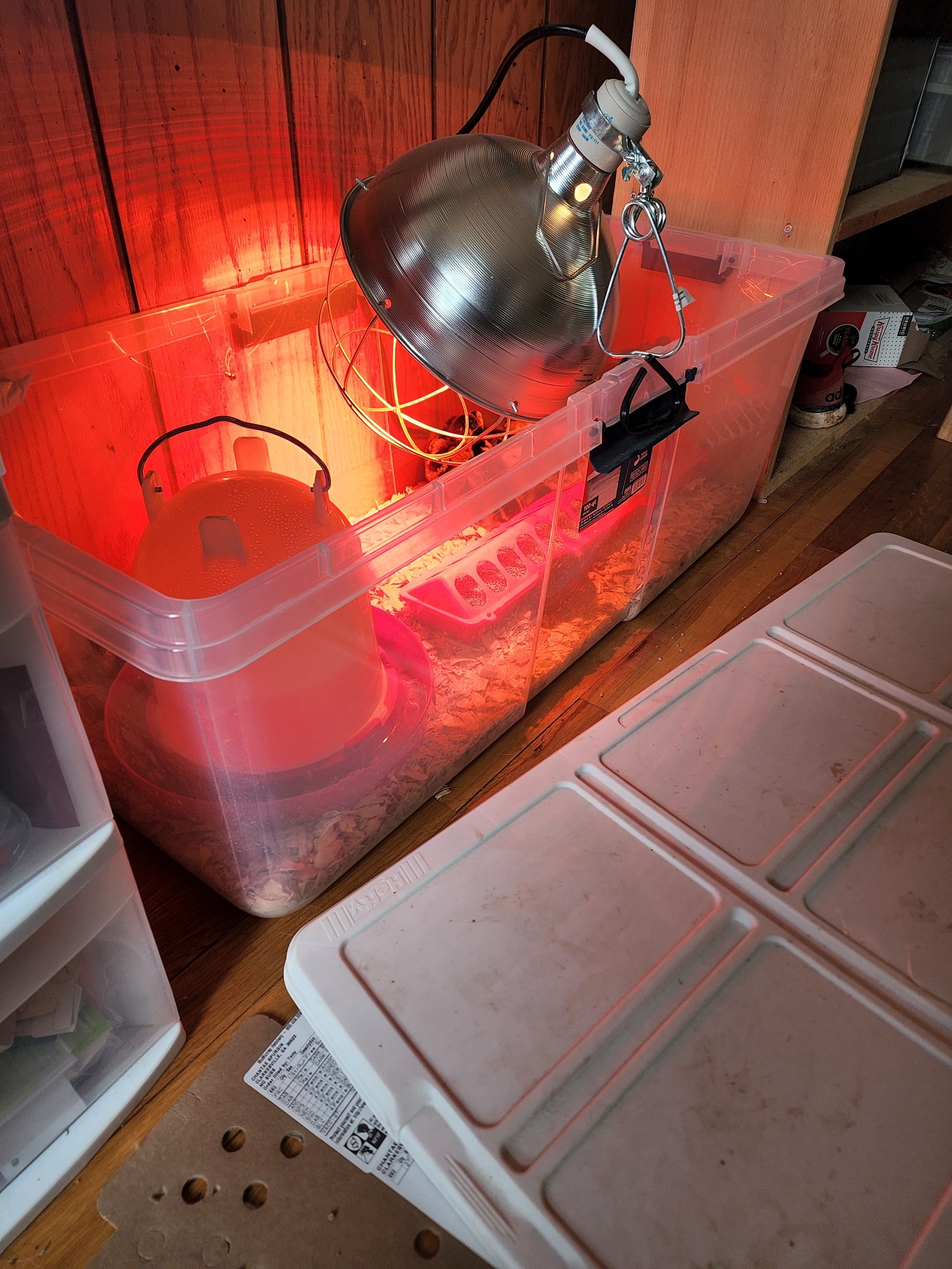
This is going to depend on how many babies you get. But you need a place to put them, a waterer, feeder, medicated chick feed, a heat lamp with red light and bedding. That’s really it. You don’t HAVE to use medicated chick starter but I do recommend it for baby chicks. It helps prevent coccidia in your flock and that my friends is huge. Coccidia and other parasites are the number one killer of all baby animals on all homesteads, except maybe predator’s.

Tractor Supply

When it comes to a place to put them, it really doesn’t have to be fancy. We use a plastic tote when we have to brood a smaller batch of chickens. There are 25 in here and this will only last about a week, maybe two. Once they have out grown this, *fingers crossed* they will go into the new chicken coop. You can read about our experiment with a metal chicken coop here . But they will stay here until it’s a “problem” and then they will be moved elsewhere. Usually if you are only brooding a couple up to maybe 6, this tote should be fine.

Approx 100Qt Plastic tote

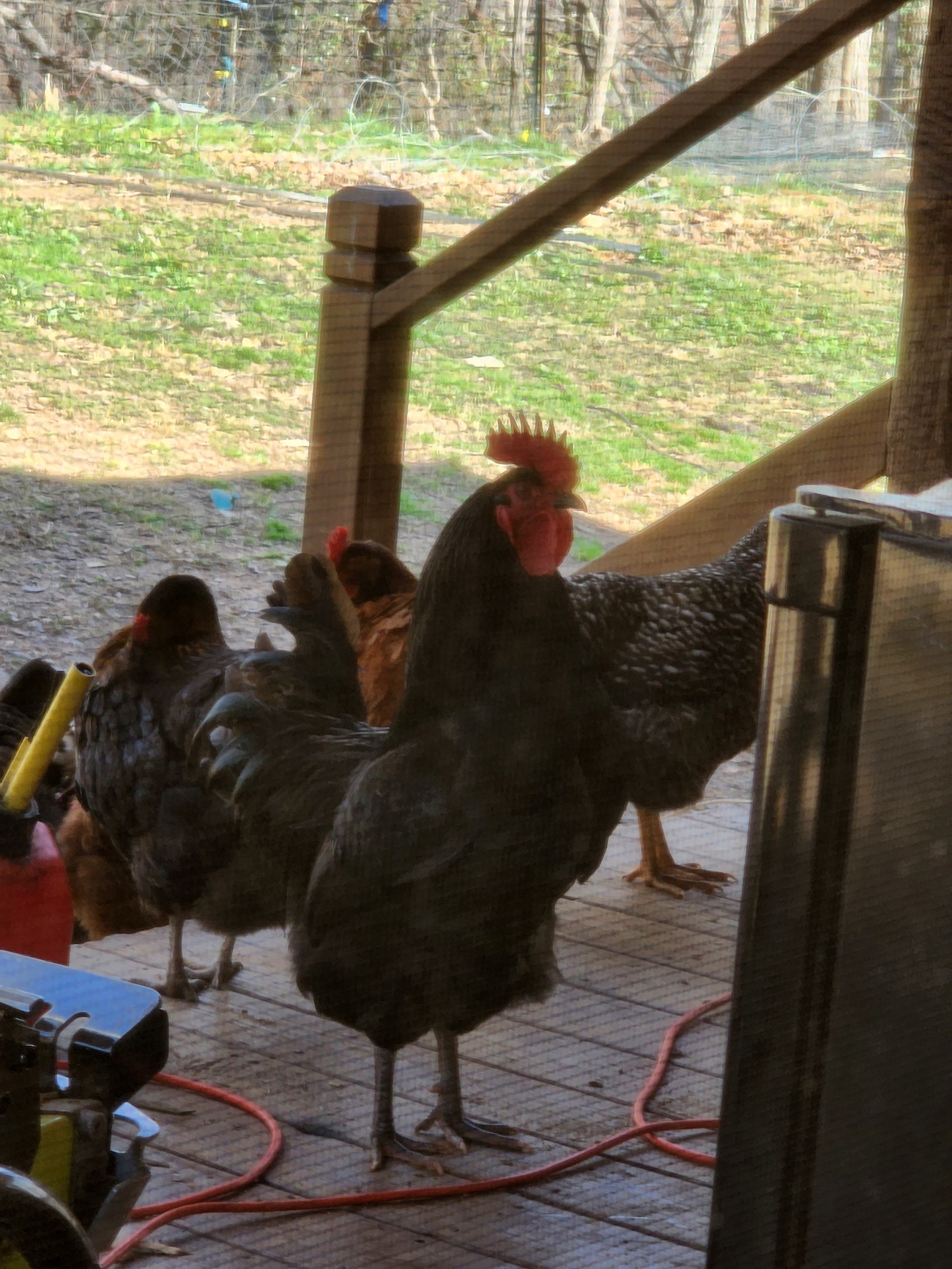
We put this tote in our living room for a couple of different reasons. Our other chickens like to come up onto the deck. Since having the chicks, the other chickens have been jumping up on the mini fridge out front to look through the window. This is going to help when the time comes to integrate everyone into the new coop. The other chickens know that we are brooding chickens in here. George and one of black stars have taken to keeping an eye on them.

George and his ladies trying to find the chicks

While you are brooding chickens, you want to try and maintain their temperatures around 90-95*. At this age, they are simply too little to regulate their own temperatures well. Every week you decrease their temps by moving the light higher and higher. If you notice your chicks staying away from the heat lamp or panting, move the heat lamp up because it’s probably too warm for them. Another thing you can buy to help gauge the heat is a Temp gun. These things are amazing for so many things beyond a chicken brooder.

If you are new to heating with firewood and are looking to master the finer points of it. We’ve got a great eBook that goes in depth of what tools you should consider, how and where to stack, how to build a fire and so much more!

Buy Now

The other reason we brood chickens in the living room is so they get used to us and our noise. We are hoping that being around us will socialize them better and we will be able to handle them more. There is also the added bonus of photo ops like this one.

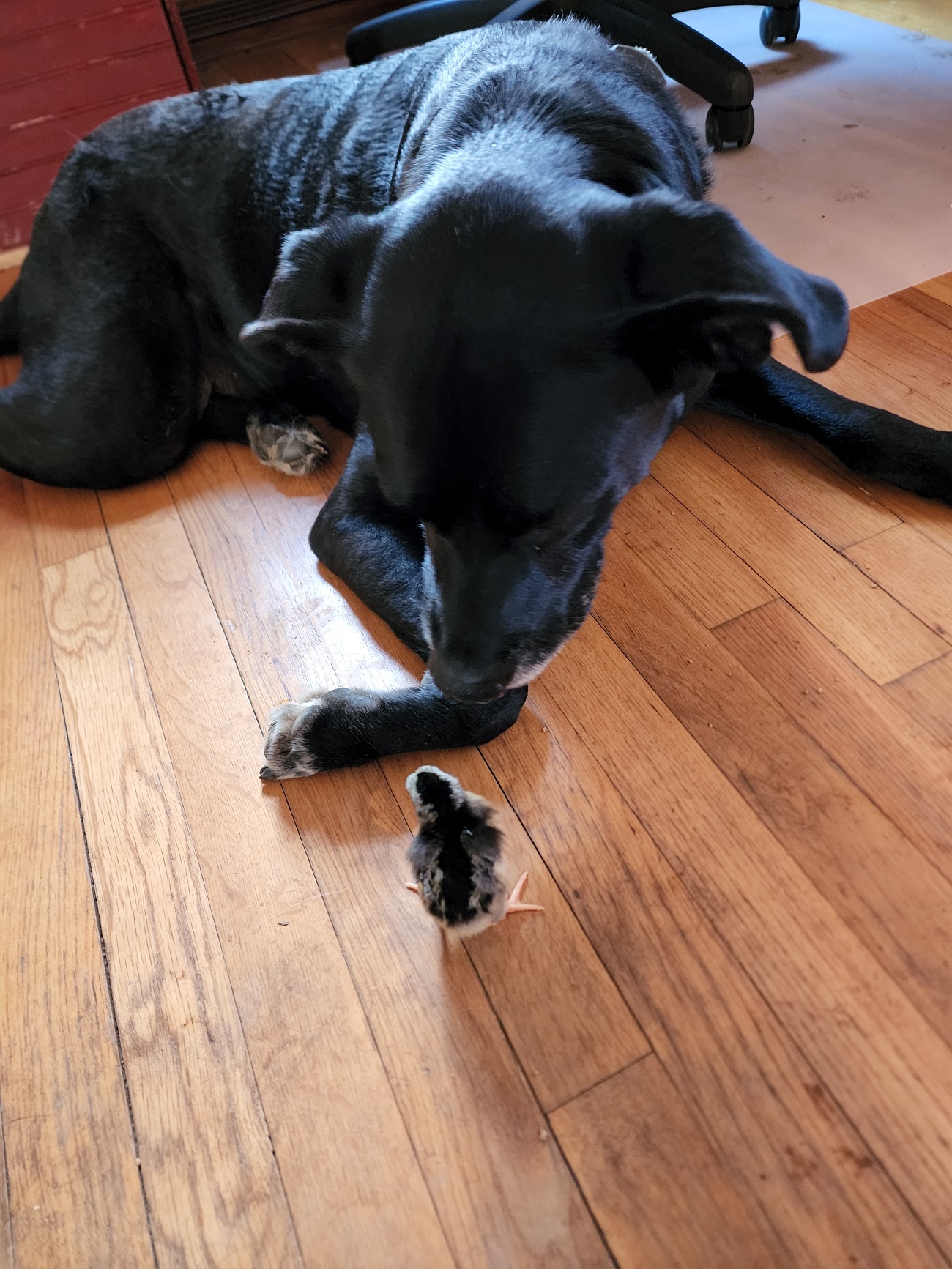
Bear says “what is this thing”

This is the first time for us using a red light for heat. Since we have reptiles, we have an abundance of CHE (ceramic heat emitters) and we used those for our first two batches. Unfortunately, we had a couple issues with our meat chicks pecking each other. After doing some research I found out that chickens are attracted to red things and they are cannibals. They will peck each other and then once they see the blood, they will kill that chick. So we got this red light and we already had the lamp with caging. But the new one is so far so good. We got ours from Tractor Supply and love it.

Tractor Supply

When it comes to feeders and waterers, it comes down to size. When they are little, you don’t need a ton of feed and water but you do want to make sure that they don’t run out. You can find the feeder shown in the picture here. However, when that one breaks we will be switching to this one because the one we have takes up a lot of space and can really only be used for chicks. I like our waterer and we will continue to use it for chicks. When the ducks come, they will need a different waterer because they like to play in it.

Logo 468x60

Tips and Tricks

Socializing

So you’ve got your set up, got all the things. Now what? Love on those babies! Seriously. If you want happy chicks that will run up to you, love on them. Let your kids play with them. Socialize them to the point where they are excited to see you. We didn’t do that with our first batch and it’s hard to get them to come to us. Our meat chicks however, loved us. They would come running when you came outside and they would follow you around because they associated us with food.

If you have older children, around five or so, make this their chore. Giving kids an animal helps teach them responsibility, empathy, and kindness in a way that human to human interaction just doesn’t do.

Pasty Butt

Chicks will get what is called pasty butt. It’s a thing. The best thing you can do to combat this is apple cider vinegar in their drinking water. I do about a tablespoon in each time we fill up our 5 Qt waterer. You can absolutely do more but I wouldn’t do much less. If your chick does end up with pasty butt simply take a warm wet rag and GENTLY wipe it off. If you are too rough you can damage their vent and that is fatal.

The Ultimate Homesteader’s Starter Bundle – Only $47!

Get the tools you need to stay organized, track profits, and manage your homestead with ease!

Includes:
✅ Schedule F Tracker – Simplify tax prep
✅ Profit Calculator – Track earnings
✅ Hay Calculator – Plan livestock feed
✅ Garden Journal – Digital & printable
✅ Herd Health Tracker – Monitor animal care
✅ Simple Budget – Manage finances
✅ Backyard Homestead eBook – Essential tips

$99 value – now just $47! Start your homesteading journey today!

Buy Now

Feeding Your Chicks

Chicks only need the medicated feed for the first bag. Again this depends on how many chicks you have and what size bag. We buy a 50lb bag for 50 chicks. If you only have 5? Get the 5lb bag. Just use common sense on how much your chicks need. Feeding them more isn’t going to hurt them but not enough could.

Logo 468 x 60

What do you feed them after that first bag? Just regular chick feed. You do want about 20-24% protein until they are mostly grown, about 4wks-2months. Also make sure that it is crumbles for a while and once they get most of their feathers, you can switch to a pellet. After that we switch our laying hens to a layer feed. This keeps them from growing too fast but also have different nutrients for healthy chickens and eggs.

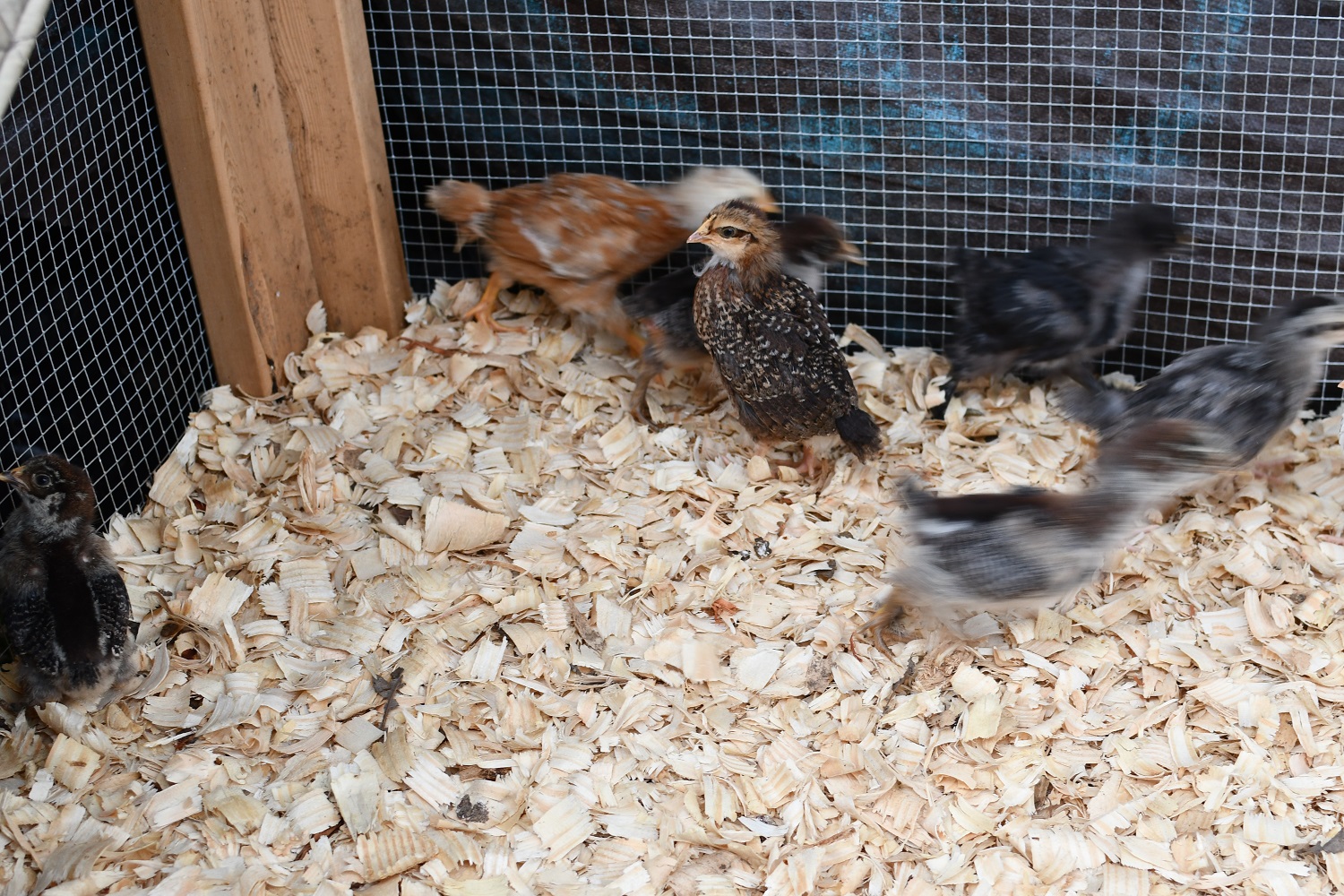
You can see that they have most of their feathers and now they are outside

How long do you brood chickens? About 3 weeks or once they are fully feathered, they can go outside into their coop or to free range. If it’s cold out, make sure to bring the heat lamp with them for nights. If it’s warm, make sure they have plenty of water.

Buying List For Brooding Chicks

Print Recipe
Equipment

Equipment

  • 1 Brooder Box
  • 1 Clamp Lamp
  • 1 Red light
  • 1 bag Pine shavings
  • 1 bag Medicated chick feed
  • 1 waterer
  • 1 feeder

That’s about it! If you have any questions about how to brood chickens feel free to comment below. Feel free to share this on your social media and like us as well!

If you like the content I put out, feel free to buy us a coffee! It helps keep this site running, marketing and the goats in grain!

Buy me a coffee

If you like this post, feel free to share it and follow us below on our social media accounts!

  • Facebook
  • Pinterest
  • Instagram
  • YouTube
  • TikTok
  • Spotify
  • Threads

Filed Under: Animals, Chickens Tagged With: Brooding, Chickens, Chicks, Eggs, Homestead

JOIN TO OUR MAILING LIST!

Leave us your email to receive new posts and special offers for members only! Don't miss a thing!

Recent Posts

  • Fall Garden Guide
  • Top Mistakes With Goats
  • How To Bond With Your Goats

What Do I Do With Bucks?

January 30, 2024 by Leigh Leave a Comment

Depending on how you run your homestead, you may start to realize that your male livestock and poultry don’t have a long life span. Or, maybe you aren’t used to the livestock way of life and are really struggling with the idea of butchering the males. Either way, you are probably asking yourself, “What do I do with bucks?” And the real answer is one that you may not like or it may not fit with your ideals. But I’m going to tell you what I do with my bucks.

What do I do with Bucks

Two goat kids in a field
goat kidding

Before we get too far into this, I have a great course on the basics of goat care. I call it Goat Crash Course: Goat 101. In this course, I explain things like types of shelter, types of feeds and hays, basic assessments and so much more! Check it out!

Buy Now

What Do I Do With Bucks?

Well, this entirely depends on your homestead goals, philosophies and needs. And that is something that you need figure out BEFORE you start breeding. Seriously, don’t get livestock or poultry and then not know what you are going to do with the animals. You will end up in a world of hurt. Ask me how I know.

Some of the ways that we handle the bucks on our farm is selling, castrating, and butchering.

Selling Bucks

We always try to sell any bucks that we don’t need for next seasons breeding cycles. But there are two very important criteria that have to be met before selling an uncastrated buckling. One, he has to come from good, hardy, proven lines. Two, he has to have good conformation, size, and disposition. If he doesn’t meet those criteria, he is castrated.

We do everything in our power to only sell uncastrated males that hit those criteria. The reason why those criteria are so important to us is the heavy losses we have sustained on our farm due to unhealthy kids and weak genetics. We don’t want to spread that to other farms. It has taken years for us to finally get our herd genetics figured out and sending out weak goats isn’t something I’m interested in.

If for some reason, we cannot sell a solid and healthy buckling by ten weeks, he is castrated.

goat kidding

Before we get too far into this, I have a great course on the basics of goat care. I call it Goat Crash Course: Goat 101. In this course, I explain things like types of shelter, types of feeds and hays, basic assessments and so much more! Check it out!

Buy Now

Castrating Bucks

If we cannot use a buck on our farm, we cannot sell him, or he doesn’t meet our criteria, he is castrated. We do this by banding around ten to twelve weeks and putting him in the buck pen. If he met our criteria but we couldn’t sell him, then we attempt to sell him as a wether or pet. Unfortunately, bucks and wethers are not as sought after as does. So this happens a lot.

I don’t want to sell any inferior goats. Goats have become increasingly fragile for a lot of reasons like; overbreeding, poor genetics, breeders just trying to make a dollar, and overuse of medical interventions. Because of all these things, it’s really hard to guarantee the health of a goat. Weak goats don’t make it through winter and you are stuck digging a hole in the frozen ground.

So to keep from spreading weak genetics, we are very strict when it comes to who is leaving our farm.

Butchering Bucks

Unfortunately, we cannot afford to feed a bunch of goats that don’t have a purpose. It’s the reality of farm life. And it HURTS! I didn’t grow up like this and I still struggle with the idea of culling members of the herd. But it’s part of responsible breeding and, PLEASE, breed responsibly. Goats are so fragile to start with and irresponsible breeders are out there just selling kids to make a dollar. That’s not doing anything to improve the situation.

When it comes to deciding who gets butchered and who stays, we have made it easy on ourselves. Well, as easy as this decision can be. If the buck doesn’t meet our criteria, he is castrated and will be butchered. If we are not using him for breeding, he gets sold. If we can’t sell him by ten to twelve weeks, he is castrated. If we cannot sell him as a wether, he is butchered.

Unfortunately, this is the life we lead.

The Ultimate Homesteader’s Starter Bundle – Only $47!

Get the tools you need to stay organized, track profits, and manage your homestead with ease!

Includes:
✅ Schedule F Tracker – Simplify tax prep
✅ Profit Calculator – Track earnings
✅ Hay Calculator – Plan livestock feed
✅ Garden Journal – Digital & printable
✅ Herd Health Tracker – Monitor animal care
✅ Simple Budget – Manage finances
✅ Backyard Homestead eBook – Essential tips

$99 value – now just $47! Start your homesteading journey today!

Buy Now

Our Does Get The Same Treatment

And just so everyone is clear, this is the same criteria we use for our does. Just without the castration part. If a doe requires deworming, we don’t breed her and she will go to the butcher. If she is sickly, she gets butchered. We don’t try to sell our does as a rule. The main reason is we want the milk.

If she doesn’t fit our requirements, there’s a really good chance she isn’t a solid goat and we don’t want to put out inferior goats. Maybe in a few years, when we have our established lines and have enough milk goats, we will think about selling our does. But for right now, we are standing by our standards.

Dealing With The Emotions Of These Decisions

I will say it again, we didn’t grow up like this. We were taught from a young age that you care for animals. You don’t kill them because they don’t “meet your criteria“. You get your meat from the grocery store like everyone else. I talked extensively about livestock are not pets in this blog post, and it’s very hard to stand by these criteria and make these decisions.

This whole situation and subsequent conversations, can create a very difficult and emotional rollercoaster ride. But I have found that when you pick a goal, set perimeters for that goal, and measure EVERYTHING against that goal? It makes these decisions a LOT easier.

But don’t get it twisted, it’s still hard.

If you are new to heating with firewood and are looking to master the finer points of it. We’ve got a great eBook that goes in depth of what tools you should consider, how and where to stack, how to build a fire and so much more!

Buy Now

Since getting into goats, we lost at least two goats a year until we implemented this criteria. We lost beloved pets because we didn’t want to make the hard decisions. We bred for milk, not for healthy kids. We thought overusing medical interventions was normal.

We did it wrong

Since making the decision that we were going to breed for hardiness first, then milk, then meat, we have had a lot less death on the homestead. We have placed beloved goats on the cull list, and it’s a hard decision to make. It feels terrible to take them to the slaughter house, but I will NOT sell inferior goats. Because I will not be part of the problem.

What’s more heartbreaking? Losing a goat to the cold because she wasn’t strong enough to survive it or butchering a goat that was raised in a healthy, happy, loving environment?

Is it better to perpetuate a vicious cycle of over deworming or only breed hardy, parasite resistant goats?

Is it better to make a dollar on any kid, or only produce top notch animals that don’t require medical intervention?

These are all decisions that you will HAVE to make if you are getting into livestock that will have a purpose. I’m not going to say that either side is right or wrong. I AM going to say that when we are making decisions on our farm, these are some of the questions we ask ourselves.

Because we are tired of sickly goats that don’t survive winter. We are tired of digging new holes in the pet cemetery.

If you like the content I put out, feel free to buy us a coffee! It helps keep this site running, marketing and the goats in grain!

Buy me a coffee

If you like this post, feel free to share it and follow us below on our social media accounts!

  • Facebook
  • Pinterest
  • Instagram
  • YouTube
  • TikTok
  • Spotify
  • Threads

Filed Under: Animals, Goats, Homestead Planning Tagged With: Butchering, Freezer, Goats, Homestead, meat goat

JOIN TO OUR MAILING LIST!

Leave us your email to receive new posts and special offers for members only! Don't miss a thing!

Recent Posts

  • Fall Garden Guide
  • Top Mistakes With Goats
  • How To Bond With Your Goats

Livestock Are Not Pets

January 20, 2024 by Leigh Leave a Comment

If you did not grow up on a farm or with livestock animals, it may be a foreign concept of raising animals for meat. It could bother you that people, like myself, butcher animals for meat. It’s difficult for a lot of people to wrap their mind around the fact that I can genuinely love my animals, yet I’m still able to put them in the freezer. But that’s because I have realized that livestock and poultry are not pets and that helps a lot. Before you click off this blog post, stick with me and I will explain more about how people can raise an animal and then butcher it. Maybe then, you can understand why people like me choose to raise our meat.

goat kidding

Before we get too far into this, I have a great course on the basics of goat care. I call it Goat Crash Course: Goat 101. In this course, I explain things like types of shelter, types of feeds and hays, basic assessments and so much more! Check it out!

Buy Now

Livestock Aren’t Pets

Now, you can absolutely have livestock animals that you bought with the sole purpose of it being a pet. But before we get too far down this rabbit hole, we need to discuss some things first. Like, the definition of livestock and poultry, what is a companion animal, why people choose to raise their own meat, and why we need to respect those decisions.

Remember, stick with me! Don’t get upset and storm off because you don’t like what I have to say. I mean, obviously you can, but if you truly want the answer to “how can you slaughter something you raised” stick around and find out.

What Is Livestock And Poultry

The Oxford Dictionary defines livestock as “Domestic animals kept on a farm for use or profit; esp. cattle, sheep, and pigs.” And poultry as “Domestic fowl collectively; birds which are commonly reared for their flesh, eggs, or feathers, as chickens, ducks, geese, turkeys, etc.“

The reason this is important is that a lot of people confuse ALL animals with pets or companion animals. They think that all animals that are kept by people should be raised but not butchered. Because that is the lens in which they see animals. They’ve never been on a farm or raised an animal knowing that it’s entire purpose is to end up in the freezer.

Which makes me wonder who they think raises the meat they get at the grocery store?

What Is A Companion Animal

I’m not going to pull out the dictionary for this one but I define a companion animal as a pet. This could be a dog, cat, gerbil, or even a pig or goat. And we have PLENTY of these on the homestead. These animals don’t really have a job, they aren’t an asset or really have a use other than companionship.

Champ is a goat and companion animal. She will live out the rest of her days here on the farm with no use. When she dies, she will be cremated. BUT she started out as livestock. Her original purpose was to give us milk and babies and she did that. Now that she is older, she has earned her retirement.

But what a lot of people don’t seem to understand is that my herd, and most peoples herd, of goats are not companion animals. They have a purpose: Milk, Money or Meat. While I don’t WANT to butcher any of my goats, I know that it is a reality that I will have to deal with. Especially because I want milk.

BeBe and Rory are not companion animals, they are livestock. They will be butchered as soon as they hit 75# or we head into winter, whichever comes first.

Answering Questions With Questions

To answer the question of why we raise our own meat, the answer is another question, actually a couple. Have you ever seen where livestock is raised? I’m not talking about the fields dotted with cattle and chicken or woods with pigs. I’m talking the pig houses, chicken houses or CAFOs. Have you seen what those animals are fed? Do you know where that feed comes from? Do you have any knowledge of ruminant biology?

I don’t ask these questions to be rude or nasty. I ask them because if you have never seen any of those things, I can understand why you would be confused. I can understand why you ask “why raise your own meat?”

Why We Raise Our Own Meat

Now, to be completely transparent, we don’t raise cow or pig on the homestead. We tried to raise pigs and it was a colossal failure meat-wise. We will try again when we are in a better position…maybe. But we do raise our own chicken and goat. That may not seem like a lot, but we just don’t have the infrastructure to raise cows yet. Building pasture for cattle and goats is a big goal for 2024.

In the mean time, we source our beef from a local farm that raises grass fed beef. We source our pigs from someone who raises pasture pork. We purchase meat in bulk instead of relying on the grocery store.

The reason is because we want the animals that are being raised for meat, to be animals. Pigs root and wallow. Cattle should walk around and eat grass. Chickens should scratch and peck. Goats should scream and eat grass. That is what they are SUPPOSED to do.

Industrial Agriculture

Industrial agriculture has created these confinement systems to hold huge groups of animals together, feed them low grade antibiotics and grains, pack them onto trailers and send them to the processor.

The amount of stress those animals endures is not okay. In fact, it’s inhumane. Animal welfare is not at the top of industrial agriculture’s list of priorities.

Like most homesteaders, I choose to source or raise the meat my family is going to consume as humanely as possible. I want animals that are raised as natural a diet as possible. I want animals that have only one bad day.

Respecting Decisions

I’m not sure when we became a country that isn’t allowed to have differences of opinions. But what I will say is that no matter where you fall on the meat eating/ raising spectrum you fall on, respecting other’s decisions is a key part of being an adult. If a person chooses to only source their meat from local farms, great. If a person decides to go to the grocery store, great…. I don’t have to like it.

I can desperately want to take them to the different chicken farms around here and show them how these animals are raised, shoved into cramped boxes, transported in the rain, heat, etc. I want show them where these animals are unloaded and butchered.

But I can’t do that. I have to respect their decision.

But the beautiful thing about a blog?

I can also show you my operation. I can show you transparency.

I can talk about all of the crazy things my chickens and goats do.

In doing those things, my hope is that you make the decision to source your food locally. From farmers who really do love their animals, instead of industrial ag….

If you like the content I put out, feel free to buy us a coffee! It helps keep this site running, marketing and the goats in grain!

Buy me a coffee

If you like this post, feel free to share it and follow us below on our social media accounts!

  • Facebook
  • Pinterest
  • Instagram
  • YouTube
  • TikTok
  • Spotify
  • Threads

Filed Under: Animals Tagged With: Ducks, ethical meat, Goats, Homestead, livestock

JOIN TO OUR MAILING LIST!

Leave us your email to receive new posts and special offers for members only! Don't miss a thing!

Recent Posts

  • Fall Garden Guide
  • Top Mistakes With Goats
  • How To Bond With Your Goats
  • « Go to Previous Page
  • Page 1
  • Interim pages omitted …
  • Page 4
  • Page 5
  • Page 6
  • Page 7
  • Go to Next Page »

Primary Sidebar

WELCOME

WELCOME

My name is Leigh and I am the lead chaos creator here at Steel Raven Farms. You will see throughout this blog that I am the crazy goat lady.

I am married to my high school sweetheart, Jared and we have two amazing boys.

FOLLOW ME

  • Amazon
  • Facebook
  • Instagram
  • Pinterest
  • TikTok

GET UPDATES!

Leave us your email to receive new posts and special offers for members only! Don't miss a thing!

In all the years that I’ve been growing a garden, the fall garden has steadily remained my favorite. Which is funny because I don’t really like any of the brassicas, which is what most people know the fall garden for. I prefer the root vegetables and cool air. But I have learned over the years…

Read More

  • Animals
    • Chickens
    • Farm Dogs
    • Goats
  • Garden
    • Compost
    • Garden Projects
    • Seeds and Plants
    • Garden Journal
    • Working With Food
      • Recipes
      • Freezing Foods
      • Dehydrating Foods
      • Canning Tips And Tricks
        • Canning Inventory Sheets
  • Helpful Info
    • Welcome to the Homestead!
    • Emergency Preparedness
    • Frequently Asked Questions
    • Goal Setting
    • Project List
    • Shop Digital Products
      • Hay Calculator
      • Farm Expense And Income Tracker
      • Goat Crash Course: 101
      • Garden Journal Prompts
      • Schedule C Tracker
      • Schedule C Tracker
      • The Homestead Bundle
  • The Truths
  • Episode List
  • Start Here
    • Privacy Policy
    • Affiliate Disclosure
    • Let’s Get in Touch
    • Members Only Library
    • Welcome To Our Homestead

Footer

  • Email
  • Facebook
  • Instagram
  • Pinterest

COME AND GET IT!

Leave us your email to receive new posts and special offers for members only! Don't miss a thing!

· Midnight Theme

Copyright © 2026 · Midnight Theme on Genesis Framework · WordPress · Log in