• Skip to primary navigation
  • Skip to main content
  • Skip to primary sidebar
  • Skip to footer

Steel Raven Farms

Where muck boots meet ground.

  • Animals
    • Chickens
    • Farm Dogs
    • Goats
  • Garden
    • Compost
    • Garden Projects
    • Seeds and Plants
    • Garden Journal
    • Working With Food
      • Recipes
      • Freezing Foods
      • Dehydrating Foods
      • Canning Tips And Tricks
        • Canning Inventory Sheets
  • Helpful Info
    • Welcome to the Homestead!
    • Emergency Preparedness
    • Frequently Asked Questions
    • Goal Setting
    • Project List
    • Shop Digital Products
      • Hay Calculator
      • Farm Expense And Income Tracker
      • Goat Crash Course: 101
      • Garden Journal Prompts
      • Schedule C Tracker
      • Schedule C Tracker
      • The Homestead Bundle
  • The Truths
  • Episode List
  • Start Here
    • Privacy Policy
    • Affiliate Disclosure
    • Let’s Get in Touch
    • Members Only Library
    • Welcome To Our Homestead

Garden Projects

How To Fill A Raised Bed For Cheap

February 10, 2024 by Leigh Leave a Comment

If you are looking to build raised beds, you may be wondering how to fill a raised bed. Or you’ve already done some calculations and wrote off raised beds because they are so expensive. But I’m going to walk you through how we fill our raised beds and how it doesn’t have to be THAT expensive.
Are you getting overwhelmed in the garden? Stressed? Or just not enjoying the garden like you used to? Check out our garden prompts! We send out weekly emails that get you back in the garden and out of your head! Turn the garden back into a place of love and joy instead of frustration and headache!

Subscribe Now!

How To Fill A Raised Bed For Cheap

First, there are a ton of different ways to fill a raised bed. You can go expensive with a ton of soil, or you can fill it with various organic materials. I’m going to walk you through how we fill our 4ft wide x 20ft long x 2ft tall raised beds.

Using Trees To Fill A Raised Bed

Once Jared is done building the bed, I start gathering all the unusable logs on the property. We have had to take down a bunch of pines on the property. Even though we heat our home solely with firewood, we don’t burn pine in the house, but sometimes we will burn pine in the firepit. Instead, we use it in the gardens. We’ve used these pine logs as bed boarders and organic material for inside the beds.

If you are new to heating with firewood and are looking to master the finer points of it. We’ve got a great eBook that goes in depth of what tools you should consider, how and where to stack, how to build a fire and so much more!

Buy Now

These pines and other rotten logs will get put on the bottom of each bed. Usually, this will fill the beds about 50-60% with logs. If the logs aren’t very large or the bed isn’t close to half filled, we will add a second layer of logs. The goal is to completely cover the bottom half (ish) of the bed with these logs. Since trees tend to take FOREVER to breakdown, the idea is that you shouldn’t have to refill the bed that much every year.

The biggest concerns when using trees or logs to help fill your raised bed is going damaging your bed as you fill it, nitrogen depletion, and termites. Out of all of this list, the only thing I am truly worried about is damaging the bed as we fill. We use galvanized steel roofing panels for the walls of the bed and the frame is outside the bed. That means that if we just throw logs into the beds, they could damage the roof panels.

We aren’t going to have issues with termites because we use the steel roofing panels. And I’m not super worried about nitrogen depletion because we use cover crops, manure, etc to keep our soil healthy.

Smaller Branches Next

After we have placed a good layer of logs into the bed, we start filling the next 25% with sticks, branches, etc. The goal is to use as much of the “free” downed trees as possible before using expensive materials like pine shavings, compost and soil.

I don’t usually go crazy breaking these into smaller pieces. But I will jump into the bed and stomp around until they are broken. Again, I’m not going crazy here, but I want to use as much free stuff as possible so I don’t HAVE to purchase more than absolutely necessary.

If you are looking for a great way to keep track of your gardens for years to come, check out our Digital Garden Journal. It’s a digital spreadsheet that helps you manage not only your seedlings but also your seed inventories, soil testing, orchard, harvests and so much more.

Buy Now

Filling With Smaller Stuff

After I’ve gotten all the logs and branches to about 75% of the bed, I start adding the small stuff. I usually fill this to about 85%. This is the stuff that is going to breakdown very quickly. Usually, it breaks down in less than a year. What is the smaller stuff? It’s leaves, wood chips, pine shavings, etc. Again, I want to add as much free stuff as possible before I start adding my compost and soil.

My local power company drops off wood chips for us all the time so we don’t have to pay for those. And our property is mostly wooded, so we have a TON of leaves. We leave a ton of those leaves on the ground for the ecosystem but we do pick up some for the beds. But the pine shavings are my magic bullet.

We use the deep litter method for our livestock and poultry to keep them warm in the winter. So I’ve already paid for the pine shavings once. The pine shavings start to compost throughout the winter and they are “dirty” with animal poop and urine. This is great compost/ filler for my raised beds. Also, because it takes a bit longer for wood to start to fully break down, it adds structure to the soil.

Finally Adding Soil And Compost

One of the reasons that our raised beds don’t cost us a ridiculous amount to fill is because we only add about 4-6″ of soil/ compost. For our 4ftx20ft raised bed, that’s about 40cu ft of soil. Which is still a LOT, but compared to 160cu ft of soil, it’s not too bad.

The reason I don’t add more soil is because I don’t need to. Because of the animal bedding/ pine shavings, there is a ton of nutrients for the roots to grab onto.

Are you getting overwhelmed in the garden? Stressed? Or just not enjoying the garden like you used to? Check out our garden prompts! We send out weekly emails that get you back in the garden and out of your head! Turn the garden back into a place of love and joy instead of frustration and headache!

Subscribe Now!

Lastly!

Worms! I add one or two bait cups of red wiggler or earthworms. Normally, you wouldn’t have to, and you don’t have to. But I like to kick start new garden beds with as much help as I possibly can.

When it comes to adding worms, remember, you don’t have to do this. But I have found that it helps to jump start their work. Also, having them get all that fresh soil, pine shavings, etc composting as soon as possible is amazing.
If you are interested in learning more about my favorite garden planner. I highly recommend Seedtime! This planner has been instrumental in helping me plan out my gardens with WAY more efficiency than I could ever expect! It has also reduced overwhelm, stress, and calmed my ADD/ADHD!

More Info!

Filling A Raised Bed FAQ:

Why Not Fill To The Top?

If you did a quick calculation, you’ll notice that the logs take up 50-60%, the sticks another 25%, and small stuff fills the bed to 85%. Soil only covers another 4-6″ bringing the total volume of the bed to about 90% full.

The reason I don’t fill the bed to the tippy top is for a couple of reasons. One, I don’t want to risk the soil sitting against the wood. Two, I don’t want to risk soil running out of the bed and causing run off. Three, I want to have a good healthy layer of mulch in the bed.

If I fill the bed to the top with soil, the mulch will not stay put and soil will sit on the ledge of the garden bed.

cropped-3.jpg

Are you looking for garden journal prompts, but aren’t interested in a weekly email? Check out our 365 Garden Journal Prompts! This is an amazing, all in one, yearly product that you only pay for once.

Buy Now!

Why Not Fill With Soil?

My beds are 4ftx20ftx2ft. This means that I would have to spend about $400+ per bed on soil. Minimum. Not to mention that if I don’t put organic matter into the soil, the soil will lose nutrients and structure.

Also, having wood in the bottom allows that all important fungi to grow even better. This improves soil quality exponentially.

Why Not Use Hay As Filler?

There are two main problems with using hay as filler. One, hay is usually sprayed with herbicides, pesticides and sometimes fungicides. That means that I am putting those -icides into my raised beds where I am trying to ENCOURAGE that growth. At worse, plants won’t grow and at best they will be stunted.

The second issue with using hay as filler is that purchasing unsprayed hay is already expensive. Using it to fill a bed seems like a waste of money in my book. That’s not to say that I won’t use spent hay that the goats have dropped. But I wouldn’t just take a bale and put it right into my beds.

There is an added inconvenience of having little hay sprouts grow in the beds. In my mind, it’s not that big of a deal, but it may be a thing for some.

Doesn’t The Soil Settle Over Time?

Yes, it does. In fact, the first year, your soil levels could drop by up to half as the soil settles and starts filling those nooks and crannies. But if you fill the bottom of the bed with logs and stack them pretty tight, you won’t lose a ton of soil.

Also, I add pine shavings, grass clippings, etc to my garden throughout the season. So even if the soil levels drop, I’m still getting fresh compost developing. It takes a while for the soil levels to settle so be prepared for the long haul. But I love my raised beds and I really enjoy having them.

If you like the content I put out, feel free to buy us a coffee! It helps keep this site running, marketing and the goats in grain!

Buy me a coffee

If you like this post, feel free to share it and follow us below on our social media accounts!

  • Facebook
  • Pinterest
  • Instagram
  • YouTube
  • TikTok
  • Spotify
  • Threads

Filed Under: Garden, Garden Projects Tagged With: garden chores, garden journal, gardens, Homestead, Raised Beds, soil

JOIN TO OUR MAILING LIST!

Leave us your email to receive new posts and special offers for members only! Don't miss a thing!

Recent Posts

  • Fall Garden Guide
  • Top Mistakes With Goats
  • How To Bond With Your Goats

Raised Bed Vs Row Gardens

February 3, 2024 by Leigh Leave a Comment

I see this question a lot when I am browsing social media and forums, “which is better, raised bed vs row gardens?” And every time, I answer, “whichever one gets you in the garden is the best.” Seriously, I don’t care what type of garden you have, if you are gardening, that’s a win in my book. But if you clicked on this blog, or read any of my posts, you know I’m not going to stop there. I am going to give you MY reasons for why a raised bed garden is better than a row garden. But I still maintain, that any garden is better than no garden!

Raised beds vs row gardens with a picture of a garden

Are you getting overwhelmed in the garden? Stressed? Or just not enjoying the garden like you used to? Check out our garden prompts! We send out weekly emails that get you back in the garden and out of your head! Turn the garden back into a place of love and joy instead of frustration and headache!

Subscribe Now!

Why Is The Question Raised Bed Vs Row Gardens?

I think the main reason for the question of which one is better is because people want a hard fast, concrete, right or wrong answer before they “waste” their time or money. But I am not one of those people. I want to have a whole conversation about WHY which one is better than the others. Plus, I figure it’s all about perspective anyways.

Benefits Of A Row Garden

Row gardens are exactly what they sound like, rows and rows of plants. Sometimes, there is trellising and stakes and sometimes not. Usually, though not always, there is a lot of tilling involved. This type of garden doesn’t require a ton of soil to be trucked in or building materials to be used. All you really need is a way to get your plants in the ground.

Row gardens can be very cheap to install and maintain because you don’t have to build anything. It’s as simple as digging up the ground enough to get your plants in the ground. It is suggested that you till just enough to get any rocks, weeds, etc out of the garden.

Another great pro to a row garden is that you don’t have to bring a ton of soil into the mix. Now, this assumes that you will be adding compost or organic matter to the bed or that you will be using cover cropping.

cropped-3.jpg

Are you looking for garden journal prompts, but aren’t interested in a weekly email? Check out our 365 Garden Journal Prompts! This is an amazing, all in one, yearly product that you only pay for once.

Buy Now!

Cons Of A Row Garden

There are a few cons to a row garden and number one is weeding! You will be on your hands and knees pulling weeds or using harsh chemicals to kill the weeds before they stunt your plant. Another option is laying a TON of mulch. But honestly, you should be mulching your garden anyways.

Another con to a row garden is going to be pests. Now, there are absolutely pests in raised beds, but they don’t seem to be as bad. Ant hills, spiders, scorpions, etc are all more likely to be found in a row garden than a raised bed. I have noticed that the only critters that are in my raised beds are tiny wolf spiders and Japanese beetles. The row garden? GIANT spiders, scorpions, grasshoppers, a million army worms and two million horn worms.

I don’t know why they don’t touch the raised beds, I just know that they don’t…. at least my beds.

If you are interested in learning more about my favorite garden planner. I highly recommend Seedtime! This planner has been instrumental in helping me plan out my gardens with WAY more efficiency than I could ever expect! It has also reduced overwhelm, stress, and calmed my ADD/ADHD!

More Info!

Benefits Of A Raised Bed Garden

There are a lot of benefits of a raised bed garden and the first is that it can be a back saver! Seriously, not having to kneel down, bend over and reach has been a life saver for my back. It’s has been amazing.

Then there is the fact that I have complete control of the soil? Yea, that’s another win in my book. We have extremely rocky, clay soil that is prone to erosion. Not only that, we live on a mountain so there are a ton of flat spots, steep inclines, etc so it is hard to get a garden to stay put. Every year, I add leaves, sticks, compost and animal bedding to my raised beds and the plants flourish.

Before we get too far into this post, I wanted to give a suggestion about keeping a garden journal. A digital garden journal is a fantastic way to keep track of past, present and future gardens. Our Digital Garden Journal is a great way to keep up with everything without getting too overwhelmed.

Buy Now

Lastly, harvesting has been a snap. While I still lose produce, it’s not nearly as bad as a row garden. Because most everything is at least a mid thigh height for me, I can actually see what needs to be harvested.

Cons of A Raised Bed Garden

Well, the first, and biggest, con to a raised bed garden is the cost. Depending on the size of the bed, materials, prefab-ed, etc, each bed can set you back several hundred dollars. That’s just the materials to build the bed. Then you have to fill the bed with materials and soil. This can ramp up the cost of a raised bed.

Which brings us to our next point. The amount of work to build and maintain raised beds can get both expensive AND labor intensive. The cost may not be a problem for you, but when it comes time to start filling those beds? You are in for a ton of work.

Depending on the size of your bed, you are going to be loading a ton of logs, sticks, leaves, soil, and compost until it’s mostly full. Then you are going to repeat this for several years as that material breaks down and settles.

The Ultimate Homesteader’s Starter Bundle – Only $47!

Get the tools you need to stay organized, track profits, and manage your homestead with ease!

Includes:
✅ Schedule F Tracker – Simplify tax prep
✅ Profit Calculator – Track earnings
✅ Hay Calculator – Plan livestock feed
✅ Garden Journal – Digital & printable
✅ Herd Health Tracker – Monitor animal care
✅ Simple Budget – Manage finances
✅ Backyard Homestead eBook – Essential tips

$99 value – now just $47! Start your homesteading journey today!

Buy Now

Why I Like Raised Beds Over Row Gardens

My personal preference is raised bed gardens. I love the way raised beds look. They are clean cut and help keep the lines of the garden pretty. It also helps with weeding because there just isn’t as many weeds to contend with.

Wear And Tear On My Body

I also really like the fact that I don’t have to kneel down and get on my hands and knees to plant, weed, mulch, etc. I can do it from standing or bending over or I can also sit on the edge of the bed and work. Also, I don’t have to worry as much about pest problems because they just don’t crawl up the beds like the do in the row garden.

When it comes time to harvest, I’m not having to get down on my hands and knees to find produce before it’s overripe. I can also see what is going to be ready for harvest a lot easier and there is a lot less wasted harvest.

Are you getting overwhelmed in the garden? Stressed? Or just not enjoying the garden like you used to? Check out our garden prompts! We send out weekly emails that get you back in the garden and out of your head! Turn the garden back into a place of love and joy instead of frustration and headache!

Subscribe Now!

But Raised Beds Are Expensive

However, there are some pretty major cons. Depending on the size of the bed, each bed costs about $150-$300 to build. Then to fill the bed takes a TON of labor. Now, I’m lucky enough that my boys are always looking for ways to earn extra money. So they are more than happy to do that manual labor for me. But if you don’t have that option, it can be very labor intensive or expensive.

Then there’s the soil cost.

Now, we mostly use logs, sticks and leaves as the foundation to our raised beds and that helps a ton. We usually fill the beds about 3/4 of the way full with woody products. Then we fill the rest with wood shavings or wood chips. After that, we add animal bedding, starting with the chicken bedding and then adding the goats. Then we fill with spent hay. After all that, we add soil.

Usually, our yearly soil cost is about $400-500 for the kitchen garden and another $800 for the big garden. We get our soil from a couple different places. We’ve been lucky that we have a neighbor that has a horse farm. She turns the manure regularly until it’s composted down into black gold. But sometimes, we still have to purchase soil. And it’s expensive.

So Which Is Better? Raised Bed Vs Row Gardens?

For me, a raised bed is better than a row garden. But that doesn’t mean that row gardens don’t have their place. In fact, I would say that if you don’t have a lot of money, row gardens are better. Or if you can’t do a lot of manual labor to set up raised beds, row gardens are better. But if you have access to the money, time and labor to set up a raised bed garden? I think raised beds are better.

cropped-3.jpg

Are you looking for garden journal prompts, but aren’t interested in a weekly email? Check out our 365 Garden Journal Prompts! This is an amazing, all in one, yearly product that you only pay for once.

Buy Now!

But remember, a garden is better than no garden. It doesn’t matter if it is a container garden on your apartment patio, an acre row garden, or 50 60ft long raised beds. A garden that produces food for you is the best garden.

If you like the content I put out, feel free to buy us a coffee! It helps keep this site running, marketing and the goats in grain!

Buy me a coffee

If you like this post, feel free to share it and follow us below on our social media accounts!

  • Facebook
  • Pinterest
  • Instagram
  • YouTube
  • TikTok
  • Spotify
  • Threads

Filed Under: Garden, Garden Projects Tagged With: Garden, Homestead, vegetable, vegetable garden

JOIN TO OUR MAILING LIST!

Leave us your email to receive new posts and special offers for members only! Don't miss a thing!

Recent Posts

  • Fall Garden Guide
  • Top Mistakes With Goats
  • How To Bond With Your Goats

Building A Garden

January 16, 2024 by Leigh Leave a Comment

Building a garden can be extremely overwhelming. There is a ton of work to do; planning, clearing, building, planting, care taking, harvesting and amending…. Just to name a few things. While the work is hard and long, sweaty and frustrating, the garden can be an oasis in times of frustration, sickness, fear, and disappointment. Today, I want to talk to you about how you can build a garden the way YOU want it.

raised beds with herbs and flowers.

The Ultimate Homesteader’s Starter Bundle – Only $47!

Get the tools you need to stay organized, track profits, and manage your homestead with ease!

Includes:
✅ Schedule F Tracker – Simplify tax prep
✅ Profit Calculator – Track earnings
✅ Hay Calculator – Plan livestock feed
✅ Garden Journal – Digital & printable
✅ Herd Health Tracker – Monitor animal care
✅ Simple Budget – Manage finances
✅ Backyard Homestead eBook – Essential tips

$99 value – now just $47! Start your homesteading journey today!

Buy Now

Building A Garden

I love building gardens. Getting a new space cleared out, set up and planted is up there with a trip to the bookstore, hanging with the goats and and harvesting from the garden. There is so much joy that I get from setting up the new space that I will probably always be “tearing out” and rebuilding my gardens.

This year, we are completely redoing our big garden because we have had a lot of struggles with soil erosion, “failing” soil, and animal break ins.

But what does building a garden actually look like? Well, it looks like a search on Pinterest or other search engines to get an idea of what you are looking for in your gardens. Then it’s selecting a place in the yard for your new garden. Now, we plan the space. After that we start clearing the area. Next, we start setting up the garden based on the plans you’ve created. Finally, we get to plant!

Are you getting overwhelmed in the garden? Stressed? Or just not enjoying the garden like you used to? Check out our garden prompts! We send out weekly emails that get you back in the garden and out of your head! Turn the garden back into a place of love and joy instead of frustration and headache!

Subscribe Now!

Figuring Out What Kind Of Garden You Want

This may seem simple, but it’s probably the hardest part of any garden. That’s because if you are a totally new gardener, you may not know exactly what type of gardens you want. So doing a quick Pinterest search of gardens and then narrowing it down from there is a great place to start. Here are a couple of types of gardens: vegetable, flower, mixed, vertical garden, raised beds, row gardens, cottage gardens, faery gardens, etc.

Yes, it can be overwhelming. But just keep searching and take notes of the various things you like from each garden that you find and want to pull into your own gardens.

I prefer raised bed gardens and have for the last 10 years. Our first summer on the homestead, we had a row garden and I hated it. Well, that’s not true. I just didn’t enjoy it as much as my kitchen garden, which has raised beds, so the big garden suffered more than it should have.

I also realized that I LOVE having tons of flowers in the garden. The more the merrier. But I also need to make sure that I can keep pushing the needle on our goal of raising 75% of the food for us and our animals. So I can’t go too crazy with flowers.

goat kidding

Before we get too far into this, I have a great course on the basics of goat care. I call it Goat Crash Course: Goat 101. In this course, I explain things like types of shelter, types of feeds and hays, basic assessments and so much more! Check it out!

Buy Now

Finding Your Garden Spot

Our first summer on the property, we did not plant a garden. I wanted to wait and really make sure that we were putting the garden in the “right” spot. Our first garden here did okay. Not amazing, but we definitively learned a ton. The second garden half flopped. I finally got Jared to agree to build my raised beds and THAT garden did great!

The big garden failed miserably. Part of that was due to location. The other part was soil and the third part was too much sun. Which yes, is a thing. In the heat of summer, too much sun or heat can scorch your plants. Our tomatoes dropped so many blossoms it looked like it was snowing. So be sure to have some sort of shade cloth available if your yard is all sun.

Another thing to look at when finding your garden space is to look at water for irrigation. We have to run about 75ft of hose to even get water to the big garden, then we have to run another 150ft of hose inside the garden to be able to water. While the location would not have changed, we could have installed a yard hydrant or something similar to lessen the amount of hoses we need.

Save on Seeds

Lastly, when building a garden keep in mind how hard it is to get to. If you are having to hike across the world to get to your garden, there is a big chance that you won’t spend nearly as much time in as you should. The kitchen garden is right next to the house. I can see it from the windows on that side of the house. Also, it’s right next to where we park our cars AND we have to walk past it to get to the goats. All of this puts the kitchen garden in direct sight so we can see if plants aren’t growing, or some other problem.

Planning Your Garden

Because I’ve talked in so many posts about planning your garden, and you can find those here and here, I’m not going to go crazy in depth here. There are a lot of planning that goes into gardens at this stage and one thing to remember: keep your garden space liquid. By that I mean, don’t do anything permanent until you KNOW that it will work.

If you are interested in learning more about my favorite garden planner. I highly recommend Seedtime! This planner has been instrumental in helping me plan out my gardens with WAY more efficiency than I could ever expect! It has also reduced overwhelm, stress, and calmed my ADD/ADHD!

More Info!

Look into fencing while you are planning your garden. If you have animals that free range, they will tear up your garden. If you have dogs, they will at the very least poop in your garden. Then there is deer, rabbits, cats, and other unwanted creatures. I would recommend a fence to protect your food, flowers, and hardwork.

Seating! I cannot recommend having chairs in the garden more! We have about a million outdoor chairs that we sit in around the garden. When it’s hot or I’m tired, the best thing for me is to have a place to sit and take a break. Then I can get back to it in a minute or two.

Logo 468x60

Clearing For The New Garden

This can and will look very different for every person and every space. Our kitchen garden required almost no clearing. The big garden? Well, it’s going to take at least a month to get all the trees cut, cleared, stumps pulled, etc. It’s going to be a process and that’s okay.

For your garden, it may be as simple as putting down cardboard and building a raised bed. Or maybe you will be as labor intensive as mine. Both are okay as long as you are enjoying the work.

Check out our Microgreens at True Leaf Market

As a tip, as you are working in your garden, whether building, planting or harvesting, always keep a good attitude and good intention. You would be surprised that you will start enjoying the work.

Start Building A Garden!

I know, technically you’ve been building the garden since you started doing research. But now is the time were you are actually setting it up. This can be landscape timbers as walkway outlines or putting in raised beds. Or maybe it’s putting in a gazebo so you have a covered seating area.

Or it could be hauling in soil, mulch and plants.

But this is the time that you are putting your plans in motion and building a garden! How cool is that!

Planting Your Garden

Now that you have built your garden, you get to plant it! Get your hands in the soil and start getting back in touch with nature. I swear it’s the best therapy I have ever had… except maybe my goats.

cropped-3.jpg

Are you looking for garden journal prompts, but aren’t interested in a weekly email? Check out our 365 Garden Journal Prompts! This is an amazing, all in one, yearly product that you only pay for once.

Buy Now!

And remember, even if your first garden is an epic failure, you still started a garden.

Even if you pull every plant out of the garden and move everything around, you still planted a garden!

Don’t get discouraged here!

If you like the content I put out, feel free to buy us a coffee! It helps keep this site running, marketing and the goats in grain!

Buy me a coffee

If you like this post, feel free to share it and follow us below on our social media accounts!

  • Facebook
  • Pinterest
  • Instagram
  • YouTube
  • TikTok
  • Spotify
  • Threads

Filed Under: Garden, Garden Projects Tagged With: big garden, Garden, growing food, kitchen garden, working with food

JOIN TO OUR MAILING LIST!

Leave us your email to receive new posts and special offers for members only! Don't miss a thing!

Recent Posts

  • Fall Garden Guide
  • Top Mistakes With Goats
  • How To Bond With Your Goats

Should You Get A Greenhouse

January 13, 2024 by Leigh Leave a Comment

Normally, I would give you a straight answer here so you didn’t have to read through roughly 1200 words unless you wanted to. But on this one, the answer of should you get a greenhouse is it depends. There are a lot of factors that come into deciding to get a greenhouse. Then you have narrow down how you are going to use it, the types of plants and finally the type of greenhouse. So instead of giving you a straight answer, I’m going to help you make a decision.

The Ultimate Homesteader’s Starter Bundle – Only $47!

Get the tools you need to stay organized, track profits, and manage your homestead with ease!

Includes:
✅ Schedule F Tracker – Simplify tax prep
✅ Profit Calculator – Track earnings
✅ Hay Calculator – Plan livestock feed
✅ Garden Journal – Digital & printable
✅ Herd Health Tracker – Monitor animal care
✅ Simple Budget – Manage finances
✅ Backyard Homestead eBook – Essential tips

$99 value – now just $47! Start your homesteading journey today!

Buy Now

Before You Get A Greenhouse, Ask Yourself…

I am all about treating yourself and getting things you want. Even if there is absolutely no purpose for the thing. But before you drop a couple thousand, or more, on a greenhouse, really ask yourself why you want a greenhouse.

Why Do You Want A Greenhouse?

Everyone will have different answers for this and it is solely based on your needs. We built our greenhouse because of our dog Blu. That’s not fair, we built the greenhouse for a lot of reasons but her longevity was high on the list.

Logo 468x60

Blu is a German Shepherd/ Great Pyrenees cross and she is massive. She is notorious for smashing her face into windows to raise hell at whatever has dared come into her yard. It doesn’t matter what or who is in the window when she goes nuts, but I can guarantee you, if it is fragile it’s probably ruined.

In 2023, she knocked over 100+ tomato starts, about 50 pepper starts and another batch of melon, eggplant, and cuke starts. We learned our lesson the hard way that a greenhouse is safer for our plant starts.

But if you don’t have a Blu, you may not need a greenhouse.

Save on Seeds

Another reason to consider getting a greenhouse would be to lengthen your growing season. Now, this would be more for a high tunnel like this but you may find that a traditional greenhouse would work well for you too.

cropped-3.jpg

Are you looking for garden journal prompts, but aren’t interested in a weekly email? Check out our 365 Garden Journal Prompts! This is an amazing, all in one, yearly product that you only pay for once.

Buy Now!

What Type Of Plants Are You Putting In A Greenhouse

For us, the greenhouse was for plant starts and some tropical stuff like citrus, coffee, and ginger plants. But mostly, the greenhouse is for our plant starts. So before you start sinking hundreds and thousands of dollars into a greenhouse, really think about the things that you are going to put into the greenhouse.

If you are only putting plant starts in your greenhouse, something small like this would probably be a good choice. Especially if you are starting smaller batches of starts.

But the more plants you are trying to house, the larger the greenhouse needs to be. Let’s not mention there are about a billion different styles of greenhouses.

Different Kinds Of Greenhouses

There are traditional glass greenhouses, plastic hoop house greenhouses, small transplant greenhouses, and even cold frames. But at the end of the day, a greenhouse is a glass or plastic structure that will grow plants. So don’t get hung up on which one is better than another. It really depends on what you are going to use it for.

If you are only starting plant starts in it, then something small and plastic that can sit on the sunny part of a deck would work beautifully. If you are looking to grow food in it, then a plastic high tunnel may be better suited. Or if you are looking to extend your growing season, I would also consider a high tunnel.

The glass window greenhouses are pretty out of date when you are looking at a production greenhouse. The simple reality is that there are so many other options when it comes to greenhouses. And you can usually built them MUCH cheaper than a glass one. My friend over at The Homesteading RD had a great post about what kind of plastics to use.

Are you getting overwhelmed in the garden? Stressed? Or just not enjoying the garden like you used to? Check out our garden prompts! We send out weekly emails that get you back in the garden and out of your head! Turn the garden back into a place of love and joy instead of frustration and headache!

Subscribe Now!

Making The Decision To Get A Greenhouse

Jared wanted a greenhouse from the get go. He wanted to be able to grow year round and while I didn’t disagree with him, I didn’t want to spend that kind of money on a greenhouse when we already have a 200+ day growing season.

But as we really got into homesteading and farming, I realized that having a greenhouse really would help us.

Getting Our Greenhouse

Since our living room is so small, and it’s the only room that gets a good amount of light and heat, we really struggled with getting our plant starts started. Then we had to deal with Blu, kids, cats, and other issues with having 300+ starts in the house.

Check out our Microgreens at True Leaf Market

So I asked Jared to build me a greenhouse. I told him that I wanted a window plane greenhouse that was huge. I didn’t want to build something small and then outgrow it. The poor man is a military guy, who wants everything dress right dress. Then there’s me, the girl who loves crazy colors, abstract, and nothing that actually matches.

But Jared indulged me, and I love my greenhouse.

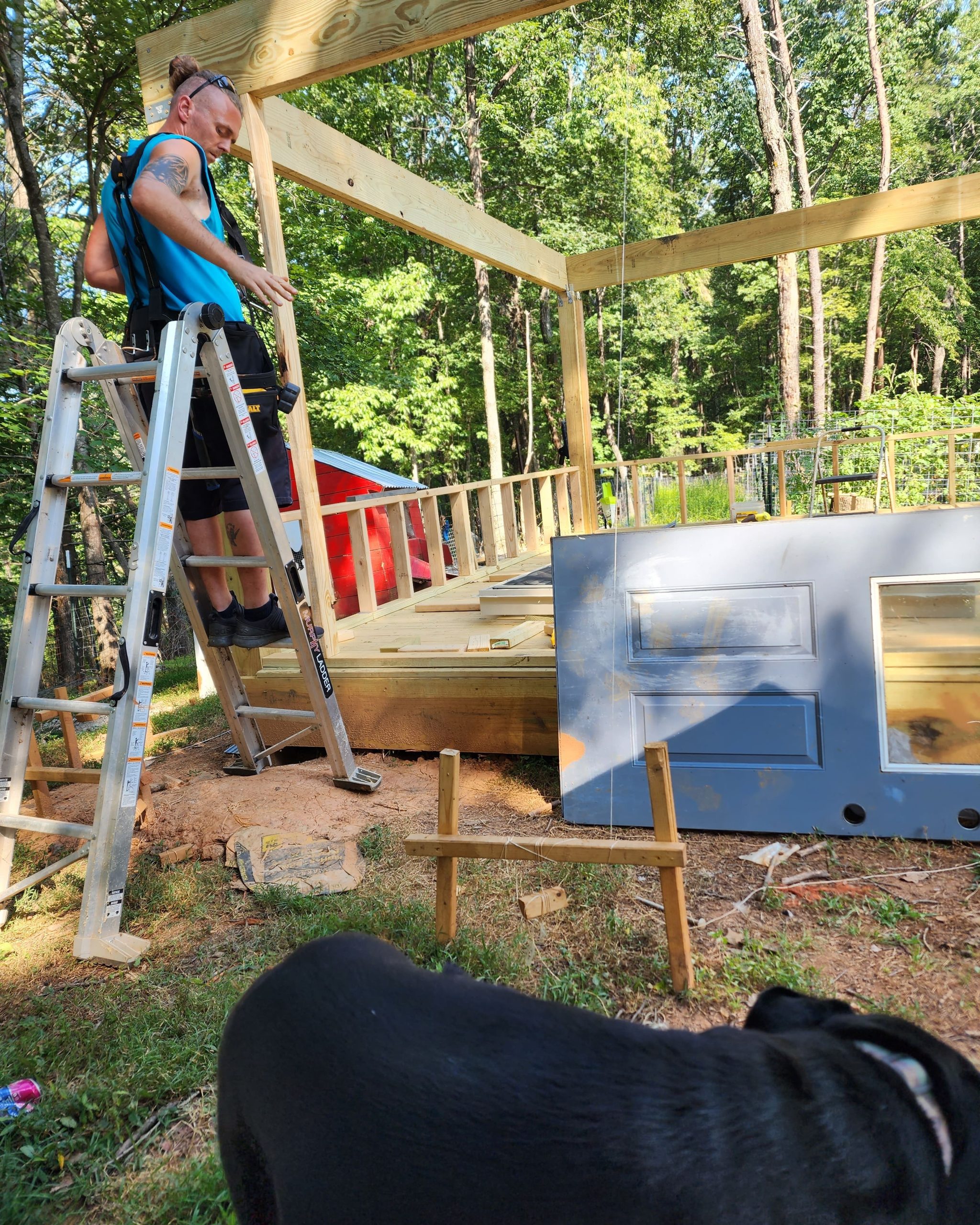
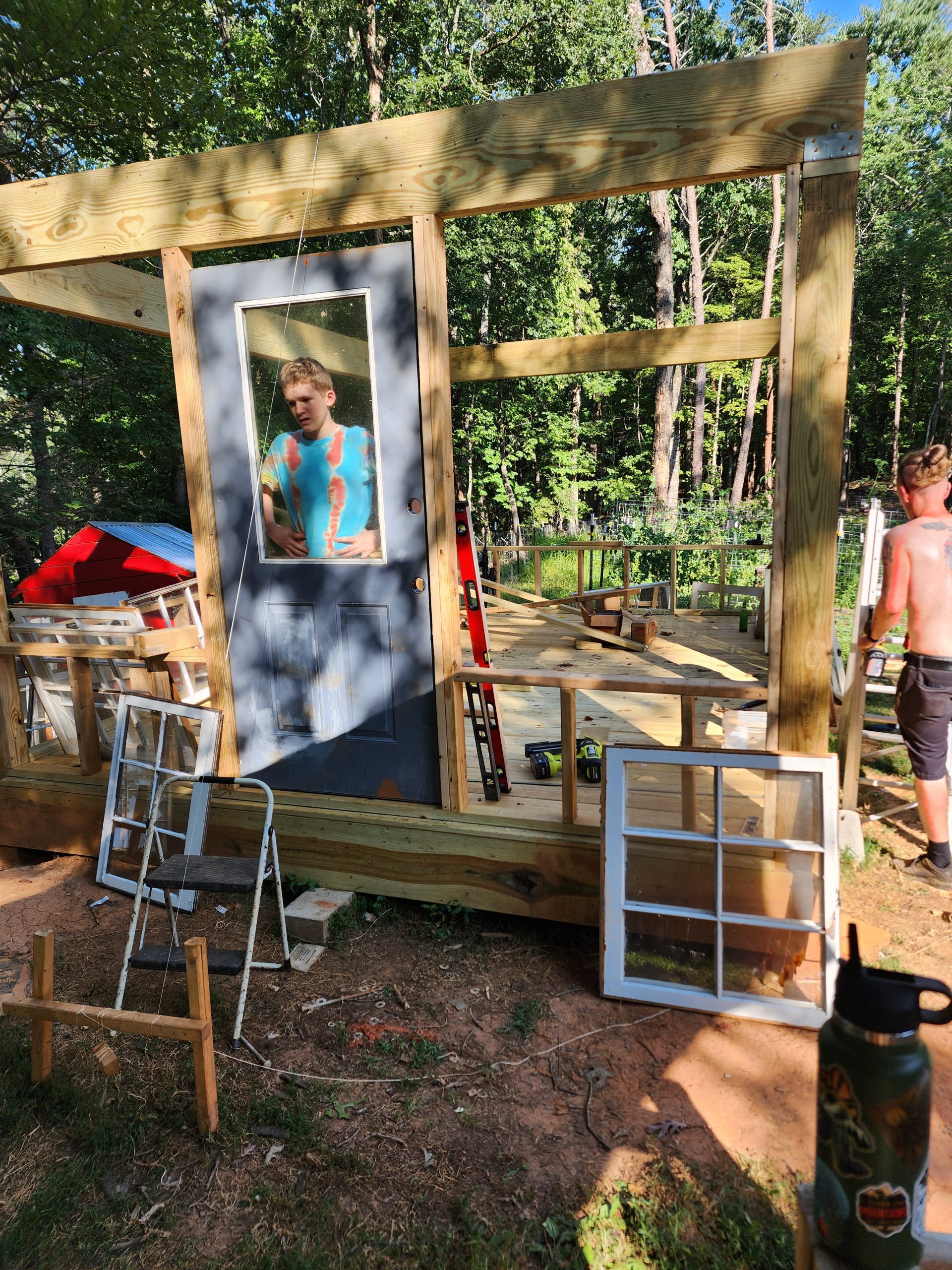
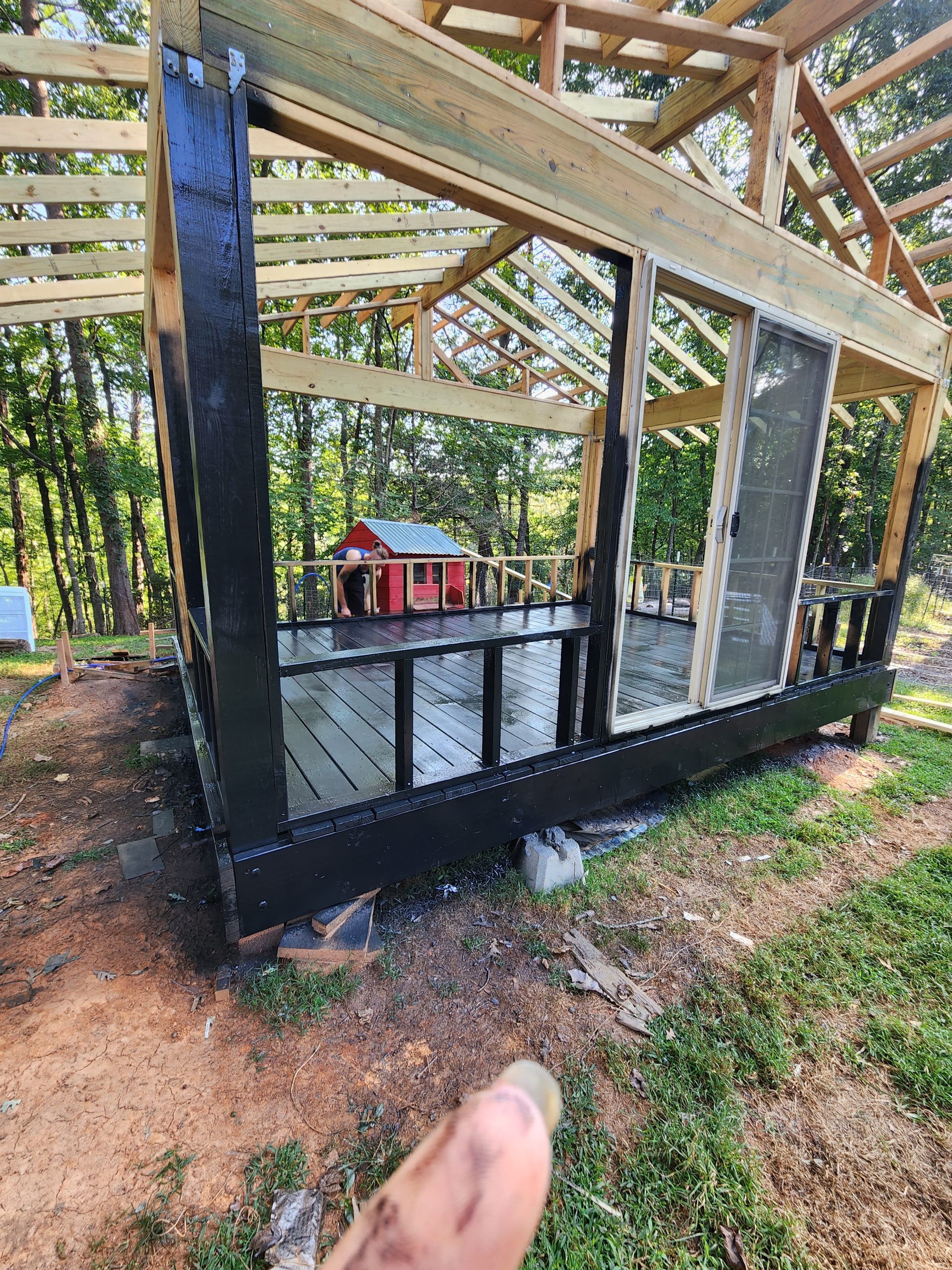
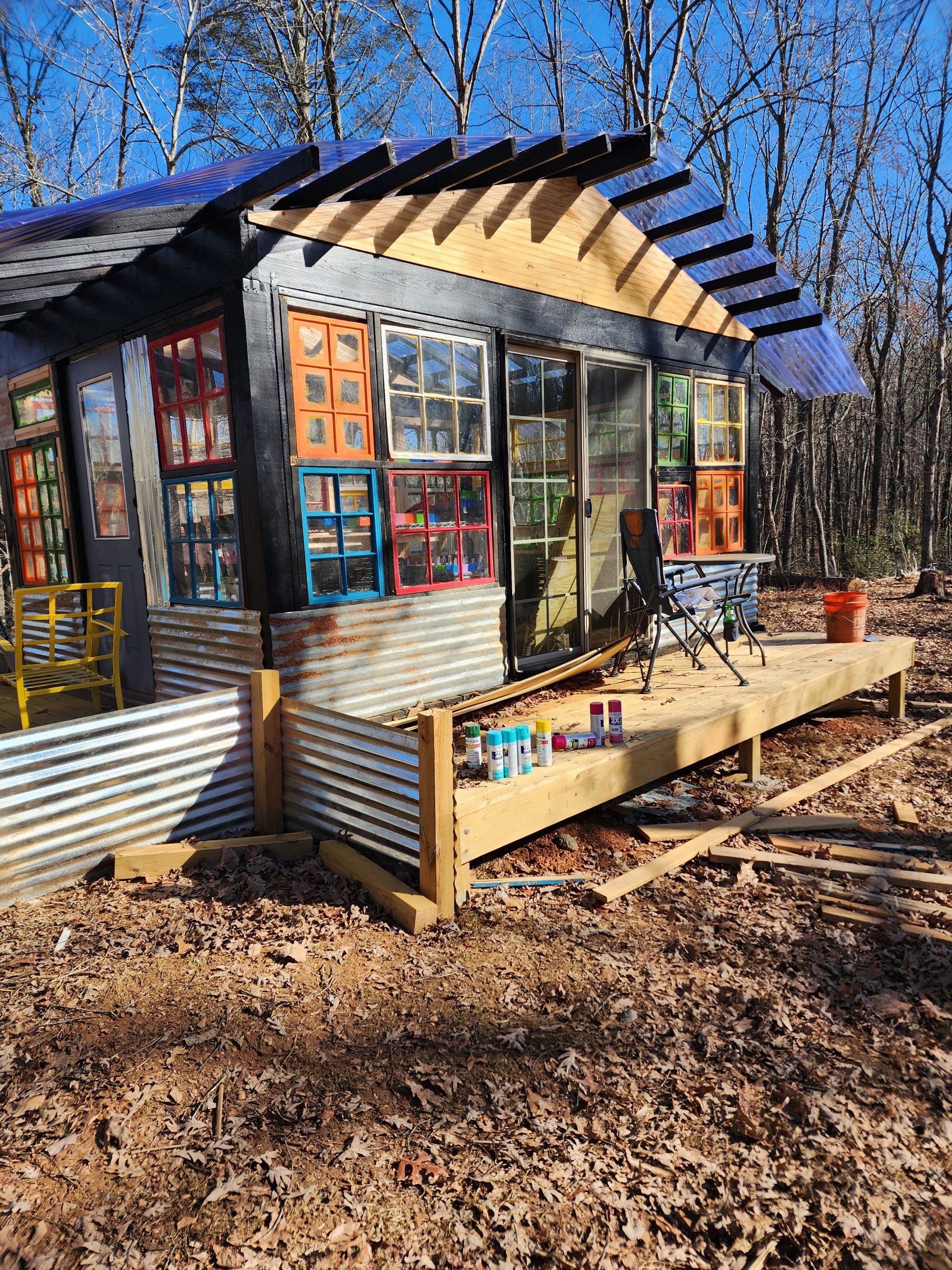
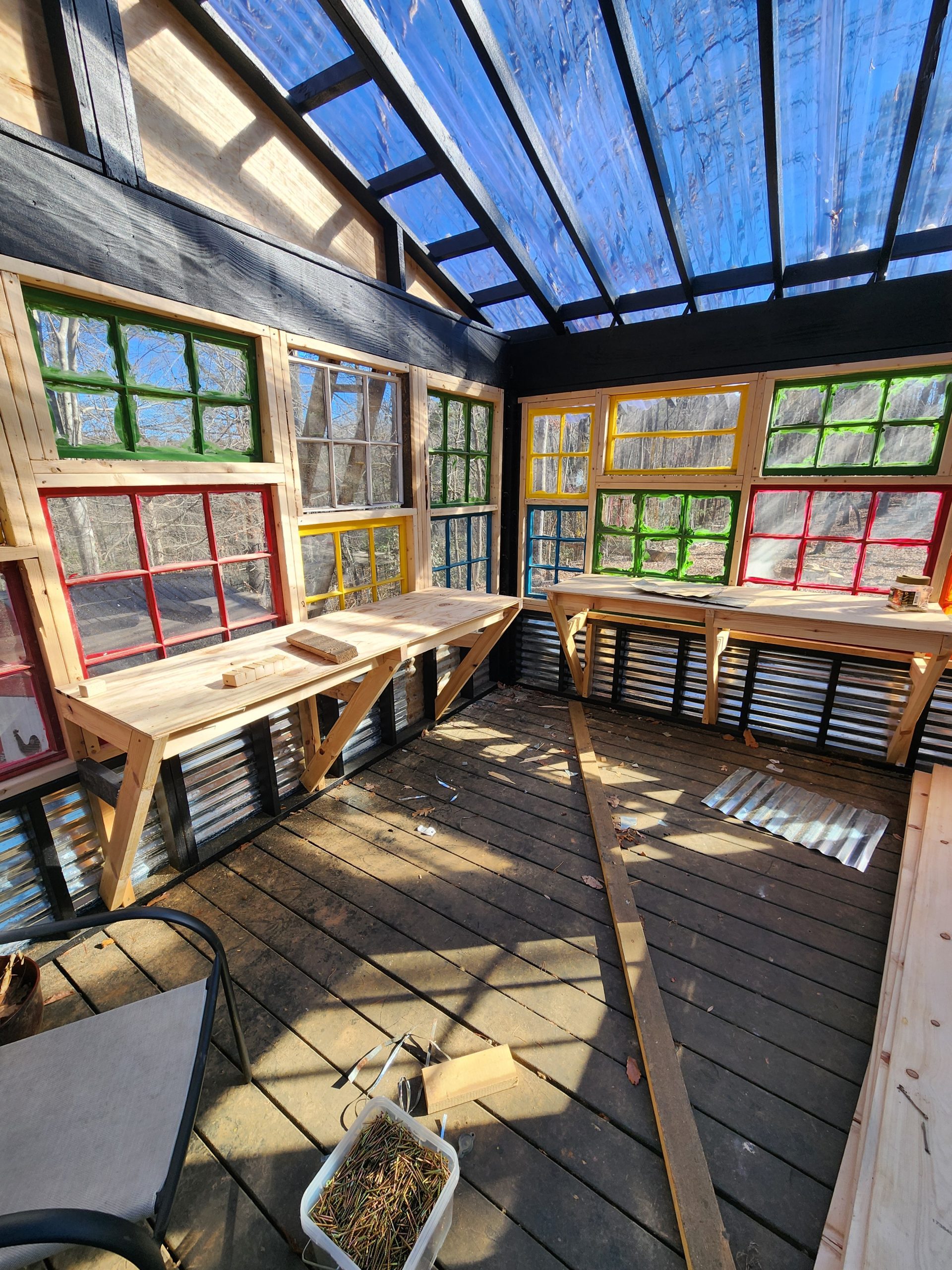
Our greenhouse is 12ft x16ft with 2 decks on the front. It’s got a sliding glass door on one side and a regular door on the other. The main structure is painted black and there are 5 different paint colors for the windows. We used tin on the “holes” and bottom to help keep it insulated but also rustic.

In between the decks, I have a small 4ftx4ft raised bed that will house Felix Felicis, our christmas tree. It will also have a couple other plants that will hopefully vine out from the greenhouse.

Save on Seeds

Inside, there is plenty of room for racks and racks of plant starts, storage for pots, tools, and more. It is probably my most favorite place on the homestead, except my gardens.

I even have my hammock set up in the corner (not pictured) so that I can hang out in the greenhouse.

Finishing The Greenhouse

There is still a ton of work left to do on the greenhouse. Things like painting, running power, putting in fans, and, of course, more plants. But those things can take time. The structure is up and able to receive plants.

Getting Your Greenhouse

Our greenhouse has cost us about $8,000 in material and probably another $4,000 in labor. But man, she is a gorgeous building and I couldn’t be happier with her.

But when you are looking at getting your own greenhouse, really make sure that it is something that you will like and use. If not, you will probably not be as happy with your greenhouse. As frilly and weird as my greenhouse is, if it wasn’t? I probably wouldn’t use it.

When you are looking at your greenhouse options, make sure that you are getting the greenhouse that you want, will work for you and is within your budget. Don’t be afraid to go all out to make it something beautiful that you will want to spend time in.

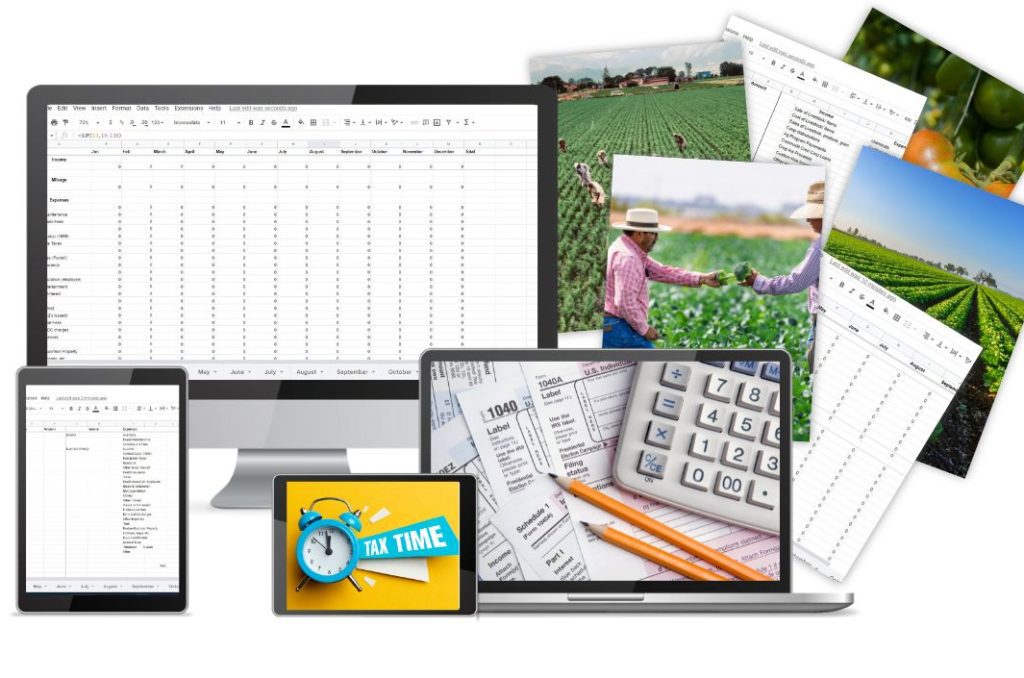
If you are a farmer/ homesteader and looking for a way to track your income and expenses, I highly recommend our Schedule F Tracker! We have been using it for years and it is the easiest, fastest and best way that we have found to keep track of the money spent on the homestead.

Buy Now

If you like the content I put out, feel free to buy us a coffee! It helps keep this site running, marketing and the goats in grain!

Buy me a coffee

If you like this post, feel free to share it and follow us below on our social media accounts!

  • Facebook
  • Pinterest
  • Instagram
  • YouTube
  • TikTok
  • Spotify
  • Threads

Filed Under: Garden Projects, Homestead Planning, Projects Tagged With: gardens, greenhouse, Homestead, Projects

JOIN TO OUR MAILING LIST!

Leave us your email to receive new posts and special offers for members only! Don't miss a thing!

Recent Posts

  • Fall Garden Guide
  • Top Mistakes With Goats
  • How To Bond With Your Goats

Planning Your Garden

January 6, 2024 by Leigh Leave a Comment

This is my favorite part of winter. I am a planner by nature and I love my garden. So this is the best part of the year for me! I get to dream about spring while impatiently waiting for the cool/cold, wet days of winter to hurry up and go. Today, I wanted to get into some of the nitty, gritty aspects of planning your garden. Whether this is your first garden, or your 50th, I hope you can learn something from this post.

Why Planning Your Garden Is Important

There are a million and a half reasons why you should at least have a general idea about WHY you should be planning your garden. Some of these reasons include space, frost dates, what you eat, what you want to grow, and your storage capabilities. That’s not all of them by any means, but it is a good place to get started for your future garden.

Are you getting overwhelmed in the garden? Stressed? Or just not enjoying the garden like you used to? Check out our garden prompts! We send out weekly emails that get you back in the garden and out of your head! Turn the garden back into a place of love and joy instead of frustration and headache!

Subscribe Now!

Planning Your Garden Space

This may seem like a fairly straight forward thing, right? But you would be surprised how many people over, or under plant, a space. Now, I have to be completely transparent here and tell you that I am an over planter. If I can plant something every 6in I’m probably planting closer to 4in. It’s a flaw that is probably not going to change anytime soon.

But the other part of planning out your garden space is understanding that you probably have more than you think. Fruit and vegetables don’t ONLY have to go into the garden! If you have a porch, patio, or other seating area, you can absolutely plant in containers. In fact, even with 500 sq ft of raised bed space, I still plant in pots around the garden.

If you are interested in learning more about my favorite garden planner. I highly recommend Seedtime! This planner has been instrumental in helping me plan out my gardens with WAY more efficiency than I could ever expect! It has also reduced overwhelm, stress, and calmed my ADD/ADHD!

More Info!

I also plant in hanging pots around the house, on our porch, and around the greenhouse, because why not!

Also look at vertical gardening! If you can trellis something, you can probably plant closer together. For example, I trellis/tie up my melons. This allows me to plant closer together to maximize space without sacrificing food.

If you like the content I put out, feel free to buy us a coffee! It helps keep this site running, marketing and the goats in grain!

Buy me a coffee

Planning For Your Frost Dates

Maybe I’m weird, which I am, but I don’t go off zones for my vegetable gardens. The reason is because zones don’t affect annuals (or things treated as annuals) like peppers, tomatoes, melons, etc. I will look at hardiness zones when looking at landscaping, perennials, orchards, etc.

Save on Seeds

Since zones aren’t my jam, I do make sure that I have a good handle on our frost dates. While this can change year to year, I take an average or look up average frost dates for my zip code. I really like this frost date finder from Dave’s Garden. This has been the most accurate as far as I can tell.

Why are frost dates more important than zones?

Well, because most vegetable gardens are planned and planted with annuals in mind, it really doesn’t matter what zone I’m in. What matters more is if I have enough days between the frost to have the plant reach maturity and harvest.

When I am planning my gardens, I look at the 50% temperature average date. If you click the link above, you will see a table that shows a bunch of temperatures, dates and percentages. In this particular example, I use the Helen, Ga table because that’s the closest to me. Then I start figuring out what I’m comfortable risking.

Logo 468x60

In the 2024 growing season, I will start my plants with the intention of planting around April 21st. That doesn’t mean that I WILL plant on April 21st but I will plan on it. Starting on April 21st, I will start looking at the 10 day forecast. If in those 10 days, there is no days that drop below freezing (or 32*), I will start planting things like corn, melons, cukes, squash, and some other frost tender plants.

cropped-3.jpg

Are you looking for garden journal prompts, but aren’t interested in a weekly email? Check out our 365 Garden Journal Prompts! This is an amazing, all in one, yearly product that you only pay for once.

Buy Now!

I will still hold off on planting my heat loving plants, like peppers and tomatoes, until May 1st or so. We have found that by waiting until the day temperatures are steadily above 70*, we get a better harvest of tomatoes and peppers.

Save on Seeds

Planning Your Garden Based On What You Eat

Every single year, I caution new gardeners to only plant the things that they eat. Especially, if they are limited on space. If you hate everything tomato, do NOT plant a million tomato plants! Buuuuuttttt, if you have space and want to experiment, make sure to plant some weird varieties. You may find that you actually like THIS type of tomato.

Another thing to be sure of is, if you like something, make sure to plant a lot of it. Again, if space allows. Jared HATES cucumbers, but he loves pickles. So I plant a LOT of cucumbers, usually 10 plants, spaced out over several weeks. This means that I have fresh cucumbers and he gets plenty of pickles.

Check out our Microgreens at True Leaf Market

Another question when it comes to planning your garden is do you have livestock? Chickens and pigs LOVE cucumbers. Goats LOVE green beans. You can lower your feed bill if you plant extra for your animals.

What Do You WANT To Grow

This is, in my opinion, the most important question when it comes to planning your garden. I’m not saying that you should only plant things that you want to grow, but I AM saying that you should absolutely, always plant things that you want to grow.

Again, I hate raw tomatoes, but watching tomatoes grow? Man, it’s so cool!

The Ultimate Homesteader’s Starter Bundle – Only $47!

Get the tools you need to stay organized, track profits, and manage your homestead with ease!

Includes:
✅ Schedule F Tracker – Simplify tax prep
✅ Profit Calculator – Track earnings
✅ Hay Calculator – Plan livestock feed
✅ Garden Journal – Digital & printable
✅ Herd Health Tracker – Monitor animal care
✅ Simple Budget – Manage finances
✅ Backyard Homestead eBook – Essential tips

$99 value – now just $47! Start your homesteading journey today!

Buy Now

I also plant a TON of flowers. Not for the pollinators, although that’s what I tell myself, but because they are pretty and I like them. I WANT to grow as many flowers as possible because they make me happy.

Don’t think that your garden has to be so utilitarian that you lose the beauty of YOUR garden.

Lastly, What Can You Store

If you only garden for fresh eating, by all means, ignore this part of the post. But if you are looking to put up food for winter, you really need to look at your storage capabilities. I have these amazing canning shelves that Jared built me, and he is working on building my food storage room this year.

Right now, we are limited only by what we can dehydrate, can or freeze. But since freezer space is limited to meats, we have to make sure that we can either eat things fresh, can or dehydrate.

Logo 468x60

If you can’t can, freeze or dehydrate, you should consider how much space you are giving to items that don’t store well. For example, tomatoes should be canned for preservation. When you freeze them, they turn to mush when they thaw. If that’s your goal, then you’re good to go. If not, maybe don’t plant 200 tomato plants.

Same goes for potatoes. If you don’t have a cool, dark place to store, I wouldn’t plant a ton of them. But if you can can them? You are golden. It’s really just thinking through how you are going to use the things you grow.

Pro Amateur Gardener Tip

I will never be a pro gardener…. Like ever. Mainly because there is just so much to learn. But one of the best tips I can ever give you, when it comes to gardening, is WRITE IT DOWN! You will absolutely not remember next year. Trust me! It’s a lie I tell myself every year, and every year I forget and regret.

Are you getting overwhelmed in the garden? Stressed? Or just not enjoying the garden like you used to? Check out our garden prompts! We send out weekly emails that get you back in the garden and out of your head! Turn the garden back into a place of love and joy instead of frustration and headache!

Subscribe Now!

I use these bullet journals because they are cute but also because they hold up really well. If you have any other tips, make sure to comment below this post. I would love to read them.

If you like this post, feel free to share it and follow us below on our social media accounts!

  • Facebook
  • Pinterest
  • Instagram
  • YouTube
  • TikTok
  • Spotify
  • Threads

Filed Under: Garden, Garden Projects, Goal Setting Tagged With: food, Garden, Planning, using what you plant, vegetables

JOIN TO OUR MAILING LIST!

Leave us your email to receive new posts and special offers for members only! Don't miss a thing!

Recent Posts

  • Fall Garden Guide
  • Top Mistakes With Goats
  • How To Bond With Your Goats

Why You Should Be Using Garden Prompts

October 26, 2023 by Leigh Leave a Comment

Whether you are a brand new gardener or you’ve been doing gardening for a few years, using garden prompts in a journal is extremely important. It doesn’t matter if you are a straight to the point garden journal-er, or someone who is more fanciful and elaborate. Journaling specifically for the garden is going to help you improve your garden year after year.

Who Is Using Garden Prompts

That entirely depends on the gardener. I’ve noticed that there are usually 4 types of gardeners: The Utilitarian, The New Gardener, The Fanciful Gardener, and The Chaotic Gardener….. One guess which one I am 🙂

The Utilitarian Gardener

This gardener KNOWS the importance of their garden, but at the end of the day, it’s a project, chore, or other responsibility. It’s a place were they go to plant, weed, grow and harvest. They are very proud of their garden but it’s not their heart and soul. They’ve probably been gardening for several years but the wanderlust of the garden isn’t lost on them.

This gardener is using garden prompts as part of a system to improve their gardens year after year. Their garden and garden journal is probably a spread sheet and is extremely organized. There are lists of where they bought seeds, if they saved seeds, what they pruned and experiments they are running.

The New Gardener

This gardener probably doesn’t even know they should be keeping a garden journal. This is their first or second garden and they aren’t exactly sure what they are doing or when they should be doing it. The entire garden is an experiment in growing food. They are are super excited and tell EVERYONE about their garden.

This gardener is also absolutely enthralled with the coming and goings in their garden. They are usually a Google machine because they are constantly looking up things like “Should I prune tomatoes?”, “Why does my zucchini leaves have spots?” and my favorite (from personal experience) “What do I do with all these beans?!”

Save on Seeds

But they don’t write anything down. By the end of their 4th or 5th garden, they are questioning their sanity because they KNOW they planted tomatillos but there are NONE in the garden. They finally figure out they should be keeping track of SOMETHING and start working on their journals grudgingly.

The Fanciful Gardener

The Fanciful Gardner is the one that has plants EVERYWHERE! In the bathroom, the kitchen, an old boot in the garden. Their beds are overflowing with flowers, herbs and vegetables. They have, or are working on, harvesting the power of soil.

This gardener’s garden is probably pretty wild just like them. Their garden journal is a tattered notebook that is filled with random tidbits, pressed flowers, and notes. There’s seed packets, garden plans, sketches, dreams and poems.

PS this is the gardener I want to be but alas…. that is not the case.

Logo 468x60

The Chaotic Gardener

This is the gardener that always starts with a plan but it is abandoned within 10 minutes of planting their garden. Everything is done in fits and starts because ADD/ADHD is real. Their use of garden prompts is more a checklist to ensure that they don’t forget to plant the tomatoes…. like they did last year.

They constantly ask themselves, “What did I plant here?” because they deviated from the plan so spectacularly, they put the wrong plants in the wrong garden. And labeling things? That’s for someone with time. Their June and July gardens look like an August garden because they totally overcommitted themselves with not just one garden, but three.

Using garden prompts for them is an insurance policy that they KNOW they have to pay in full, otherwise they will forget to make the payments. And yet, they still manage to miss the payment and now their garden is overgrown.

Which One Am I?

Well, I want to be The Utilitarian and The Fanciful. But the reality is that my brain doesn’t work on a wavelength that allows for either. In fact, as I was writing this blog post, I was trying to figure out where I fit in to these categories.

Where Do I Fit In?

I am no longer the new gardener that is absolutely clueless and growing food despite of myself. Though, I still grow food despite my best efforts at unintentional self sabotage, like NEVER hardening off my plant starts and then wondering why they died.

Save on Seeds

I am definitely not The Utilitarian Gardener. I have a very utilitarian journal that I update as the seasons pass but my go to journal would make The Fanciful Gardener proud.

I am more The Fanciful Gardener who plants things where ever I want, simply because I love them.

But at the end of the day, month or season? I am The Chaotic Gardener, meandering through the garden, hacking away at unsuspecting tomato plants while Jared gasps in horror. Pouring mulch on weeds that I am WAY to lazy to pull. I am constantly complaining about chickens getting in my gardens with no intention of actually getting them out of the garden.

I will never be one to keep up with labels, instead always being surprised when a zucchini plant turns into a patty pan squash. Or that time I could have sworn I planted watermelon only to realize WAY to late that it was ACTUALLY a pumpkin…. oh well.

Why I Use Garden Prompts

I started creating garden prompts as a way to reduce my stress and overwhelm in the garden. But as I started to use them more regularly, I realized that when I take my tattered notebook into the garden, I can write about whatever I want. There is no set thing that I HAVE to write about. As I look at past garden journals, I see how far I’ve come.

Are you getting overwhelmed in the garden? Stressed? Or just not enjoying the garden like you used to? Check out our garden prompts! We send out weekly emails that get you back in the garden and out of your head! Turn the garden back into a place of love and joy instead of frustration and headache!

Subscribe Now!

My first garden journals were an attempt at being something I’m not. Again, I am a Chaotic Gardener so trying to smash myself into the mold of being Utilitarian or Fanciful just isn’t going to work. But because I KNOW which gardener I am, I can use garden prompts as a way to keep me on track.

My garden journal and subsequent prompts are a mash up of homework, tasks and journal prompts. I’ve got over 600 prompts that I put into seasons to ensure I don’t get behind in the gardens. This allows me to track my gardens, plan my gardens and, most importantly, ENJOY my gardens.

Should You Be Using Garden Prompts

In short, yes. Everyone should have a garden journal. It doesn’t matter if it’s a spread sheet, notebook, old journal or a bunch of papers. You should always have a garden journal. You should absolutely have garden prompts that help guide you.

Like journal prompts for mental health, creative writing, or ANYTHING else. But you don’t have to use the prompts every day. You don’t have to write a garden journal entry every day. The prompts are simply a tool to help you enjoy your gardens while also allowing them to be the most productive.

Plus, who doesn’t want to gush about their garden to a captive audience.

Buying A Garden Prompt Subscription

Remember me telling you that I have over 600 garden prompts? Well, I created a garden prompt subscription that sends you weekly emails to help you if you are looking to be more intentional in the garden. When I tell you this saved my gardens as a semi New Gardener, I’m not lying!

I can’t tell you how many times I would forget to plant things or get overwhelmed with the sheer square footage of my garden and just start throwing seeds in beds. Yes, that happened. In my defense, I was OVER it that day. But as I grew my prompt list and started journaling, that stress and overwhelm subsided and I was able to enjoy my gardens again.

Logo 468x60

Creating Your Own Garden Journal Prompts

You can absolutely create your own garden journal prompts. In fact, I think it’s a great idea! My prompts are semi universal but also semi specific. While they can be used for anyone in any season, the reality is that those prompts aren’t specific to YOU and YOUR garden.

Be aware, it takes a LONG time to build up enough prompts to not repeat the same journal entry over and over again. It can also be hard to figure out where to start with your prompts. Do you want to focus your garden prompts on a task list? A reminder? Or do you want to wax poetic about your garden for every entry?

Lastly, the biggest problem with creating your own prompts, at least it was for me, is consistency. It’s very hard to start a habit of journaling in the garden. Especially in the winter or “off season”. That’s why I set up our email list to send out two emails a week. But you could put reminders in your calendar or on your phone.

Which Gardener are you?

Are you The Utilitarian, The New Gardener, The Fanciful Gardener or The Chaotic Gardener?

Let me know below which gardener you are and if you journal for your garden!

If you like this post, feel free to share it and follow us below on our social media accounts!
  • Facebook
  • Pinterest
  • Instagram
  • YouTube
  • TikTok
  • Spotify
  • Threads

Filed Under: Garden, Garden Projects Tagged With: Garden, journal, prompts

JOIN TO OUR MAILING LIST!

Leave us your email to receive new posts and special offers for members only! Don't miss a thing!

Recent Posts

  • Fall Garden Guide
  • Top Mistakes With Goats
  • How To Bond With Your Goats

Primary Sidebar

WELCOME

WELCOME

My name is Leigh and I am the lead chaos creator here at Steel Raven Farms. You will see throughout this blog that I am the crazy goat lady.

I am married to my high school sweetheart, Jared and we have two amazing boys.

FOLLOW ME

  • Amazon
  • Facebook
  • Instagram
  • Pinterest
  • TikTok

GET UPDATES!

Leave us your email to receive new posts and special offers for members only! Don't miss a thing!

In all the years that I’ve been growing a garden, the fall garden has steadily remained my favorite. Which is funny because I don’t really like any of the brassicas, which is what most people know the fall garden for. I prefer the root vegetables and cool air. But I have learned over the years…

Read More

  • Animals
    • Chickens
    • Farm Dogs
    • Goats
  • Garden
    • Compost
    • Garden Projects
    • Seeds and Plants
    • Garden Journal
    • Working With Food
      • Recipes
      • Freezing Foods
      • Dehydrating Foods
      • Canning Tips And Tricks
        • Canning Inventory Sheets
  • Helpful Info
    • Welcome to the Homestead!
    • Emergency Preparedness
    • Frequently Asked Questions
    • Goal Setting
    • Project List
    • Shop Digital Products
      • Hay Calculator
      • Farm Expense And Income Tracker
      • Goat Crash Course: 101
      • Garden Journal Prompts
      • Schedule C Tracker
      • Schedule C Tracker
      • The Homestead Bundle
  • The Truths
  • Episode List
  • Start Here
    • Privacy Policy
    • Affiliate Disclosure
    • Let’s Get in Touch
    • Members Only Library
    • Welcome To Our Homestead

Footer

  • Email
  • Facebook
  • Instagram
  • Pinterest

COME AND GET IT!

Leave us your email to receive new posts and special offers for members only! Don't miss a thing!

· Midnight Theme

Copyright © 2026 · Midnight Theme on Genesis Framework · WordPress · Log in