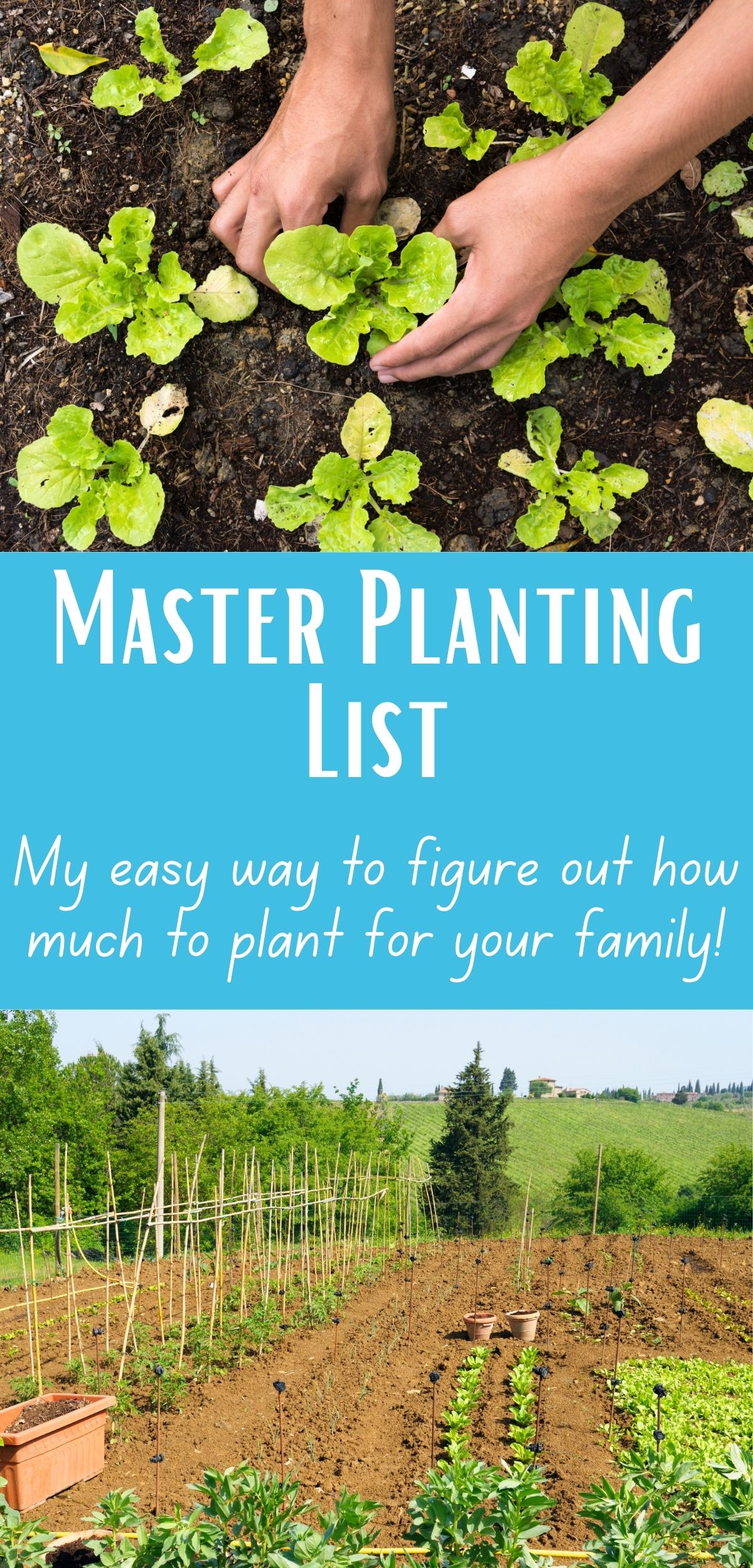
Over the last several years, I have tried to figure out the best way to help new gardeners, garden effectively. Sometimes it helps new gardeners, other times? Maybe not so much. So today, I am going to give you my master planting list for my family of 4 and livestock. I’m also going to give you what I would have done differently if I needed to start over with the knowledge that I have now.

Are you looking for garden journal prompts, but aren’t interested in a weekly email? Check out our 365 Garden Journal Prompts! This is an amazing, all in one, yearly product that you only pay for once.
My Master Planting List
The biggest problem with new gardeners that I have learned is that people expect gardening to be easy and then get discouraged when they struggle. They think they have a black thumb and give up. Or, the exact opposite happens. They have a GREAT year, and are overconfident next year. But if you aren’t exactly sure where you fall because this year is your first garden, let me help you out.
In this blog post, I am going to give you my master planting list but also how to figure out exactly how much space you need, how many plants to start or purchase, and then finally, how to put it all together.
How Much Space
Realistically, you only need about 100 Sq Ft (10ft x10ft) of space per person for a fresh eating garden. If you are looking to put up food for winter, then you need about 200 Sq Ft (10×20). This is going to vary greatly based the space you have, what you are growing, and how much meat you consume.
But what you “should” have may not be what you actually have. So how can you increase your space? Container gardens are a great option. Especially if you are focusing on fresh eating. A 5 gallon bucket with good soil and drainage can easily grow a tomato plant and it only has about a 12 inch footprint. And with vertical support, a cucumber plant can easily trellis and give you a ton of food.
Another thing to consider is adding additional plants within a space. A good example of this is planting green beans with tomatoes. A tomato needs about 12-18 inches of space between tomato plants. But that doesn’t mean that those 12-18 inches needs to be empty. You can plant something else in between those tomatoes.
As you stretch your gardening muscle and learn what works and what doesn’t, you will find more space for more plants.
How Many Plants
This is the nitty gritty of what everyone really wants to know when it comes to new gardeners. How many plants do I need…? There are a ton of formulas to figure this out, and to be honest, they are all really useful. And completely overwhelming.
If you are starting from scratch and you don’t have a clue what is going on, that’s totally ok. My rule of thumb is a minimum of 1 plant per person. At the very least, this gets you started on a garden and gives you plenty of information for your next garden.
If you are a family of 4, this means 4 tomato plants. If well cared for, that tomato plant will yield you about 25 to 40# of tomatoes depending on variety. But this doesn’t work well for say corn which only gives 1 or 2 ears of corn per stalk.
You will have to do some research about what you eat, what you are comfortable preserving, your space, etc. Which is why I say that you have to work on your gardening skills.
Putting Your Garden Together
First, let’s say that you have a 25ftx 50ft space that you can convert into a garden and are a family of 4. Then let’s say that you are not super comfortable with pressure canning but you have plenty of freezer space. Here is what I would plant within my garden:
50 Tomato Plants- That is 1 row in my garden and will give me approximately 400# for fresh eating and preservation. I can water bath can tomato sauce, dice tomato, and salsa.
4 Cucumber Plants- If put on a fence, cattle panel or something to get it off the ground, it will take up 4 sq ft and yield approximately 100#, if well cared for, for fresh eating and livestock food. If picked small, you can pickle them for shelf stability.
4 Zucchini or Summer Squash Plants- This will take up approximately 8 sq ft and yield approximately 40# of squash if reasonably cared for. Summer squashes do not can well but if flash frozen does well in the freezer to be used in soups and stews. Excess can be given to livestock.
50 Corn- Plant in a square instead of a row to increase pollination. This will yield between 50-100 ears of corn. It can be eaten fresh OR decobbed and put in the freezer for later. Cobs, husks and silks can all be fed to livestock.
8 Ft (16 plants) Green Beans- If you really like green beans and you have room, add more. They only need about 6in between plants. Green beans are super easy to grow, are delicious and usually yield about 1/2# per plant, if well cared for. They also hold up well to being frozen. Unfortunately, you should pressure can green beans.
8 Ft (16 plants) Peas- Now, peas are a cool ish weather crop. So make sure that if you are planting them in the summer, they are in shade and get well watered. Shelling peas usually yield about 2# for 16 plants but this will vary on variety and care.
10 Pepper Plants- If you don’t like peppers, plant extra tomatoes. Peppers do not need or want a ton of water and usually do well in high heat, high sun areas. You will get about 200 hot peppers or about 70 bell or sweet peppers with 10 plants. Peppers do not can well unless they are in something like salsa or relish. But they do freeze or dehydrate extremely well.
10 Potato Plants- Potatoes are the unsung hero in a world that tells us starch and carbs are bad for us. Personally, I freaking love potatoes and could eat them every day. Regardless, potatoes yield about 10# per plant and can store in a cool dry place for months. If you get an indeterminate variety, that number goes up to about 15#. You can pretty much forget about your potatoes and are all but guaranteed to get something.
Tips From A Not So Master Gardener
- Start where you are and learn as you go.
- Don’t panic if you can’t do all organic, everything. Simply growing your own food is better than nothing.
- Gardening should be fun, not a horrible chore.
- Gardening is not intuitive, it is a skill and should be treated as such.
- WRITE IT DOWN! Trust me, you will not remember.
- Learn to save seeds, but don’t sweat it if you can’t.
- Start small and grow as you learn.
- Gardening is not easy.
- Mulch is your friend.
- Learn to grow your own soil!
If you like the content I put out, feel free to buy us a coffee! It helps keep this site running, marketing and the goats in grain!
Buy me a coffeeIf you like this post, feel free to share it and follow us below on our social media accounts!
Leave a Reply