If your garden is anything like mine, we’ve got a couple of pickling cucumbers every day, but never enough to can a big batch of dill pickles. Or you’ve got a couple of peppers but can’t do much with them because there’s only five today, 3 tomorrow and 17 on Wednesday. Welcome to the world of gardening, right? If you think there’s nothing you can do about it, think again! I’ve got a solution to your pickle…. see what I did there? Read on for my pickling brine and famous dill pickle recipe.

The Ultimate Homesteader’s Starter Bundle – Only $47!
Get the tools you need to stay organized, track profits, and manage your homestead with ease!
Includes:
✅ Schedule F Tracker – Simplify tax prep
✅ Profit Calculator – Track earnings
✅ Hay Calculator – Plan livestock feed
✅ Garden Journal – Digital & printable
✅ Herd Health Tracker – Monitor animal care
✅ Simple Budget – Manage finances
✅ Backyard Homestead eBook – Essential tips
$99 value – now just $47! Start your homesteading journey today!
What Is Pickling Brine?
Simply put, pickling brine is just the solution that is going help preserve your fruits or veggies. The brine is vinegar, salt, and water. That’s it. Some people add sugar to cut the vinegar and salt down but I don’t. When I want a pickle, I want it to be salty, vinegar-y, and delicious.

What can you use Pickling Brine for?
Anything. Literally. Obviously pickles is the first choice but I have used left over brine for brisket, pulled pork, marinades, and Jared’s Bloody Mary’s. The options are endless. We will also pickle peppers, onions, carrots and okra. You can even use it in some fruits if you want. The best part is that you can make a batch, throw it in the fridge or on the shelf and always have it on hand.
How to make the Brine
The brine is so easy to make, you can’t screw it up. The recipe is 10c of water, 3/4c salt, and 2c vinegar. Don’t worry, I have a recipe card at the bottom for my favorite dill pickles. You can add sugar and the ratio for the recipe above is 1-1.5c sugar.
Also, you do not need fancy pickling/ canning vinegar or salt. Skip the upcharge on those items, they are pretty much the same as regular salt or vinegar. I do use pink Himalayan salt but that’s just because that’s what I always have on hand.

I add all of the ingredients above to a big stock pot of water. Also, I use stainless steel pots because it’s not reactive…. and it’s the only thing I have on hand that will handle the quantity I make. Next, use hot water to start dissolving the salt and bring everything to a boil.
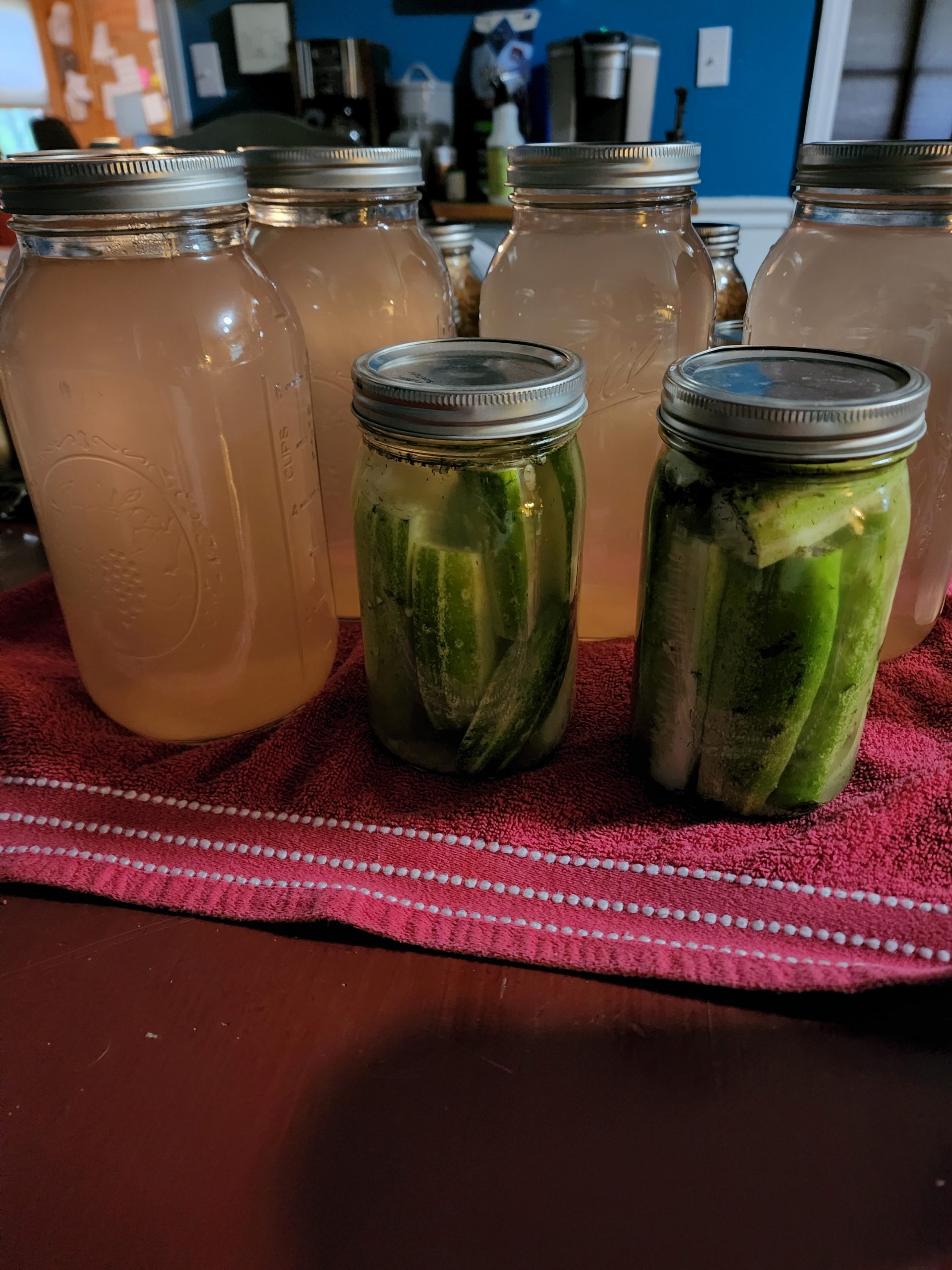
Once it’s boiling I will can it into whatever size mason jars I have, wipe the rim, add a ring and lid, then wait for the glorious pings. I do not process them in a canner.
If I don’t get a ping, I just throw that one in the fridge to use first. Why don’t I water bath it? Because the pH of the pickling solution (without sugar) is 3.2. Not many organisms are going to grow in that. And the heat from the boiling brine will create a vacuum seal from the jar. But if you want to water bath can this to make sure that it is shelf stable, you just need to process for 15 minutes for quarts and 25 for half gallon.
All of that being said, I cannot guarantee the safety of your food. If you follow this recipe, you do it at your own risk. I don’t know if you, your kitchen, or cooking utensils are clean/ sterile or how knowledgeable you are on canning. I have to say all of this because… lawyers.
Now, do you want the recipe for crunchy home canned dill pickles? Remember, you do this at your own risk because not only will you eat every single jar in one day, but you will also be *gasp* open kettle canning all of this.

What is open kettling?
Before we get started too far into the recipe, I’ve had a lot of people ask what is open kettle canning. Simply put, it is using HOT food in HOT jars with HOT liquid. For this example, we are using hot jars that have been sterilized and kept hot with hot water. We are using a boiling brine and clean/ fresh cukes. Since the jar is hot and sterile combined with the boiling brine which is highly acidic, you don’t have to process.
As a side note, you can also heat your jars in your oven once sterile. I will put my jars, lids and rings in the oven at about 250*. This reduces your risks of shattering and having to handle jars full of hot water.
The problem with home canned pickles and salsa specifically is that the veggies get turned to mush when they are heated for cooking and then heated again during the water bath. Even the most stout veggies are going to be mushy when you heat them too long. A cuke and tomato? Forget it. They will not stand up and you will end up with mushy pickles and soup for salsa.
The term open kettle was first found in 1914 as a form of home preservation, but stopped in the 1980’s. Many canners still use open kettle to preserve tons of foods. Some of us, myself included, only open kettle HIGHLY acidic foods. So the choice is yours, I choose to do research and figure things out on my own.
Ingredients
Equipment
Method
- Making Your Brine
- Add Water, vinegar and salt to stock pot and get it to boiling, stirring occasionally to dissolve salt
- Start working on Cucumbers

- Fill a bowl or sink with ICE COLD water
- Cut off both ends of cuke then slice for spears, chips, or whatever pickle you want
- Place in cold water as you get your jars ready
- Start heating your jars, lids and rings. You can do this by running your jars through a sterilizing cycle in your dishwasher, placing in your oven on 250 or in hot water. It doesn't really matter as long as they are clean and hot.
- **Please use a jar grabber, hot pad, or something, these jars are hot and the brine needs to stay boiling**
- Once your brine is boiling and ready, Take hot jar and add 1T garlic, 1T Dill (or sprig), 1 Bay leaf to the bottom
- Add your cukes, You are going to pack them in there so make sure to be careful
- Put your canning funnel on top and then ladle your HOT brine over cukes, leaving 1" head space.
- Wipe rim with vinegar towel, add lid and ring then set aside on a towel to start cooling
- Repeat until you are out of cukes or brine.
- Place a towel over all of the jars and listen for the pings over the next couple hours.
- Whatever doesn't ping, place in refrigerator. But give it a couple of days before you eat it so they are actually pickled.
- If you have left over brine, go ahead and fill any HOT jars you have. Same as above. Place funnel and ladle in brine
- Wipe rim, add lid and ring and set with the others to cool under a towel.


